
AB1543P

Anti-Synapsin I Antibody
Chemicon®, from rabbit
Synonim(y):
Synapsin-1
Wybierz wielkość
| Gabaryty przesyłki | SKU | Dostępność | Cena netto |
|---|---|---|---|
| 10 μg | Przewidywana wysyłka DZISIAJzKuehne + Nagel Sp. z o.o. | 1770,00 zł |
Informacje o tej pozycji
1770,00 zł
Przewidywana wysyłka DZISIAJSzczegóły
biological source
rabbit
Quality Level
conjugate
unconjugated
antibody form
affinity purified immunoglobulin
antibody product type
primary antibodies
clone
polyclonal
species reactivity
human, mouse, rat, bovine
manufacturer/tradename
Chemicon®
technique(s)
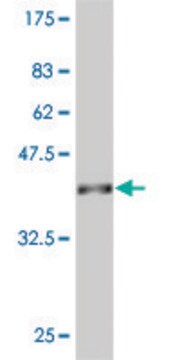
ELISA: suitable, immunocytochemistry: suitable, immunohistochemistry (formalin-fixed, paraffin-embedded sections): suitable, immunoprecipitation (IP): suitable, western blot: suitable
NCBI accession no.
UniProt accession no.
shipped in
dry ice
target post-translational modification
unmodified
Gene Information
human ... SYN1(6853)
General description
Current studies suggest the following hypothesis for the role of synapsin: synapsins bind synaptic vesicles to components of the cytoskeleton which prevents them from migrating to the presynaptic membrane and releasing transmitter. During an action potential, synapsins are phosphorylated by Ca2+/calmodulin-dependent protein kinase II, releasing the synaptic vesicles and allowing them to move to the membrane and release their neurotransmitter.
Immunogen
Application
Neuroscience
Synapse & Synaptic Biology
1:200-1:1,000 dilution of a previous lot was used.
Immunocytochemistry:
1:500-1:2,000 dilution of a previous lot was used.
Immunoprecipitation:
1 μg of a previous lot immunoprecipitated all of the synapsin I from a SDS homogenate of 200 μg of rat brain protein.
Note: The above dilutions are with 35S-protein A; with ECL dilutions may need to be considerably higher to obtain specific immunolabeling.
Immunohistochemistry:
1:500-1:2,500
ELISA:
1:2,500-1:10,00
Optimal working dilutions must be determined by the end user.
Biochem/physiol Actions
Physical form
Preparation Note
Analysis Note
Brain tissue.
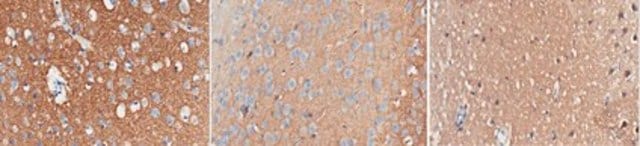
Synapsin I (AB1543P) representative staining pattern/morphology in rat hippocampal neurons. Tissue was pretreated with Citrate pH 6.0, antigen retrieval. This lot of antibody was diluted to 1:1000, IHC-Select reagents used with HRP-DAB. Immunoreactivity is seen directly associated with terminal end of neuronal cell body.
IHC-Paraffin Staining With Epitope Retrieval:
Rat Hippocampus
Other Notes
Legal Information
Disclaimer
1 of 1
Ta pozycja | |||
|---|---|---|---|
| biological source rabbit | biological source mouse | biological source rabbit | biological source mouse |
| conjugate unconjugated | conjugate unconjugated | conjugate unconjugated | conjugate unconjugated |
| Quality Level 100 | Quality Level 100 | Quality Level 100 | Quality Level 100 |
| antibody form affinity purified immunoglobulin | antibody form purified antibody | antibody form affinity isolated antibody | antibody form purified immunoglobulin |
| shipped in dry ice | shipped in wet ice | shipped in wet ice | shipped in dry ice |
| clone polyclonal | clone 10.22, monoclonal | clone polyclonal | clone 1D10, monoclonal |


Still not finding the right product?
Klasa składowania
11 - Combustible Solids
wgk
WGK 1
Certyfikaty analizy (CoA)
Poszukaj Certyfikaty analizy (CoA), wpisując numer partii/serii produktów. Numery serii i partii można znaleźć na etykiecie produktu po słowach „seria” lub „partia”.
Masz już ten produkt?
Dokumenty związane z niedawno zakupionymi produktami zostały zamieszczone w Bibliotece dokumentów.
Numer pozycji handlu globalnego
| SKU | NUMER GTIN |
|---|---|
| AB1543P | 04053252323324 |