
475886

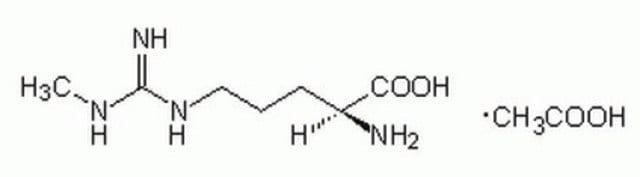
NG-Monometylo-L-arginina, sól monooctanowa
Cell permeable. L-Arginine analog that acts as a competitive inhibitor of all three isoforms of NOS.
Synonim(y):
Nω-Me-L-Arg,NG-Me-L-Arg, AcOH, L-NMMA, N ω-Me-L-Arg, N G-Me-L-Arg, AcOH, L-NMMA
Wybierz wielkość
| Gabaryty przesyłki | SKU | Dostępność | Cena netto |
|---|---|---|---|
| 5 g | Przewidywany termin wysyłki13 lipca 2026zKuehne + Nagel Sp. z o.o. | 61 550,00 zł |
Informacje o tej pozycji
61 550,00 zł
Przewidywany termin wysyłki13 lipca 2026Szczegóły
Quality Level
assay
≥99% (HPLC), ≥99% (TLC)
form
solid
manufacturer/tradename
Calbiochem®
storage condition
OK to freeze, desiccated (hygroscopic)
color
white
solubility
water: 50 mg/mL, methanol: soluble
shipped in
ambient
storage temp.
10-30°C
SMILES string
[N+H2]=C(NCCC[C@H](N)C(=O)O)NC.[O-]C(=O)C
InChI
1S/C7H16N4O2.C2H4O2/c1-10-7(9)11-4-2-3-5(8)6(12)13;1-2(3)4/h5H,2-4,8H2,1H3,(H,12,13)(H3,9,10,11);1H3,(H,3,4)/t5-;/m0./s1
InChI key
IKPNWIGTWUZCKM-JEDNCBNOSA-N
General description
Biochem/physiol Actions
eNOS
Packaging
Preparation Note
Other Notes
O'Kane, K.P., et al. 1994. Br. J. Clin. Pharmacol. 38, 311.
Kubes, P., et al. 1991. Proc. Natl. Acad. Sci. USA88, 4651.
Mehta, J.L., et al. 1990. Biochem. Biophys. Res. Commun. 173, 438.
Thomas, G., et al. 1989. Biochem. Biophys. Res. Commun.158, 177.
Sakuma, I., et al. 1988. Proc. Natl. Acad. Sci. USA85, 8664.
Hibbs, J.B., et al. 1987. Science237, 473.
Palmer, R.M.J., et al. 1987. Nature327, 524.
Legal Information
Disclaimer
1 of 1
Ta pozycja | |||
|---|---|---|---|
| form solid | form amorphous solid | form solid | form solid |
| assay ≥99% (HPLC), ≥99% (TLC) | assay ≥98% (TLC) | assay ≥97% (HPLC) | assay ≥98% (HPLC) |
| Quality Level 100 | Quality Level 100 | Quality Level 100 | Quality Level 100 |
| manufacturer/tradename Calbiochem® | manufacturer/tradename Calbiochem® | manufacturer/tradename Calbiochem® | manufacturer/tradename Calbiochem® |
| storage temp. 10-30°C | storage temp. −20°C | storage temp. 2-8°C | storage temp. −20°C |
| solubility water: 50 mg/mL, methanol: soluble | solubility water: 50 mg/mL | solubility water: 50 mg/mL | solubility water: 1 mg/mL |


Klasa składowania
11 - Combustible Solids
wgk
WGK 3
flash_point_f
Not applicable
flash_point_c
Not applicable
Certyfikaty analizy (CoA)
Poszukaj Certyfikaty analizy (CoA), wpisując numer partii/serii produktów. Numery serii i partii można znaleźć na etykiecie produktu po słowach „seria” lub „partia”.
Masz już ten produkt?
Dokumenty związane z niedawno zakupionymi produktami zostały zamieszczone w Bibliotece dokumentów.
Powiązane treści
"Aging: getting older, exhibiting the signs of age, the decline in the physical (and mental) well-being over time, leading to death. Since the beginning of time, man has been obsessed with trying to slow down, stop, or even reverse the signs of aging. Many have gone as far as experimenting with nutritional regimens, eccentric exercises, fantastic rituals, and naturally occurring or synthetic wonder-elements to evade the signs of normal aging. Biologically speaking, what is aging? And what does the latest research tell us about the possibility of discovering the elusive “fountain of youth”? Many advances in our understanding of aging have come from systematic scientific research, and perhaps it holds the key to immortality. Scientifically, aging can be defined as a systems-wide decline in organismal function that occurs over time. This decline occurs as a result of numerous events in the organism, and these events can be classified into nine “hallmarks” of aging, as proposed by López-Otin et al. (2013). Several of the pathologies associated with aging are a direct result of these events going to extremes and may also involve aberrant activation of proliferation signals or hyperactivity. The hallmarks of aging have been defined based on their fulfillment of specific aging related criteria, such as manifestation during normal aging, acceleration of aging if experimentally induced or aggravated, and retardation of aging if prevented or blocked, resulting in increased lifespan. The nine hallmarks of aging are genomic instability, telomere attrition, epigenetic alterations, loss of proteostasis, deregulated nutrient sensing, mitochondrial dysfunction, cellular senescence, stem cell exhaustion, and altered intercellular communication. The biological processes underlying aging are complex. By understanding the hallmarks in greater detail, we can get closer to developing intervention strategies that can make the aging process less of a decline, and more of a recline."
Numer pozycji handlu globalnego
| SKU | NUMER GTIN |
|---|---|
| 475886-5GM | 04055977203561 |