
17-683

ChIPAb+ Acetylo-Histone H3 (Lys27) - przeciwciało i zestaw primerów zweryfikowane pod kątem ChIP
clone CMA309, from mouse
Synonim(y):
H3K27Ac, histon H3 (acetyl K27), histon H3K27Ac
Wybierz wielkość
| Gabaryty przesyłki | SKU | Dostępność | Cena netto |
|---|---|---|---|
| 25 assays | Przewidywany termin wysyłki27 maja 2026zKuehne + Nagel Sp. z o.o. | 2350,00 zł |
Informacje o tej pozycji
biological source
mouse
Quality Segment
antibody form
purified immunoglobulin
clone
CMA309, monoclonal
species reactivity
vertebrates, human
manufacturer/tradename
ChIPAb+, Upstate®
technique(s)
ChIP: suitable, immunoprecipitation (IP): suitable, western blot: suitable
isotype
IgG
NCBI accession no.
shipped in
dry ice
General description
The ChIPAb+ Acetyl-Histone H3 (Lys27) set includes the Anti-acetyl-Histone H3 (Lys27) antibody, a negative control antibody (purified Mouse IgG), and qPCR primers which amplify a 178 bp region within the promoter of the human RPL10 gene. The acetyl-histone H3 (Lys27) and negative control antibodies are supplied in a scalable "per ChIP" reaction size and can be used to functionally validate the precipitation of acetyl-histone H3 (Lys27)-associated chromatin.
Immunogen
Application
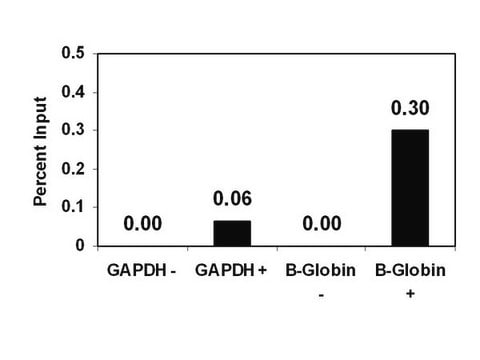
Sonicated chromatin prepared from HeLa cells (1 X 10⁶ cell equivalents per IP) was subjected to chromatin immunoprecipitation using 2 µg of either a normal mouse IgG or Anti-acetyl-Histone H3 (Lys27) antibody and the Magna ChIP G (Cat. #17-611) Kit. Successful immunoprecipitation of acetyl-histone H3 (Lys27)-associated DNA fragments was verified by qPCR using β-globin Promoter ChIP Primers versus RPL10 Promoter Primers (Please see figures). Data is presented as percent input of each IP sample relative to input chromatin for each amplicon and ChIP sample as indicated.
Please refer to the EZ-Magna G ChIP (Cat. #17-408) or EZ-ChIP (Cat. #17-371) protocol for experimental details.
Western Blot Analysis:
Acid extracts from untreated (Lane 1) and sodium-butyrate treated (Lane 2) HeLa cells were resolved by electrophoresis, transferred to PVDF membrane and probed with Anti-acetyl Histone H3 (Lys27), clone CMA309 (0.1 μg/mL). Proteins were visualized using a goat
anti-mouse secondary antibody conjugated to HRP and a chemiluminescence detection system (Please see figures).
Epigenetics & Nuclear Function
Chromatin Biology
Biochem/physiol Actions
Packaging
Physical form
Normal Mouse IgG. Two vials containing 25 μg purified Mouse IgG in 25 μL storage buffer containing 0.1% sodium azide. Store at -20°C.
ChIP Primers, RPL10 Promoter. One vial containing 75 μL of 5 μM of each primer specific for the promoter region of human RPL10. Store at -20°C.
FOR: ACC CGT CTT CGA CAG GAC T
REV: GGA ACG GAA GAC GAG AAC AG
Preparation Note
Analysis Note
Sonicated chromatin prepared from HeLa cells (1 X 10⁶ cell equivalents per IP) were subjected to chromatin immunoprecipitation using 2 µg of either a normal mouse IgG or Anti-acetyl-Histone H3 (Lys27) antibody and the Magna ChIP G (Cat. #17-611) Kit.
Successful immunoprecipitation of acetyl-histone H3 (Lys27) associated DNA fragments was verified by qPCR using ChIP Primers RPL10 Promoter (Please see figures).
Please refer to the EZ-Magna G ChIP (Cat. #17-409) or EZ-ChIP (Cat. #17-371) protocol for experimental details.
Included negative control mouse IgG antibody and control primers specific for human RPL10 promoter.
Legal Information
Disclaimer
1 of 1
Ta pozycja | |||
|---|---|---|---|
| antibody form purified immunoglobulin | antibody form serum | antibody form serum | antibody form serum |
| species reactivity vertebrates, human | species reactivity mouse, bovine, Saccharomyces cerevisiae, human | species reactivity Saccharomyces cerevisiae, yeast, human | species reactivity human, mouse |
| biological source mouse | biological source rabbit | biological source rabbit | biological source rabbit |
| clone CMA309, monoclonal | clone polyclonal | clone polyclonal | clone polyclonal |
| technique(s) ChIP: suitable, western blot: suitable, immunoprecipitation (IP): suitable | technique(s) ChIP: suitable, western blot: suitable | technique(s) ChIP: suitable (ChIP-seq), dot blot: suitable, western blot: suitable | technique(s) ChIP: suitable, electrophoretic mobility shift assay: suitable, flow cytometry: suitable, immunofluorescence: suitable, immunohistochemistry (formalin-fixed, paraffin-embedded sections): suitable, immunoprecipitation (IP): suitable, western blot: suitable |
| shipped in dry ice | shipped in dry ice | shipped in dry ice | shipped in dry ice |

Klasa składowania
10 - Combustible liquids
wgk
WGK 2
Certyfikaty analizy (CoA)
Poszukaj Certyfikaty analizy (CoA), wpisując numer partii/serii produktów. Numery serii i partii można znaleźć na etykiecie produktu po słowach „seria” lub „partia”.
Masz już ten produkt?
Dokumenty związane z niedawno zakupionymi produktami zostały zamieszczone w Bibliotece dokumentów.
Powiązane treści
"Epigenetics describes heritable changes in gene expression caused by non-genetic mechanisms instead of by alterations in DNA sequence. These changes can be cell- or tissue-specific, and can be passed on to multiple generations. Epigenetic regulation enriches DNAbased information, allowing a cell to vary its response across diverse biological and environmental contexts. Although epigenetic mechanisms are primarily centered in the nucleus, these mechanisms can be induced by environmental signals such as hormones, nutrients, stress, and cellular damage, pointing to the involvement of cytoplasmic and extracellular factors in epigenetic regulation."
Epigenetics describes heritable changes in gene expression caused by non-genetic mechanisms. Epigenetic regulation allows a cell to vary its response based on its biological and environmental contexts. Epigenetic changes can effect transcriptional and post-transcriptional regulation via mechanisms such as histone modification, chromatin and nucleosome remodeling, DNA methylation, and small and non-coding RNA-mediated regulation. These mechanisms, in cooperation with transcription factors and other nucleic acid-binding proteins, regulate gene expression. Epigenetic mechanisms of gene regulation impacts diverse areas of research—from agriculture to human health. Common epigenetic assays such as chromatin immunoprecipitation (ChIP) and RNA immunoprecipitation (RIP) rely on high quality antibodies that recognize specific epigenetic modifications for accurate results. EMD Millipore offers over 100 ChIPAb+™ and RIPAb+™ validated antibody kits that are quality tested on ChIP/RIP assays and are conveniently provided with control qPCR primers and negative control antibodies to ensure first time ChIP/RIP success.
Numer pozycji handlu globalnego
| SKU | NUMER GTIN |
|---|---|
| 17-683 | 04053252368974 |