

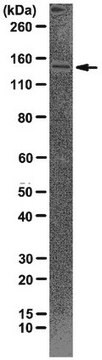

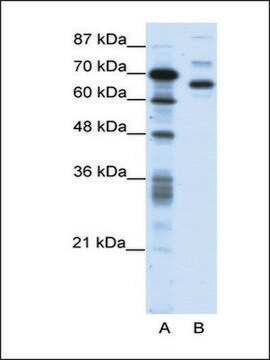
This product is a polyclonal Anti-serum. The specific antibody concentration is not determined, but expected to range from 1-3 mg/mL. For western blotting, a 1:1000–1:5000 dilution range is recommended.
07-729

Przeciwciało anty-CTCF
serum, Upstate®
Synonim(y):
Represor transkrypcyjny z palcem cynkowym 11, białko z palcem cynkowym 11, czynnik wiążący CCCTC, czynnik wiążący CCCTC (białko z palcem cynkowym), paralog CTCFL, represor transkrypcyjny CTCF
Zaloguj się, aby wyświetlić ceny organizacyjne i kontraktowe.
Wybierz wielkość
Zmień widok
| Gabaryty przesyłki | SKU | Dostępność | Cena netto |
|---|---|---|---|
| 25 μL | Sprawdź dostępność w koszyku | 766,00 zł | |
| 200 μL | Sprawdź dostępność w koszyku | 2440,00 zł |
Informacje o tej pozycji
UNSPSC Code:
12352203
NACRES:
NA.41
eCl@ss:
32160702
Conjugate:
unconjugated
Clone:
polyclonal
Application:
ChIP, WB
Citations:
426
766,00 zł
Sprawdź dostępność w koszyku
Rekombinowane, niezawierające konserwantów przeciwciało jest dostępne dla Twojego celu. Wypróbuj ZRB1009
Pomoc techniczna
Potrzebujesz pomocy? Nasz zespół doświadczonych naukowców chętnie Ci pomoże.
Pozwól nam pomócbiological source
rabbit
Quality Level
conjugate
unconjugated
antibody form
serum
antibody product type
primary antibodies
clone
polyclonal
species reactivity
mouse, human, canine, rat, primate
packaging
antibody small pack of 25 μL
manufacturer/tradename
Upstate®
technique(s)
ChIP: suitable (ChIP-seq), western blot: suitable
NCBI accession no.
UniProt accession no.
shipped in
ambient
target post-translational modification
unmodified
Gene Information
human ... CTCF(10664)
General description
CTCF to wszechobecne białko 11 palca cynkowego (ZF) o bardzo wszechstronnych funkcjach. Represor transkrypcji, CTCF, wiąże się z promotorami genu c-myc kręgowców. Wiąże się również z promotorami PLK i PIM1. CTCF może zapobiegać dostępowi aktywatorów transkrypcyjnych do enhancerów. CTCF działa również jako aktywator transkrypcyjny APP. Jest zaangażowany w różne aspekty regulacji genów, w tym aktywację lub represję promotora, wyciszanie genów zależne od hormonów, izolację chromatyny zależną od metylacji i imprinting genomowy. CTCF może również działać jako supresor nowotworów. CTCF organizuje epigenetycznie kontrolowane izolatory chromatyny, które regulują geny imprintowane w soma.
Około 120 kDa
Immunogen
Syntetyczny peptyd sprzężony z KLH odpowiadający aminokwasom 659-675 (C-TNQPKQNQPTAIIQVED) ludzkiego czynnika wiążącego CCCTC (CTCF) z N-końcową cysteiną dodaną do celów koniugacji.
Application
Immunoprecypitacja chromatyny:
Niezależne laboratorium potwierdziło, że to przeciwciało immunoprecypituje chromatynę związaną z CTCF z komórek WEHI B.
Niezależne laboratorium potwierdziło, że to przeciwciało immunoprecypituje chromatynę związaną z CTCF z komórek WEHI B.
Użyj przeciwciała anty-CTCF (królicze przeciwciało poliklonalne) zwalidowanego w ChIP, WB, ChIP-seq w celu wykrycia CTCF znanego również jako białko palca 11-cynkowego, czynnik wiążący CCCTC.
Biochem/physiol Actions
Przewidywana reakcja krzyżowa z myszami, szczurami, psami i naczelnymi na podstawie homologii sekwencji.
Uznaje CTCF na a.a. 659-675.
Physical form
Królicza surowica poliklonalna zawierająca 0,05% azydku sodu i 30% glicerolu.
Preparation Note
Przechowywać przez 1 rok w temperaturze -20°C od daty otrzymania.
Zalecenia dotyczące postępowania: Po pierwszym rozmrożeniu, a przed zdjęciem korka, odwirować fiolkę i delikatnie wymieszać roztwór. Rozdzielić do probówek mikrowirówkowych i przechowywać w temperaturze -20°C.
Unikać powtarzających się cykli zamrażania/rozmrażania, które mogą uszkodzić IgG i wpłynąć na działanie produktu. Uwaga: Zmienność temperatur w zamrażarce poniżej -20°C może powodować zamarzanie roztworów zawierających glicerol podczas przechowywania.
Zalecenia dotyczące postępowania: Po pierwszym rozmrożeniu, a przed zdjęciem korka, odwirować fiolkę i delikatnie wymieszać roztwór. Rozdzielić do probówek mikrowirówkowych i przechowywać w temperaturze -20°C.
Unikać powtarzających się cykli zamrażania/rozmrażania, które mogą uszkodzić IgG i wpłynąć na działanie produktu. Uwaga: Zmienność temperatur w zamrażarce poniżej -20°C może powodować zamarzanie roztworów zawierających glicerol podczas przechowywania.
Analysis Note
Kontrola
Pozytywna kontrola antygenu: Katalog #12-309, ekstrakt jądrowy komórek Hela. Dodaj równą objętość buforu redukującego Laemmli do 10 µl ekstraktu i gotuj przez 5 minut, aby zredukować preparat. Załadować 20 µg zredukowanego ekstraktu na pas dla minigelów.
Pozytywna kontrola antygenu: Katalog #12-309, ekstrakt jądrowy komórek Hela. Dodaj równą objętość buforu redukującego Laemmli do 10 µl ekstraktu i gotuj przez 5 minut, aby zredukować preparat. Załadować 20 µg zredukowanego ekstraktu na pas dla minigelów.
Routinely evaluated by Western Blot.
Western Blot Analysis:
A 1:1000–1:5000 dilution of this lot detected CTCF in HeLa nuclear extract. A previous lot detected CTCF in K562 nuclear extract (data not shown).
Western Blot Analysis:
A 1:1000–1:5000 dilution of this lot detected CTCF in HeLa nuclear extract. A previous lot detected CTCF in K562 nuclear extract (data not shown).
Other Notes
Stężenie: Stężenie tego przeciwciała w surowicy nie zostało określone.
Zastępuje: MABE547
Legal Information
UPSTATE is a registered trademark of Merck KGaA, Darmstadt, Germany
Ta strona może zawierać tekst przetłumaczony maszynowo.
1 of 1
Ta pozycja | |||
|---|---|---|---|
| conjugate unconjugated | conjugate unconjugated | conjugate - | conjugate unconjugated |
| species reactivity mouse, human, canine, rat, primate | species reactivity human | species reactivity human | species reactivity human |
| antibody form serum | antibody form purified antibody | antibody form purified immunoglobulin | antibody form affinity isolated antibody |
| biological source rabbit | biological source mouse | biological source mouse | biological source rabbit |
| clone polyclonal | clone 1.2.1.5.4, monoclonal | clone 1.2.1.5.4, monoclonal | clone polyclonal |
| Gene Information human ... CTCF(10664) | Gene Information human ... CTCF(10664) | Gene Information human ... CTCF(10664) | Gene Information human ... CTCFL(140690) |
Still not finding the right product?
Wypróbuj nasze narzędzie Narzędzie selektora produktów, aby zawęzić opcje.
Klasa składowania
10 - Combustible liquids
wgk
WGK 1
flash_point_f
Not applicable
flash_point_c
Not applicable
Certyfikaty analizy (CoA)
Poszukaj Certyfikaty analizy (CoA), wpisując numer partii/serii produktów. Numery serii i partii można znaleźć na etykiecie produktu po słowach „seria” lub „partia”.
Masz już ten produkt?
Dokumenty związane z niedawno zakupionymi produktami zostały zamieszczone w Bibliotece dokumentów.
Powiązane treści
Cancer is a complex disease manifestation. At its core, it remains a disease of abnormal cellular proliferation and inappropriate gene expression. In the early days, carcinogenesis was viewed simply as resulting from a collection of genetic mutations that altered the gene expression of key oncogenic genes or tumor suppressor genes leading to uncontrolled growth and disease (Virani, S et al 2012). Today, however, research is showing that carcinogenesis results from the successive accumulation of heritable genetic and epigenetic changes. Moreover, the success in how we predict, treat and overcome cancer will likely involve not only understanding the consequences of direct genetic changes that can cause cancer, but also how the epigenetic and environmental changes cause cancer (Johnson C et al 2015; Waldmann T et al 2013). Epigenetics is the study of heritable gene expression as it relates to changes in DNA structure that are not tied to changes in DNA sequence but, instead, are tied to how the nucleic acid material is read or processed via the myriad of protein-protein, protein-nucleic acid, and nucleic acid-nucleic acid interactions that ultimately manifest themselves into a specific expression phenotype (Ngai SC et al 2012, Johnson C et al 2015). This review will discuss some of the principal aspects of epigenetic research and how they relate to our current understanding of carcinogenesis. Because epigenetics affects phenotype and changes in epigenetics are thought to be key to environmental adaptability and thus may in fact be reversed or manipulated, understanding the integration of experimental and epidemiologic science surrounding cancer and its many manifestations should lead to more effective cancer prognostics as well as treatments (Virani S et al 2012).
Role of CCCTC binding factor (CTCF) and cohesin in the generation of single-cell diversity of protocadherin-? gene expression.
Monahan, K; Rudnick, ND; Kehayova, PD; Pauli, F; Newberry, KM; Myers, RM; Maniatis, T
Proceedings of the National Academy of Sciences of the USA null
An elaborate pathway required for Ras-mediated epigenetic silencing.
Gazin, C; Wajapeyee, N; Gobeil, S; Virbasius, CM; Green, MR
Nature null
M D Delgado et al.
FEBS letters, 444(1), 5-10 (1999-02-26)
CTCF is a transcriptional repressor of the c-myc gene. Although CTCF has been characterized in some detail, there is very little information about the regulation of CTCF activity. Therefore we investigated CTCF expression and phosphorylation during induced differentiation of human
Numer pozycji handlu globalnego
| SKU | NUMER GTIN |
|---|---|
| 07-729-25UL | 04054839337413 |
-
What is the concentration of this antibody?
1 answer-
Helpful?
-