
07-441

Przeciwciało przeciw dimetylo-histonowi H3 (Lys9)
Upstate®, from rabbit
Synonim(y):
H3K9me2, histon H3 (di metyl K9), rodzina histonów H3, członek T, histon 3, H3, klaster histonów 3, H3
Wybierz wielkość
| Gabaryty przesyłki | SKU | Dostępność | Cena netto |
|---|---|---|---|
| 100 μg | Dostępne do wysyłki DZISIAJzKuehne + Nagel Sp. z o.o. | 2370,00 zł |
Informacje o tej pozycji
biological source
rabbit
Quality Level
antibody form
purified immunoglobulin
antibody product type
primary antibodies
clone
polyclonal
species reactivity
human, mouse, Schizosaccharomyces pombe, rat, chicken
manufacturer/tradename
Upstate®
technique(s)
dot blot: suitable, immunocytochemistry: suitable, inhibition assay: suitable (peptide), western blot: suitable
isotype
IgG
NCBI accession no.
UniProt accession no.
shipped in
dry ice
target post-translational modification
dimethylation (Lys9)
Gene Information
human ... H3C1(8350)
mouse ... H3C1(360198)
rat ... H3C1(679994)
General description
Immunogen
Application
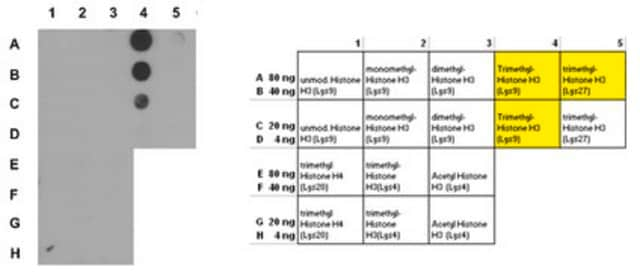
Specyficzność potwierdzona przez niezależne laboratorium.
Inhibicja peptydowa:
Swoistość została potwierdzona przez zdolność 1 μM peptydu immunizującego do całkowitego zniesienia wykrywania histonu H3 w analizie western blot ekstraktów kwasu HeLa (rysunek A, linia 4).
Immunocytochemia:
Zgłoszone przez niezależne laboratorium.
Biochem/physiol Actions
Physical form
Preparation Note
Zalecenia dotyczące postępowania: Po otrzymaniu, a przed zdjęciem nasadki, odwirować fiolkę i delikatnie wymieszać roztwór. Rozdzielić do probówek mikrowirówkowych i przechowywać w temperaturze -20°C.
Unikać powtarzających się cykli zamrażania/rozmrażania, które mogą uszkodzić IgG i wpłynąć na działanie produktu. Uwaga: Zmienność temperatur w zamrażarce poniżej -20°C może powodować zamarzanie roztworów zawierających glicerol podczas przechowywania.
Analysis Note
Lizat całych komórek HeLa, lizat komórek U2OS.
Western Blot Analysis:
1:500 dilution of this lot detected dimethyl Histone H3 on 10 μg of HeLa acid extract but not on recombinant Histone H3.
Other Notes
Legal Information
1 of 1
Ta pozycja | |||
|---|---|---|---|
| species reactivity human, mouse, Schizosaccharomyces pombe, rat, chicken | species reactivity Tetrahymena sp., human | species reactivity Saccharomyces cerevisiae, human, vertebrates, chicken | species reactivity human |
| antibody form purified immunoglobulin | antibody form unpurified | antibody form affinity isolated antibody | antibody form serum |
| clone polyclonal | clone polyclonal | clone polyclonal | clone polyclonal |
| biological source rabbit | biological source rabbit | biological source rabbit | biological source rabbit |
| shipped in dry ice | shipped in dry ice | shipped in dry ice | shipped in dry ice |
| technique(s) dot blot: suitable, inhibition assay: suitable (peptide), immunocytochemistry: suitable, western blot: suitable | technique(s) ChIP: suitable (ChIP-seq), dot blot: suitable, immunocytochemistry: suitable, immunofluorescence: suitable, inhibition assay: suitable (peptide), western blot: suitable | technique(s) immunocytochemistry: suitable, western blot: suitable | technique(s) dot blot: suitable, inhibition assay: suitable (peptide), western blot: suitable |


Still not finding the right product?
Explore all of our products under Przeciwciało przeciw dimetylo-histonowi H3 (Lys9)
— lub —
Wypróbuj nasze narzędzie Narzędzie selektora produktów, aby zawęzić opcje.
Klasa składowania
10 - Combustible liquids
wgk
WGK 1
Certyfikaty analizy (CoA)
Poszukaj Certyfikaty analizy (CoA), wpisując numer partii/serii produktów. Numery serii i partii można znaleźć na etykiecie produktu po słowach „seria” lub „partia”.
Masz już ten produkt?
Dokumenty związane z niedawno zakupionymi produktami zostały zamieszczone w Bibliotece dokumentów.
Powiązane treści
Cancer is a complex disease manifestation. At its core, it remains a disease of abnormal cellular proliferation and inappropriate gene expression. In the early days, carcinogenesis was viewed simply as resulting from a collection of genetic mutations that altered the gene expression of key oncogenic genes or tumor suppressor genes leading to uncontrolled growth and disease (Virani, S et al 2012). Today, however, research is showing that carcinogenesis results from the successive accumulation of heritable genetic and epigenetic changes. Moreover, the success in how we predict, treat and overcome cancer will likely involve not only understanding the consequences of direct genetic changes that can cause cancer, but also how the epigenetic and environmental changes cause cancer (Johnson C et al 2015; Waldmann T et al 2013). Epigenetics is the study of heritable gene expression as it relates to changes in DNA structure that are not tied to changes in DNA sequence but, instead, are tied to how the nucleic acid material is read or processed via the myriad of protein-protein, protein-nucleic acid, and nucleic acid-nucleic acid interactions that ultimately manifest themselves into a specific expression phenotype (Ngai SC et al 2012, Johnson C et al 2015). This review will discuss some of the principal aspects of epigenetic research and how they relate to our current understanding of carcinogenesis. Because epigenetics affects phenotype and changes in epigenetics are thought to be key to environmental adaptability and thus may in fact be reversed or manipulated, understanding the integration of experimental and epidemiologic science surrounding cancer and its many manifestations should lead to more effective cancer prognostics as well as treatments (Virani S et al 2012).