
03-308

Zestaw sond lncRNA Magna ® NEAT1
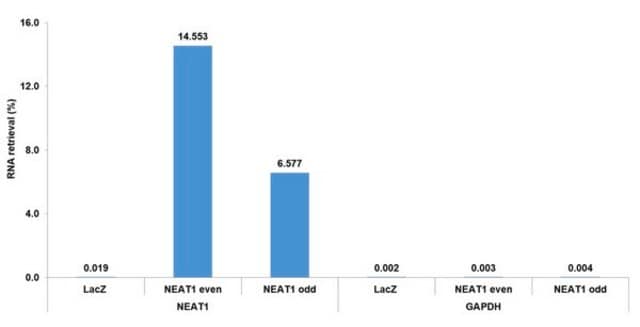
The Magna ChIRP NEAT1 lncRNA Probe Set contains 33 predesigned 20-mer DNA oligonucleotides tiled along and complementary to the sequence of human lncRNA NEAT1.
Wybierz wielkość
| Gabaryty przesyłki | SKU | Dostępność | Cena netto |
|---|---|---|---|
| 1 set | Przewidywany termin wysyłki27 kwietnia 2026zKuehne + Nagel Sp. z o.o. | 1330,00 zł |
Informacje o tej pozycji
Quality Level
manufacturer/tradename
Magna ChIRP®
technique(s)
DNA sequencing: suitable, RNA extraction: suitable (nuclear function kit), RNA purification: suitable (with magnetic beads), activity assay: suitable (protein interaction), nucleic acid detection: suitable (RNA), protein purification: suitable (protein determination)
shipped in
dry ice
General description
Application
Epigenetyka i funkcje jądrowe
Physical form
Preparation Note
Legal Information
Disclaimer
1 of 1
Ta pozycja | |||
|---|---|---|---|
| technique(s) DNA sequencing: suitable, RNA purification: suitable (with magnetic beads), nucleic acid detection: suitable (RNA), RNA extraction: suitable (nuclear function kit), protein purification: suitable (protein determination), activity assay: suitable (protein interaction) | technique(s) DNA sequencing: suitable, RNA extraction: suitable (nuclear function kit), RNA purification: suitable (with magnetic beads), activity assay: suitable (protein interaction), nucleic acid detection: suitable (RNA) | technique(s) DNA sequencing: suitable, RNA extraction: suitable (nuclear function kit), RNA purification: suitable (with magnetic beads), activity assay: suitable (protein interaction), protein purification: suitable (protein determination) | technique(s) DNA sequencing: suitable, RNA extraction: suitable (nuclear function kit), RNA purification: suitable (with magnetic beads), activity assay: suitable (protein interaction), nucleic acid detection: suitable (RNA), protein purification: suitable (protein determination) |
| Quality Level 100 | Quality Level 100 | Quality Level 100 | Quality Level 100 |
| shipped in dry ice | shipped in - | shipped in - | shipped in - |
| manufacturer/tradename Magna ChIRP® | manufacturer/tradename Magna ChIRP® | manufacturer/tradename Chemicon®, Magna ChIRP® | manufacturer/tradename Chemicon®, Magna ChIRP® |

Klasa składowania
10 - Combustible liquids
Certyfikaty analizy (CoA)
Poszukaj Certyfikaty analizy (CoA), wpisując numer partii/serii produktów. Numery serii i partii można znaleźć na etykiecie produktu po słowach „seria” lub „partia”.
Masz już ten produkt?
Dokumenty związane z niedawno zakupionymi produktami zostały zamieszczone w Bibliotece dokumentów.
Powiązane treści
"Cancer research giving you mixed signals? Signaling molecules are deeply embedded in processes associated with cancer. The study of signaling pathways is nearly synonymous with cancer research. Elucidating the various cellular and molecular mechanisms of cancer requires high quality research tools that give you precise, reproducible data. At EMD Millipore, our scientists are dedicated to developing and delivering thoroughly tested and validated tools for life science research."
Historically chromatin was considered to contain only DNA, histones, non-histone proteins and transiently associated mRNAs. While this remains true, current data suggest that a variety of non-coding RNAs (e.g. long non-coding RNAs, enhancer RNAs and even miRNAs) also associate with chromatin and serve regulatory functions.
Cancer is a complex disease manifestation. At its core, it remains a disease of abnormal cellular proliferation and inappropriate gene expression. In the early days, carcinogenesis was viewed simply as resulting from a collection of genetic mutations that altered the gene expression of key oncogenic genes or tumor suppressor genes leading to uncontrolled growth and disease (Virani, S et al 2012). Today, however, research is showing that carcinogenesis results from the successive accumulation of heritable genetic and epigenetic changes. Moreover, the success in how we predict, treat and overcome cancer will likely involve not only understanding the consequences of direct genetic changes that can cause cancer, but also how the epigenetic and environmental changes cause cancer (Johnson C et al 2015; Waldmann T et al 2013). Epigenetics is the study of heritable gene expression as it relates to changes in DNA structure that are not tied to changes in DNA sequence but, instead, are tied to how the nucleic acid material is read or processed via the myriad of protein-protein, protein-nucleic acid, and nucleic acid-nucleic acid interactions that ultimately manifest themselves into a specific expression phenotype (Ngai SC et al 2012, Johnson C et al 2015). This review will discuss some of the principal aspects of epigenetic research and how they relate to our current understanding of carcinogenesis. Because epigenetics affects phenotype and changes in epigenetics are thought to be key to environmental adaptability and thus may in fact be reversed or manipulated, understanding the integration of experimental and epidemiologic science surrounding cancer and its many manifestations should lead to more effective cancer prognostics as well as treatments (Virani S et al 2012).
Numer pozycji handlu globalnego
| SKU | NUMER GTIN |
|---|---|
| 03-308 | 04055977123548 |