
Przejdź do
S9684

Anti-SNAP-25 antibody produced in rabbit
IgG fraction of antiserum, buffered aqueous solution
Wybierz wielkość
| Gabaryty przesyłki | SKU | Dostępność | Cena netto |
|---|---|---|---|
| 25 μL | Skontaktuj się z Obsługą Klienta, aby uzyskać informacje na temat dostępności | 764,00 zł | |
| 100 μL | Skontaktuj się z Obsługą Klienta, aby uzyskać informacje na temat dostępności | 2190,00 zł | |
| 0.2 mL | Skontaktuj się z Obsługą Klienta, aby uzyskać informacje na temat dostępności | 2890,00 zł |
Informacje o tej pozycji
764,00 zł
biological source
rabbit
Quality Segment
conjugate
unconjugated
antibody form
IgG fraction of antiserum
antibody product type
primary antibodies
clone
polyclonal
form
buffered aqueous solution
mol wt
antigen 25 kDa
species reactivity
rat, mouse
packaging
antibody small pack of 25 μL
technique(s)
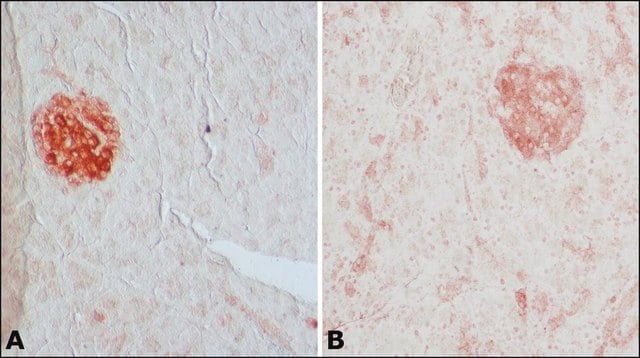
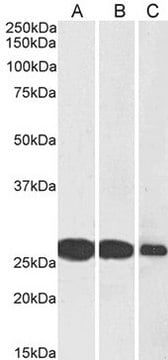
immunohistochemistry (formalin-fixed, paraffin-embedded sections): 1:5,000 using rat cerebellum sections, microarray: suitable, western blot: 1:10,000 using rat pheochromocytoma PC12 cell extract, western blot: 1:5,000 using mouse brain extract
UniProt accession no.
shipped in
dry ice
storage temp.
−20°C
target post-translational modification
unmodified
Gene Information
human ... SNAP25(6616)
mouse ... Snap25(20614)
rat ... Snap25(25012)
General description
Anti-SNAP-25 is developed in rabbit using a synthetic peptide corresponding to the N-terminus of human SNAP-25 conjugated to KLH as immunogen. This sequence is identical in SNAP-25 alternatively spliced forms SNAP-25A and SNAP-25B, in mouse, rat and chicken SNAP-25 and highly conserved (80-85%) in goldfish and zebrafish SNAP25. Whole antiserum is fractionated and then further purified by ion-exchange chromatography to provide the IgG fraction of antiserum that is essentially free of other rabbit serum proteins. Anti-SNAP-25 recognizes mouse SNAP-25 (25 kD). The antibody cross-reacts with rat SNAP-25. Applications include the detection and localization of SNAP-25 (25 kDa) by immunoblotting and immunohistochemistry. Staining of SNAP-25 in immunoblotting is specifically inhibited with SNAP-25 immunizing peptide (SNAP-25, mouse)
Immunogen
Application
- the primary detection of SNAP-25
- enzyme-linked immunosorbent assay in human neuroblastoma cell lines
- immunohistochemistry
- in human neuronal cells using western blotting
Biochem/physiol Actions
The molecular events leading to neurotransmitter release in the synaptic cleft are complex, involving multiple interacting proteins, generically termed SNAP receptors (SNAREs). It has been suggested that SNAP-25 and syntaxin on the neuronal plasma membrane (t-SNARE) and synaptobrevin/VAMP on the synaptic vesicle (v-SNARE) form a stable ternary complex. This core complex serves as a docking complex for two additional membrane fusion proteins, β-SNAP and NSF. ATP hydrolysis by NSF causes dissociation of the complex during priming of the exocytosis machinery. SNAP-25 induced reassembly and interaction with synaptotagmin (Syt), is thought to drive the Ca2+ -triggered vesicle-plasma membrane fusion and exocytosis. SNAP-25 has a key role in both developing and mature neurons. During development, SNAP-25 expression correlates with synaptogenesis, axonal growth and neuronal maturation and is found mainly in cell bodies of neonatal brain. In the adult nervous system, SNAP-25 is localized to presynaptic nerve terminals where it is conveyed by fast axonal transport.
SNAP-25 consists of two alternatively spliced isoforms SNAP-25a and SNAP-25b, differentially expressed in neurons and neuroendocrine cells. SNAP-25a and SNAP-25b differ by nine amino acids in the central domain. Two of these residues alter the relative positioning of clustered cysteine residues that are required for post-translational palmitoylation implicated in membrane anchoring, suggesting that the two SNAP-25 isoforms may play distinct roles in vesicular fusion events.
Physical form
Preparation Note
Disclaimer
1 of 1
Ta pozycja | |||
|---|---|---|---|
| biological source rabbit | biological source rabbit | biological source mouse | biological source goat |
| Quality Level 200 | Quality Level 200 | Quality Level 100 | Quality Level 100 |
| conjugate unconjugated | conjugate unconjugated | conjugate unconjugated | conjugate unconjugated |
| antibody form IgG fraction of antiserum | antibody form IgG fraction of antiserum | antibody form purified immunoglobulin | antibody form affinity isolated antibody |
| UniProt accession no. | UniProt accession no. | UniProt accession no. | UniProt accession no. |
| species reactivity rat, mouse | species reactivity human, mouse, rat, pig, monkey | species reactivity human | species reactivity rat, canine, human, mouse |


Still not finding the right product?
Explore all of our products under Anti-SNAP-25 antibody produced in rabbit
— lub —
Wypróbuj nasze narzędzie Narzędzie selektora produktów, aby zawęzić opcje.
Klasa składowania
12 - Non Combustible Liquids
wgk
nwg
flash_point_f
Not applicable
flash_point_c
Not applicable
ppe
Eyeshields, Gloves, multi-purpose combination respirator cartridge (US)
Wybierz jedną z najnowszych wersji:
Masz już ten produkt?
Dokumenty związane z niedawno zakupionymi produktami zostały zamieszczone w Bibliotece dokumentów.
Powiązane treści
Datasheet
Numer pozycji handlu globalnego
| SKU | NUMER GTIN |
|---|---|
| S9684-.2ML | 04061837724688 |
| S9684-25UL | 04061838511140 |
| S9684-100UL | 04061837724695 |