Przejdź do zawartości
Merck

R5403

Monoclonal Anti-Rhodopsin antibody produced in mouse

clone 1D4, purified immunoglobulin, buffered aqueous solution

Synonim(y):

Anti-CSNBAD1, Anti-OPN2, Anti-RP4

Zaloguj się, aby wyświetlić ceny organizacyjne i kontraktowe.

Wybierz wielkość

100 μL

3020,00 zł

3020,00 zł


Skontaktuj się z Obsługą Klienta, aby uzyskać informacje na temat dostępności
Rekombinowane, niezawierające konserwantów przeciwciało jest dostępne dla Twojego celu. Wypróbuj ZMS1069


Informacje o tej pozycji

UNSPSC Code:
12352203
NACRES:
NA.41
MDL number:
Conjugate:
unconjugated
Clone:
1D4, monoclonal
Application:
ICC, WB
Citations:
18

Przejdź do

Pomoc techniczna
Potrzebujesz pomocy? Nasz zespół doświadczonych naukowców chętnie Ci pomoże.
Pozwól nam pomóc

biological source

mouse

conjugate

unconjugated

antibody form

purified immunoglobulin

antibody product type

primary antibodies

clone

1D4, monoclonal

form

buffered aqueous solution

species reactivity

human, rat, bovine

technique(s)

immunocytochemistry: 1:1,000 using human retinal samples, western blot: 1:1,000 using Sf9 cells expressing the bovine gene

isotype

IgG1

UniProt accession no.

shipped in

wet ice

storage temp.

−20°C

target post-translational modification

unmodified

Quality Level

Gene Information

human ... RHO(6010)
rat ... Rho(24717)

Porównaj podobne pozycje

Wyświetl pełne porównanie

Pokaż różnice

1 of 4

Ta pozycja
O4886R9153MAB5356
biological source

mouse

biological source

mouse

biological source

rabbit

biological source

mouse

Gene Information

human ... RHO(6010)
rat ... Rho(24717)

Gene Information

human ... RHO(6010)
mouse ... Rho(212541)
rat ... Rho(24717)

Gene Information

human ... RHO(6010)
mouse ... Rho(212541)
rat ... Rho(24717)

Gene Information

human ... RHO(6010)

antibody form

purified immunoglobulin

antibody form

ascites fluid

antibody form

affinity isolated antibody

antibody form

purified immunoglobulin

species reactivity

human, rat, bovine

species reactivity

goldfish, mouse, tiger salamander, rat, amphibian, quail, dove, duck, rabbit, bovine, human, turtle

species reactivity

human

species reactivity

vertebrates

clone

1D4, monoclonal

clone

RET-P1, monoclonal

clone

polyclonal

clone

Rho 1D4, monoclonal

conjugate

unconjugated

conjugate

unconjugated

conjugate

unconjugated

conjugate

-

General description

Vision involves the conversion of light into electrochemical signals that are processed by the retina and subsequently sent to and interpreted by the brain. The process of converting light to an electrochemical signal begins when the membrane-bound protein, rhodopsin, absorbs light within the retina. Photoexcitation of rhodopsin causes the cytoplasmic surface of the protein to become catalytically active. In the active state, rhodopsin activates transducin, a GTP binding protein. Once activated, transducin promotes the hydrolysis of cGMP by phosphodiesterase (PDE). The decrease of intracellular cGMP concentrations causes the ion channels within the outer segment of the rod or cone to close, thus causing membrane hyperpolarization and, eventually, signal transmission. Rhodopsin′s activity is believed to be shut off by its phosphorylation followed by binding of the soluble protein arrestin.

Immunogen

bovine rhodopsin.

Application

Applications in which this antibody has been used successfully, and the associated peer-reviewed papers, are given below.
Immunohistochemistry (1 paper)
Mouse monoclonal clone 1D4 anti-Rhodopsin antibody has been successfully used in Western blot, immunocytochemistry, and immunoprecipitation. It is used as a probe to determine the presence and roles of rhodopsin in the conversion of light into electrochemical signals.

Biochem/physiol Actions

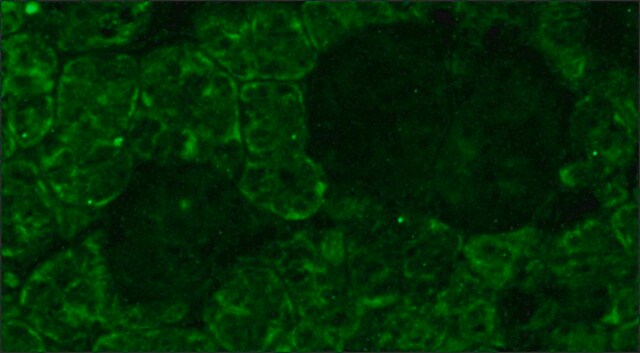
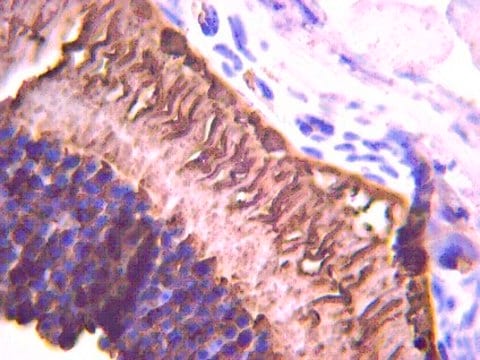
By Western blot, mouse monoclonal clone 1D4 anti-Rhodopsin antibody detects an ~40 kDa protein representing rhodopsin from Sf 9 cells expressing the bovine gene. Immunocytochemical staining of rhodopsin in human retinal samples results in staining of both rod and cone outer segments.
The epitope for this antibody has been localized to the C-terminal nine amino acids of bovine rhodopsin known as the 1D4 epitope, and detects rhodopsin from human and bovine retinal samples.

Physical form

Solution in phosphate buffered saline containing 1 mg/mL BSA and 0.05% sodium azide.

Disclaimer

Unless otherwise stated in our catalog or other company documentation accompanying the product(s), our products are intended for research use only and are not to be used for any other purpose, which includes but is not limited to, unauthorized commercial uses, in vitro diagnostic uses, ex vivo or in vivo therapeutic uses or any type of consumption or application to humans or animals.
Ta strona może zawierać tekst przetłumaczony maszynowo.

Nie możesz znaleźć właściwego produktu?  

Wypróbuj nasz Narzędzie selektora produktów.

Klasa składowania

10 - Combustible liquids

wgk

nwg

flash_point_f

Not applicable

flash_point_c

Not applicable


Wybierz jedną z najnowszych wersji:

Certyfikaty analizy (CoA)

Lot/Batch Number

Nie widzisz odpowiedniej wersji?

Jeśli potrzebujesz konkretnej wersji, możesz wyszukać konkretny certyfikat według numeru partii lub serii.

Masz już ten produkt?

Dokumenty związane z niedawno zakupionymi produktami zostały zamieszczone w Bibliotece dokumentów.

Odwiedź Bibliotekę dokumentów

Maria Carmela Latella et al.
Molecular therapy. Nucleic acids, 5(11), e389-e389 (2016-11-23)
The bacterial CRISPR/Cas system has proven to be an efficient tool for genetic manipulation in various organisms. Here we show the application of CRISPR-Cas9 technology to edit the human Rhodopsin (RHO) gene in a mouse model for autosomal dominant Retinitis
Angelo Felline et al.
Computational and structural biotechnology journal, 19, 6020-6038 (2021-12-02)
Failure of a protein to achieve its functional structural state and normal cellular location contributes to the etiology and pathology of heritable human conformational diseases. The autosomal dominant form of retinitis pigmentosa (adRP) is an incurable blindness largely linked to
Silvia Ravera et al.
Cells, 12(17) (2023-09-08)
Dysfunction of the retinal pigment epithelium (RPE) is associated with several diseases characterized by retinal degeneration, such as diabetic retinopathy (DR). However, it has recently been proposed that outer retinal neurons also participate in the damage triggering. Therefore, we have
Jun Yin et al.
Investigative ophthalmology & visual science, 53(8), 4943-4951 (2012-06-30)
In experimental eye research, zebrafish has become a powerful model for human retina disorders. The purpose of the present study is the characterization of antibodies commonly employed in zebrafish models for rod photoreceptor degeneration. The 1D4 monoclonal antibody, developed against
Kirk Haltaufderhyde et al.
Photochemistry and photobiology, 91(1), 117-123 (2014-10-01)
Human skin is constantly exposed to solar light containing visible and ultraviolet radiation (UVR), a powerful skin carcinogen. UVR elicits cellular responses in epidermal cells via several mechanisms: direct absorption of short-wavelength UVR photons by DNA, oxidative damage caused by

Powiązane treści

Instructions

Questions

Reviews

No rating value

Active Filters

Nasz zespół naukowców ma doświadczenie we wszystkich obszarach badań, w tym w naukach przyrodniczych, materiałoznawstwie, syntezie chemicznej, chromatografii, analityce i wielu innych dziedzinach.

Skontaktuj się z zespołem ds. pomocy technicznej