
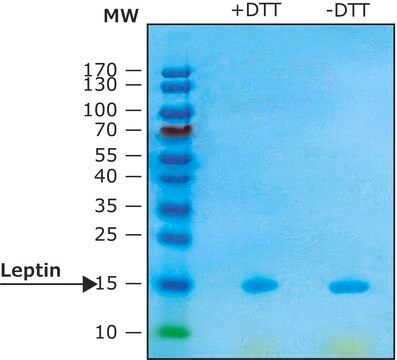
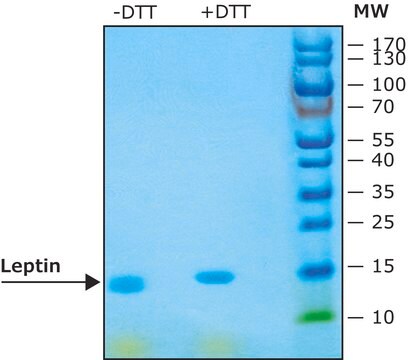


The molecular weight has not been determined for this product. Historically, the molecular weight has been approximated to be 2611 g/mol based on the average chain length of 25 phosphate units (n = 25).
Przejdź do
L4146

Leptin human
≥97% (SDS-PAGE), recombinant, expressed in E. coli, lyophilized powder
Synonim(y):
OB
Zaloguj się, aby wyświetlić ceny organizacyjne i kontraktowe.
Wybierz wielkość
Zmień widok
| Gabaryty przesyłki | SKU | Dostępność | Cena netto |
|---|---|---|---|
| 1 mg | Skontaktuj się z Obsługą Klienta, aby uzyskać informacje na temat dostępności | 1600,00 zł |
Informacje o tej pozycji
Biological source:
Escherichia coli
Form:
lyophilized powder
Assay:
≥97% (SDS-PAGE)
1600,00 zł
Skontaktuj się z Obsługą Klienta, aby uzyskać informacje na temat dostępności
Pomoc techniczna
Potrzebujesz pomocy? Nasz zespół doświadczonych naukowców chętnie Ci pomoże.
Pozwól nam pomócbiological source
Escherichia coli
Quality Level
recombinant
expressed in E. coli
sterility
sterile; 0.2 μm filtered
assay
≥97% (SDS-PAGE)
form
lyophilized powder
potency
≤3.0 ng/mL ED50/EC50
mol wt
predicted mol wt ~16 kDa
impurities
≤1.0 EU/μg endotoxin
UniProt accession no.
shipped in
ambient
storage temp.
−20°C
Gene Information
human ... LEP(3952)
General description
Application
Leptin human has been used:
- to study the effect of leptin on ACAT1 (acyl-coenzyme A:cholesterol acyltransferase 1) expression and cholesterol efflux from primary cultured human macrophages[4]
- to study the effect of leptin on expression of IGFBP2 (insulin growth factor binding protein 2) in skeletal muscle[5]
- to study the effect of leptin on HLA-G (human leukocyte antigen G) expression in placental trophoblasts[6]
- to study the effect of leptin on in vitro maturation, fertilization and development of horse oocytes after ICSI (intracytoplasmic sperm injection)[7]
Biochem/physiol Actions
Hormone produced primarily in adipocytes; primary site of action appears to be on neurons in the hypothalamus that are involved in regulating energy balance, appetite, and body weight.
Leptin is a hormone produced primarily in adipocytes, although leptin mRNA has also been identified in placenta and fetal tissues, gastric tissue and liver. Its primary site of action appears to be on neurons in the hypothalamus that are involved in regulating energy balance, appetite, and body weight. Leptin increases the production of nitric oxide in endothelial cells and stimulates angiogenesis in vitro and in vivo.
Human and mouse leptin share ~84% sequence identity.
Human and mouse leptin share ~84% sequence identity.
Mutations in LEP (leptin) are linked with type-2 diabetes.[8] Presence of high levels of leptin in plasma is related to adiposity.[2]
Leptin is believed to play a role in normal pregnancy development.
Physical form
Lyophilized from a 0.2 μm filtered solution with 0.0045 mM NaHCO3
Analysis Note
The biological activity is measured by its ability to induce proliferation of leptin-dependent human OB-R transfected murine BAF3 cells.
Ta strona może zawierać tekst przetłumaczony maszynowo.
1 of 1
Ta pozycja | |||
|---|---|---|---|
| biological source Escherichia coli | biological source mouse | biological source Escherichia coli | biological source rabbit |
| assay ≥97% (SDS-PAGE) | assay ≥98% (SDS-PAGE) | assay ≥97% (SDS-PAGE) | assay - |
| recombinant expressed in E. coli | recombinant expressed in E. coli | recombinant expressed in E. coli | recombinant - |
| Quality Level 100 | Quality Level 200 | Quality Level 200 | Quality Level 200 |
| form lyophilized powder | form lyophilized powder | form lyophilized powder | form buffered aqueous solution |
| Gene Information human ... LEP(3952) | Gene Information mouse ... Lep(16846) | Gene Information rat ... Lep(25608) | Gene Information human ... LEP(3952) |
Klasa składowania
11 - Combustible Solids
wgk
WGK 3
flash_point_f
Not applicable
flash_point_c
Not applicable
ppe
Eyeshields, Gloves, type N95 (US)
Wybierz jedną z najnowszych wersji:
Masz już ten produkt?
Dokumenty związane z niedawno zakupionymi produktami zostały zamieszczone w Bibliotece dokumentów.
Produkty
Lipid Induced Insulin Resistance
Powiązane treści
Eiji Kashiwagi et al.
American journal of translational research, 12(6), 3033-3045 (2020-07-14)
Adipocytokines such as leptin and adiponectin have functions in metabolism as well as the development and progression of various types of malignancies. However, little is known about their role in bladder cancer. In this study, we investigated whether leptin, adiponectin
Shih-Ping Cheng et al.
Oncology reports, 23(6), 1721-1727 (2010-04-30)
Excess body weight is associated with a moderately increased risk of thyroid cancer. Adipocyte-derived hormone, leptin, has been shown to enhance cell growth and migration in many cancer types. Limited evidence suggests that leptin has direct actions on the thyroid
Elisabetta Trevellin et al.
Oncotarget, 6(13), 11203-11215 (2015-04-11)
Obesity is associated with cancer risk in esophageal adenocarcinoma (EAC). Adipose tissue directly stimulates tumor progression independently from body mass index (BMI), but the mechanisms are not fully understood. We studied the morphological, histological and molecular characteristics of peritumoral and
Numer pozycji handlu globalnego
| SKU | NUMER GTIN |
|---|---|
| L4146-1MG | 04061833957301 |
-
how this leptin is further diluted and stored after reconstitution?
-
Helpful?
-
It is recommended to reconstitute this product in sterile distilled, deionized water to a final concentration of 0.1 - 1 mg/mL. For long-term storage at -20 °C, if the concentration is below 1 mg/mL, a carrier protein, such as 0.1% BSA in buffer, should be added. To avoid freeze-thaw cycles, aliquot into single-use portions and store for up to 3 months.
Helpful?
-