
Przejdź do
H9539

Anti-HMGB1 (HMG1) (C-terminal) antibody produced in rabbit
affinity isolated antibody, buffered aqueous solution
Synonim(y):
Anti-Amphoterin, Anti-High mobility group box 1, Anti-High mobility group protein 1
Wybierz wielkość
| Gabaryty przesyłki | SKU | Dostępność | Cena netto |
|---|---|---|---|
| 200 μL | Skontaktuj się z Obsługą Klienta, aby uzyskać informacje na temat dostępności | 2220,00 zł 1887,00 zł |
Informacje o tej pozycji
1887,00 zł
Cena katalogowa2220,00 złZaoszczędź 15%biological source
rabbit
Quality Level
conjugate
unconjugated
antibody form
affinity isolated antibody
antibody product type
primary antibodies
clone
polyclonal
form
buffered aqueous solution
mol wt
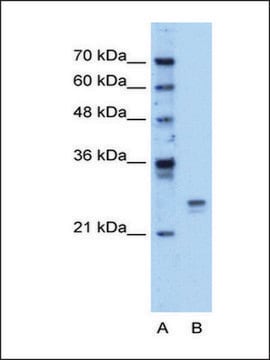
antigen 25 kDa
species reactivity
rat, mouse, human
packaging
antibody small pack of 25 μL
enhanced validation
independent
Learn more about Antibody Enhanced Validation
technique(s)
immunoprecipitation (IP): 5-10 μg using HEK-293T cell lysates., indirect immunofluorescence: suitable, western blot: 0.5-1 μg/mL using 3T3 or PC12 cell lysates.
UniProt accession no.
shipped in
dry ice
storage temp.
−20°C
target post-translational modification
unmodified
Gene Information
human ... HMGB1(3146)
mouse ... Hmgb1(15289)
rat ... Hmgb1(25459)
General description
Immunogen
Application
Biochem/physiol Actions
Physical form
Preparation Note
For extended storage, freeze in working aliquots.
Repeated freezing and thawing, or storage in “frostfree” freezers, is not recommended. If slight turbidity occurs upon prolonged storage, clarify the solution by centrifugation before use. Working dilutions should be discarded if not used within 12 hours.
Other Notes
Disclaimer
1 of 1
Ta pozycja | |||
|---|---|---|---|
| Quality Level 200 | Quality Level 200 | Quality Level 200 | Quality Level - |
| conjugate unconjugated | conjugate unconjugated | conjugate unconjugated | conjugate unconjugated |
| biological source rabbit | biological source rabbit | biological source mouse | biological source rabbit |
| antibody form affinity isolated antibody | antibody form affinity isolated antibody | antibody form purified immunoglobulin | antibody form IgG fraction of antiserum |
| UniProt accession no. | UniProt accession no. | UniProt accession no. | UniProt accession no. |
| technique(s) immunoprecipitation (IP): 5-10 μg using HEK-293T cell lysates., western blot: 0.5-1 μg/mL using 3T3 or PC12 cell lysates., indirect immunofluorescence: suitable | technique(s) immunoprecipitation (IP): 10 μg using HEK-293T cell lysates, indirect immunofluorescence: 1-2 μg/mL using paraformaldehyde-Triton fixed PC12 cultured cells., indirect immunofluorescence: suitable, western blot: 1-2 μg/mL using 3T3 cell lysates | technique(s) indirect ELISA: suitable, microarray: suitable, western blot: 0.5-1 μg/mL using total cell extract of human MCF7 breast carcinoma cells | technique(s) western blot: suitable |


Still not finding the right product?
Wypróbuj nasze narzędzie Narzędzie selektora produktów, aby zawęzić opcje.
Klasa składowania
12 - Non Combustible Liquids
wgk
nwg
flash_point_f
Not applicable
flash_point_c
Not applicable
ppe
Eyeshields, Gloves, multi-purpose combination respirator cartridge (US)
Wybierz jedną z najnowszych wersji:
Masz już ten produkt?
Dokumenty związane z niedawno zakupionymi produktami zostały zamieszczone w Bibliotece dokumentów.
Powiązane treści
Instructions
Numer pozycji handlu globalnego
| SKU | NUMER GTIN |
|---|---|
| H9539-200UL | 04061837794551 |