Przejdź do zawartości
Merck

Przejdź do

F2645

Anti-Factor IX antibody, Mouse monoclonal

clone HIX-1, purified from hybridma cell culture

Synonim(y):

Monoclonal Anti-Factor IX

Zaloguj się, aby wyświetlić ceny organizacyjne i kontraktowe.

Wybierz wielkość

Zmień widok
Gabaryty przesyłkiSKUDostępnośćCena netto
0.2 mL
Skontaktuj się z Obsługą Klienta, aby uzyskać informacje na temat dostępności
2240,00 zł

Informacje o tej pozycji

UNSPSC Code:
12352203
NACRES:
NA.41
MDL number:
Conjugate:
unconjugated
Clone:
HIX-1, monoclonal
Application:
ELISA (i), WB
Citations:
14

2240,00 zł


Skontaktuj się z Obsługą Klienta, aby uzyskać informacje na temat dostępności
Rekombinowane, niezawierające konserwantów przeciwciało jest dostępne dla Twojego celu. Wypróbuj ZRB1537

Zamów zamówienie zbiorcze
Pomoc techniczna
Potrzebujesz pomocy? Nasz zespół doświadczonych naukowców chętnie Ci pomoże.
Pozwól nam pomóc


biological source

mouse

Quality Level

conjugate

unconjugated

antibody form

purified immunoglobulin

antibody product type

primary antibodies

clone

HIX-1, monoclonal

form

buffered aqueous solution

species reactivity

human

technique(s)

indirect ELISA: suitable, western blot: 2-4 μg/mL

isotype

IgG1

UniProt accession no.

shipped in

dry ice

storage temp.

−20°C

target post-translational modification

unmodified

Gene Information

human ... F9(2158)

General description

Anti Factor IX antibody, Mouse monoclonal (mouse IgG1 isotype) is derived from the HIX-1 hybridoma produced by the fusion of mouse Sp2/0-Ag14 myeloma cells and splenocytes from BALB/c mice immunized with factor IX purified from human plasma. Factor IX concentration in human plasma ranges between 2.5-5 mg/ml and its half-life is approximately 24 hours. The human factor IX gene is about 40 Kb in size and is localized at the distal end of the X-chromosome.

Immunogen

Factor IX from pooled normal human plasma.

Application

Applications in which this antibody has been used successfully, and the associated peer-reviewed papers, are given below.
Enzyme-linked immunosorbent assay (1 paper)
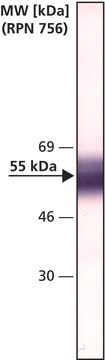
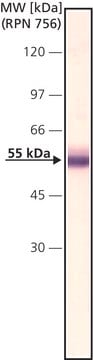
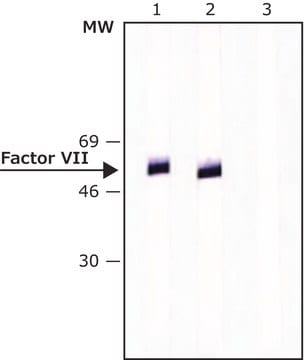
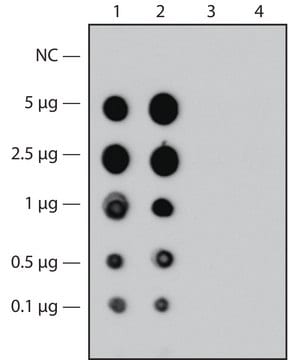
Monoclonal Anti-Factor IX antibody produced in mouse is suitable for ELISA-based assay in detection of FIX Inhibitors and it has been used as a positive control in ELISA.[1] It is also suitable for western blot at a concentration of 2-4μg/mL.

Biochem/physiol Actions

FIX plays a key role in the intrinsic and extrinsic blood coagulation systems. It is synthesized in liver and later upon activation in plasma it gets converted into a serine protease. In second step, FIX undergoes series of complex post-translation modifications such as γ-carboxylation of 12 N-terminal glutamic acid residues, N- and O-linked glycosylation, phosphorylation, β-hydroxylation, sulfation, disulfide bond formation etc. It is secreted into the plasma after completion of post-translation modifications. Hereditary deficiencies or dysfunctions of factor IX cause hemophilia B or "Christmas Disease" (the surname of the first family described). In haemophilia B, FIX showed impaired coagulation and increased tendency to bleed as a reason of mutation in the X chromosome linked FIX gene. Factor IX is synthesized in liver parenchymal cells and requires a post-translational vitamin K-dependent modification in order to become a mature plasma zymogen. When patients lack vitamin-K or take oral anticoagulants that interfere with the metabolism of vitamin-K, a hypocoagulable or antithrombotic state is induced.
Monoclonal Anti-Factor IX, a divalent cation-independent antibody, recognizes factor IX when used on immunoblots of non-denatured, non-reduced human plasma. It is also useful as paired labeled antibody in sandwich-type immunoassays with Monoclonal anti-Factor IX, clone HIX-5 (Product No. F1020).

This antibody may be used for purification of Factor IX and preparation of Factor IX depleted human plasma.

Physical form

Solution in 10 mM HEPES, pH 7.4, with 140 mM sodium chloride and 0.05% sodium azide.

Disclaimer

Unless otherwise stated in our catalog or other company documentation accompanying the product(s), our products are intended for research use only and are not to be used for any other purpose, which includes but is not limited to, unauthorized commercial uses, in vitro diagnostic uses, ex vivo or in vivo therapeutic uses or any type of consumption or application to humans or animals.
Ta strona może zawierać tekst przetłumaczony maszynowo.

Porównaj podobne pozycje

Wyświetl pełne porównanie

Pokaż różnice

1 of 1

Ta pozycja
F1020F8146F2145
antibody form

purified immunoglobulin

antibody form

purified from hybridoma cell culture

antibody form

purified immunoglobulin

antibody form

purified immunoglobulin

conjugate

unconjugated

conjugate

unconjugated

conjugate

unconjugated

conjugate

-

Gene Information

human ... F9(2158)

Gene Information

human ... F9(2158)

Gene Information

human ... F7(2155)

Gene Information

human ... F5(2153)

species reactivity

human

species reactivity

human

species reactivity

human

species reactivity

human

biological source

mouse

biological source

mouse

biological source

mouse

biological source

-

clone

HIX-1, monoclonal

clone

HIX-5, monoclonal

clone

HVII-1, monoclonal

clone

HV-1, monoclonal


Still not finding the right product?

Explore all of our products under

lub

Wypróbuj nasze narzędzie Narzędzie selektora produktów, aby zawęzić opcje.


Klasa składowania

12 - Non Combustible Liquids

wgk

nwg

flash_point_f

Not applicable

flash_point_c

Not applicable


Wybierz jedną z najnowszych wersji:

Certyfikaty analizy (CoA)

Lot/Batch Number

Nie widzisz odpowiedniej wersji?

Jeśli potrzebujesz konkretnej wersji, możesz wyszukać konkretny certyfikat według numeru partii lub serii.

Masz już ten produkt?

Dokumenty związane z niedawno zakupionymi produktami zostały zamieszczone w Bibliotece dokumentów.

Odwiedź Bibliotekę dokumentów


Powiązane treści

Instructions


Patricia Favaro et al.
Human gene therapy, 22(7), 843-852 (2010-12-04)
Intravascular delivery of adeno-associated virus (AAV) vector is commonly used for liver-directed gene therapy. In humans, the high prevalence of neutralizing antibodies to AAV-2 capsid and the wide cross-reactivity with other serotypes hamper vector transduction efficacy. Moreover, the safety of
Jianming Liu et al.
The protein journal, 33(2), 174-183 (2014-02-26)
Recombinant human FIX concentrates (rhFIX) are essential in the treatment and prevention of bleeding in the bleeding disorder haemophilia B. However, due to the complex nature of FIX production yields are low which leads to high treatment costs. Here we
Jiamiao Lu et al.
Molecular therapy : the journal of the American Society of Gene Therapy, 25(5), 1187-1198 (2017-04-04)
Conventional plasmid vectors are incapable of achieving sustained levels of transgene expression in vivo even in quiescent mammalian tissues because the transgene expression cassette is silenced. Transcriptional silencing results from the presence of the bacterial plasmid backbone or virtually any DNA


Numer pozycji handlu globalnego

SKUNUMER GTIN
F2645-.2ML04061838105219

Questions

Reviews

No rating value

Active Filters