Przejdź do zawartości
Merck

Przejdź do

C5176

Monoclonal Anti-Cytokeratin Peptide 4 antibody produced in mouse

clone 6B10, ascites fluid

Zaloguj się, aby wyświetlić ceny organizacyjne i kontraktowe.

Wybierz wielkość

Zmień widok
Gabaryty przesyłkiSKUDostępnośćCena netto
0.2 mL
Skontaktuj się z Obsługą Klienta, aby uzyskać informacje na temat dostępności
2260,00 zł
1921,00 zł

Informacje o tej pozycji

UNSPSC Code:
12352203
NACRES:
NA.41
MDL number:
Conjugate:
unconjugated
Clone:
6B10, monoclonal
Application:
ARR, IF, IHC (f), IHC (p), WB
Citations:
6

1921,00 zł

Cena katalogowa2260,00 złZaoszczędź 15%

Skontaktuj się z Obsługą Klienta, aby uzyskać informacje na temat dostępności

Zamów zamówienie zbiorcze
Pomoc techniczna
Potrzebujesz pomocy? Nasz zespół doświadczonych naukowców chętnie Ci pomoże.
Pozwól nam pomóc


biological source

mouse

Quality Level

conjugate

unconjugated

antibody form

ascites fluid

antibody product type

primary antibodies

clone

6B10, monoclonal

mol wt

antigen 59 kDa

contains

15 mM sodium azide

species reactivity

rabbit, feline, hamster, goat, guinea pig, human, canine, sheep

technique(s)

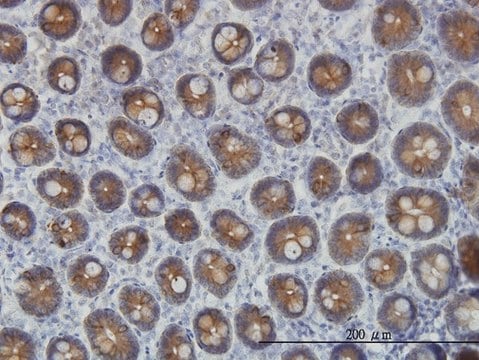
immunohistochemistry (formalin-fixed, paraffin-embedded sections): suitable, immunohistochemistry (frozen sections): suitable, indirect immunofluorescence: 1:300 using formalin-fixed, paraffin-embedded sections of human or animal tissue, microarray: suitable, western blot: suitable

isotype

IgG1

UniProt accession no.

shipped in

dry ice

storage temp.

−20°C

target post-translational modification

unmodified

Gene Information

human ... KRT4(3851)

General description

Cytokeratins are intermediary filaments that are expressed during epithelial development. Cytokeratin-4 is largely found in non-epidermal, stratified epithelial tissues such as larynx, pharynx, vagina, exocervix and epiglottis among several others . Cytokeratin-4 has been implicated in Streptococcus agalactiae infection and genetic mutations in Cytokeratin-4 have been linked to white sponge naevus . Monoclonal Anti-Cytokeratin Peptide 4 antibody is specific for cytokeratin 4 in goats, hamsters, guinea pigs, cats, sheep, humans, rabbits, and dogs. The antibody weakly stains ciliated pseudostratified epithelium of bronchi. Ducts of skin sweat glands and prostate are focally stained by the antibody. Some endocervical columnar cells may also react with the antibody. This antibody is reactive with methanol or acetone fixed frozen sections, and with protease-digested formalin fixed paraffin embedded human tissues. Embedded methacarn fixed material can also be used for cytokeratin 4 demonstration.

Immunogen

cytokeratin from human esophagus.

Application

Monoclonal Anti-Cytokeratin Peptide 4 antibody is suitable for use in a broad range of immunoassays such as immunohistochemistry (frozen or formalin-fixed, paraffin-embedded sections), immunoblot, dot blot, and indirect immunofluorescence (1:300 using formalin-fixed, paraffin-embedded sections of human or animal tissue). The antibody may also be used for western blot and microarray.

Biochem/physiol Actions

The antibody reacts with non-cornifying squamous epithelium (e.g., exocervix, esophagus and cornea). Ciliated pseudostratified epithelium of bronchi is weakly stained. Ducts of sweat glands and prostate are focally stained. The antibody may react with some endocervical columnar cells.

Disclaimer

Unless otherwise stated in our catalog or other company documentation accompanying the product(s), our products are intended for research use only and are not to be used for any other purpose, which includes but is not limited to, unauthorized commercial uses, in vitro diagnostic uses, ex vivo or in vivo therapeutic uses or any type of consumption or application to humans or animals.
Ta strona może zawierać tekst przetłumaczony maszynowo.

Porównaj podobne pozycje

Wyświetl pełne porównanie

Pokaż różnice

1 of 1

Ta pozycja
C5301WH0003851M1C1801
conjugate

unconjugated

conjugate

unconjugated

conjugate

unconjugated

conjugate

unconjugated

Gene Information

human ... KRT4(3851)

Gene Information

human ... KRT8(3856)

Gene Information

human ... KRT4(3851)

Gene Information

bovine ... Krt1(100301161)
dog ... Krt1(444857)
human ... KRT1(3848), KRT5(3852), KRT5(3852), KRT5(3852), KRT6A(3868), KRT6A(3868), KRT6A(3868), KRT6B(3854), KRT6B(3854), KRT6B(3854), KRT8(3856), KRT8(3856), KRT8(3856)
mouse ... KRT1(16678), KRT1(16678), KRT1(16678), Krt1(16678), Krt5(110308), Krt5(110308), Krt5(110308), Krt6a(16687), Krt6a(16687), Krt6a(16687), Krt6b(16688), Krt6b(16688), Krt6b(16688), Krt8(16691), Krt8(16691), Krt8(16691)
rat ... Krt1(300250), Krt2-5(369017), Krt2-5(369017), Krt2-5(369017), Krt2-8(25626), Krt2-8(25626), Krt2-8(25626)

antibody form

ascites fluid

antibody form

ascites fluid

antibody form

purified immunoglobulin

antibody form

ascites fluid

species reactivity

rabbit, feline, hamster, goat, guinea pig, human, canine, sheep

species reactivity

feline, human, rabbit, canine, bovine

species reactivity

human

species reactivity

human, chicken, snake, hamster, pig, goat, feline, bovine, carp, rat, rabbit, canine, lizard, sheep, mouse, guinea pig

biological source

mouse

biological source

mouse

biological source

mouse

biological source

mouse

clone

6B10, monoclonal

clone

M20, monoclonal

clone

5H5, monoclonal

clone

PCK-26, monoclonal


Still not finding the right product?

Wypróbuj nasze narzędzie Narzędzie selektora produktów, aby zawęzić opcje.


Klasa składowania

10 - Combustible liquids

wgk

nwg

flash_point_f

Not applicable

flash_point_c

Not applicable


Wybierz jedną z najnowszych wersji:

Certyfikaty analizy (CoA)

Lot/Batch Number

Nie widzisz odpowiedniej wersji?

Jeśli potrzebujesz konkretnej wersji, możesz wyszukać konkretny certyfikat według numeru partii lub serii.

Masz już ten produkt?

Dokumenty związane z niedawno zakupionymi produktami zostały zamieszczone w Bibliotece dokumentów.

Odwiedź Bibliotekę dokumentów


Tamsin R Sheen et al.
Journal of bacteriology, 193(24), 6834-6842 (2011-10-11)
Streptococcus agalactiae (group B streptococcus [GBS]) is a Gram-positive bacterium found in the female rectovaginal tract and is capable of producing severe disease in susceptible hosts, including newborns and pregnant women. The vaginal tract is considered a major reservoir for
Dianlei Guo et al.
Experimental eye research, 180, 208-225 (2018-12-28)
Ocular surface disease is one major type of eye diseases. Different etiologies trigger distinct pathological responses of the ocular surface. We previously reported that genetically engineered mice with ablation of Prickle 1 manifested precocious eyelid opening with ensuing cornea dysplasia.
S-C Chao et al.
The British journal of dermatology, 148(6), 1125-1128 (2003-06-28)
White sponge naevus (WSN) is a rare, autosomal dominant disorder that predominantly affects noncornified stratified squamous epithelia, most commonly the buccal mucosa. Clinically, WSN manifests as thickened spongy mucosa with a white opalescent tint in the mouth and may be


Numer pozycji handlu globalnego

SKUNUMER GTIN
C5176-.2ML04061838104366
C5176-.5ML04061838162762

Questions

Reviews

No rating value

Active Filters