Przejdź do zawartości
Merck

Przejdź do

C1603

Anti-Calcium Channel (α1C Subunit) (L-type of Voltage-gated Ca2+ Channel) antibody produced in rabbit

affinity isolated antibody

Synonim(y):

Anti-CACH2, Anti-CACN2, Anti-CACNL1A1, Anti-CCHL1A1, Anti-CaV1.2, Anti-LQT8, Anti-TS, Anti-TS. LQT8

Zaloguj się, aby wyświetlić ceny organizacyjne i kontraktowe.

Wybierz wielkość

Zmień widok
Gabaryty przesyłkiSKUDostępnośćCena netto
0.2 mL
Skontaktuj się z Obsługą Klienta, aby uzyskać informacje na temat dostępności
4140,00 zł

Informacje o tej pozycji

UNSPSC Code:
12352203
NACRES:
NA.41
MDL number:
Conjugate:
unconjugated
Clone:
polyclonal
Application:
IHC, WB
Citations:
14

4140,00 zł


Skontaktuj się z Obsługą Klienta, aby uzyskać informacje na temat dostępności
Rekombinowane, niezawierające konserwantów przeciwciało jest dostępne dla Twojego celu. Wypróbuj ZRB1293

Zamów zamówienie zbiorcze
Pomoc techniczna
Potrzebujesz pomocy? Nasz zespół doświadczonych naukowców chętnie Ci pomoże.
Pozwól nam pomóc


biological source

rabbit

Quality Level

conjugate

unconjugated

antibody form

affinity isolated antibody

antibody product type

primary antibodies

clone

polyclonal

species reactivity

human, rat, mouse, rabbit

technique(s)

immunohistochemistry: suitable using Rat brain sections, western blot: 1:200 using Rat brain and rat heart membranes

UniProt accession no.

storage temp.

−20°C

target post-translational modification

unmodified

Gene Information

mouse ... Cacna1c(12288)

General description

L-type of Voltage-gated Ca2+ Channels (L-type VGCC) is a high voltage-activated channel that exerts spatial and temporal control over cellular calcium concentrations and modulates function such as neurotransmitter release, hormone secretion, muscle contraction, electrical activity, cell metabolism and proliferation, gene expression and neuronal survival. Calcium dependent processes are important in synaptic modification and thus alterations in calcium channel function may be important for both modifying synaptic plasticity and also in age-related neurodegenerative diseases. Calcium channel antagonists are used as antiarrhythmics and in the treatment of hypertension and may even be neuroprotective in Parkinson′s Disease. Calcium Channel α1C subunit is a pore-forming subunit that together with β subunits generates the necessary signal for membrane targeting of class C L-type calcium channels.

Immunogen

synthetic peptide corresponding to amino acids 848 to 865 of rat α1C.

Application

Anti-Calcium Channel (α1C Subunit) (L-type of Voltage-gated Ca2+ Channel) antibody produced in rabbit has been used in:
  • SDS-PAGE
  • western blotting
  • coimmunoprecipitation
Applications in which this antibody has been used successfully, and the associated peer-reviewed papers, are given below.
Immunohistochemistry (1 paper)
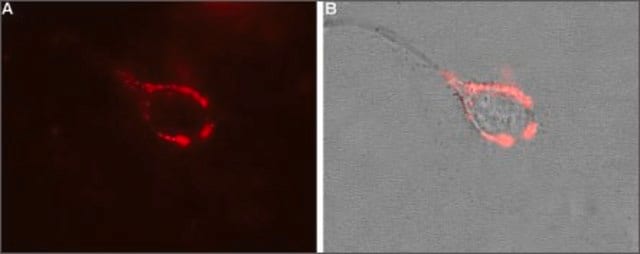
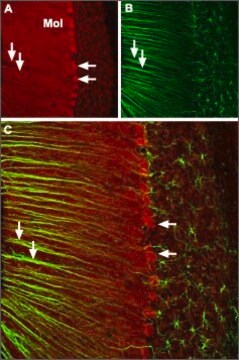
Rabbit polyclonal anti-Calcium Channel α1C subunit antibody is used to tag class C L-type calcium channel subunit α1C for detection and quantitation by immunocytochemical and immunohistochemical (IHC) techniques such as ELISA, immunoblotting, and immunoprecipitation. It is used as a probe to determine the presence and roles of calcium channel subunit α1C in class C L-type voltage-gated Ca2+ channel subunit complexes.

Biochem/physiol Actions

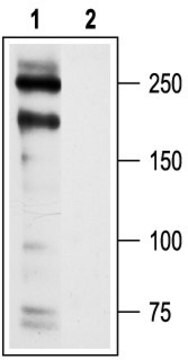
Anti-Voltage-gated Calcium Channel α1C subunit recognizes the α1C subunit by immunoblotting in rat brain and rat heart membranes. Reactivity has been confirmed for rat, mouse, rabbit and human.

Physical form

Lyophilized from phosphate buffered saline, pH 7.4, containing 1% bovine serum albumin and 0.05% sodium azide.

Disclaimer

Unless otherwise stated in our catalog or other company documentation accompanying the product(s), our products are intended for research use only and are not to be used for any other purpose, which includes but is not limited to, unauthorized commercial uses, in vitro diagnostic uses, ex vivo or in vivo therapeutic uses or any type of consumption or application to humans or animals.
Ta strona może zawierać tekst przetłumaczony maszynowo.

Porównaj podobne pozycje

Wyświetl pełne porównanie

Pokaż różnice

1 of 1

Ta pozycja
C1241C5105C1353
conjugate

unconjugated

conjugate

unconjugated

conjugate

unconjugated

conjugate

unconjugated

antibody form

affinity isolated antibody

antibody form

affinity isolated antibody

antibody form

affinity isolated antibody

antibody form

affinity isolated antibody

Quality Level

100

Quality Level

200

Quality Level

100

Quality Level

100

biological source

rabbit

biological source

rabbit

biological source

rabbit

biological source

rabbit

technique(s)

immunohistochemistry: suitable using Rat brain sections, western blot: 1:200 using Rat brain and rat heart membranes

technique(s)

immunocytochemistry: suitable, western blot: 1:200 using rat heart membranes

technique(s)

western blot (chemiluminescent): 1:200 using rat brain membranes

technique(s)

immunohistochemistry: 1:100, western blot: 1:200

Gene Information

mouse ... Cacna1c(12288)

Gene Information

human ... CACNA1C(775)
mouse ... Cacna1c(12288)
rat ... Cacna1c(24239)

Gene Information

human ... CACNA2D1(781)
mouse ... Cacna2d1(12293)
rat ... Cacna2d1(25399)

Gene Information

mouse ... Cacna1a(12286)
rat ... Cacna1a(25398)


Still not finding the right product?

Wypróbuj nasze narzędzie Narzędzie selektora produktów, aby zawęzić opcje.


Klasa składowania

10 - Combustible liquids

wgk

WGK 3

flash_point_f

Not applicable

flash_point_c

Not applicable


Wybierz jedną z najnowszych wersji:

Certyfikaty analizy (CoA)

Lot/Batch Number

Nie widzisz odpowiedniej wersji?

Jeśli potrzebujesz konkretnej wersji, możesz wyszukać konkretny certyfikat według numeru partii lub serii.

Masz już ten produkt?

Dokumenty związane z niedawno zakupionymi produktami zostały zamieszczone w Bibliotece dokumentów.

Odwiedź Bibliotekę dokumentów


Calcium channel function and regulation in beta1-and beta2-adrenoceptor transgenic mice
Foerster K, et al.
Naunyn-Schmiedeberg'S Archives of Pharmacology, 369(5), 490-495 (2004)
Functional coupling of the metabotropic glutamate receptor, InsP3 receptor and L-type Ca2+ channel in mouse CA1 pyramidal cells
Kato HK, et al.
The Journal of Physiology, 590(13), 3019-3034 (2012)
Nina Daschil et al.
Pharmacology, 93(1-2), 24-31 (2014-01-18)
It is well established that reactive astrocytes express L-type calcium channels (LTCC), but their functional role is completely unknown. We have recently shown that reactive astrocytes highly express the CaV1.2 α1-subunit around β-amyloid (Aβ) plaques in an Alzheimer mouse model.


Numer pozycji handlu globalnego

SKUNUMER GTIN
C1603-.2ML04061833467787

Questions

Reviews

No rating value

Active Filters