Przejdź do zawartości
Merck

Przejdź do

ZRB1203

Anti-Twist1 Antibody, clone 4L15 ZooMAb® Rabbit Monoclonal

greener alternative

recombinant, expressed in HEK 293 cells

Synonim(y):

Twist-related protein 1;Class A basic helix-loop-helix protein 38;bHLHa38;H-twist

Zaloguj się, aby wyświetlić ceny organizacyjne i kontraktowe.

Wybierz wielkość

Zmień widok
Gabaryty przesyłkiSKUDostępnośćCena netto

Informacje o tej pozycji

NACRES:
NA.41
UNSPSC Code:
12352203
Conjugate:
unconjugated
Clone:
4L15, recombinant monoclonal
Application:
ICC, WB, affinity binding assay
Citations:
-
Informacje o cenach i dostępności nie są obecnie dostępne.
Pomoc techniczna
Potrzebujesz pomocy? Nasz zespół doświadczonych naukowców chętnie Ci pomoże.
Pozwól nam pomóc


biological source

rabbit

Quality Segment

recombinant

expressed in HEK 293 cells

conjugate

unconjugated

antibody form

purified antibody

antibody product type

primary antibodies

clone

4L15, recombinant monoclonal

description

recombinant, expressed in HEK 293 cells

product line

ZooMAb® learn more

form

lyophilized

mol wt

calculated mol wt 20.95 kDa, observed mol wt ~27 kDa

purified by

using Protein A

species reactivity

mouse, human

species reactivity (predicted by homology)

bovine, porcine, feline, horse, monkey

packaging

antibody small pack of 25 μL

greener alternative product characteristics

Waste Prevention
Designing Safer Chemicals
Design for Energy Efficiency
Learn more about the Principles of Green Chemistry.

enhanced validation

recombinant expression
Learn more about Antibody Enhanced Validation

sustainability

Greener Alternative Product

technique(s)

affinity binding assay: suitable, immunocytochemistry: suitable, western blot: suitable

isotype

IgG

epitope sequence

N-terminal

Protein ID accession no.

UniProt accession no.

greener alternative category

shipped in

ambient

storage temp.

2-8°C

target post-translational modification

unmodified

General description

Twist-related protein 1 (UniProt: Q15672; also known as Class A basic helix-loop-helix protein 38, bHLHa38, H-twist) is encoded by the TWIST1 (also known as BHLHA38, TWIST) gene (Gene ID: 7291) in human. TWIST1 is a basic helix-loop-helix (bHLH) domain (aa 108-159) containing transcription factor with two nuclear localization sequences (aa 37-40 and 73-77). It can form homodimers or heterodimers in order to bind the Nde E-box element and activate or repress its target genes. It is shown to inhibit myogenesis by sequestrating E proteins. TWIST1 is also reported to represses expression of proinflammatory cytokines such as TNF-a and IL-1b. During development, it is shown to be essential for mesoderm specification and differentiation. It promotes EMT in part by directly repressing E-cadherin expression by recruiting the nucleosome remodeling and deacetylase complex for gene repression and by upregulating Bmi1, AKT2, and YB-1. TWIST1 stability is regulated by phosphorylation of serine 68 by MAP kinases (p38, JNK, and ERK1/2). This phosphorylation prevents ubiquitination-mediated degradation of TWIST1. Heterozygous loss-of-function mutations of the human Twist1 gene is shown to cause several diseases including the Saethre-Chotzen syndrome and Robinow-Sorauf syndrome. Twist1-null mouse embryos die with unclosed cranial neural tubes and defective head mesenchyme, somites and limb buds. TWIST1 expression is also observed in many types of aggressive tumors, including breast cancer, hepatocellular carcinoma, prostate cancer, pancreatic cancer, and esophageal squamous cell carcinoma. It can override oncogene-induced cell senescence and apoptosis and can increase cancer cell resistance to chemotherapeutic agents. This ZooMAb® recombinant monoclonal antibody, generated by our propriety technology, offers significantly enhanced specificity, affinity, reproducibility, and stability over conventional monoclonals. (Ref.: Qin, Q., et al. (2012). Cell Res. 22(1); 90-106; Hong, J., et al. (2011). Cancer Res. 71(11); 3980-3990).
We are committed to bringing you greener alternative products, which adhere to one or more of The 12 Principles of Green Chemistry.This antibody is Preservative-free, produced without the harm or sacrifice of animals and exceptionally stable to allow for ambient shipping and storage if needed and thus aligns with "Waste Prevention", "Designing Safer Chemicals" and "Design for Energy Efficiency". Click here for more information.
ZooMAb® antibodies represent an entirely new generation of recombinant monoclonal antibodies.Each ZooMAb® antibody is manufactured using our proprietary recombinant expression system, purified to homogeneity, and precisely dispensed to produce robust and highly reproducible lot-to-lot consistency. Only top-performing clones are released for use by researchers. Each antibody is validated for high specificity and affinity across multiple applications, including its most commonly used application. ZooMAb® antibodies are reliably available and ready to ship when you need them.

Immunogen

KLH-conjugated linear peptide corresponding to 20 amino acids from the N-terminal region of human Twist1.

Application

Quality Control Testing

Evaluated by Western Blotting in HepG2 cell nuclear extract.

Western Blotting Analysis: A 1:1,000 dilution of this antibody detected Twist1 in HepG2 cell nuclear extract..

Tested applications

Western Blotting Analysis: A 1:1,000 dilution from a representative lot detected Twist1 in nuclear extracts of HeLa cells and BALB 3T3/A31 cells.

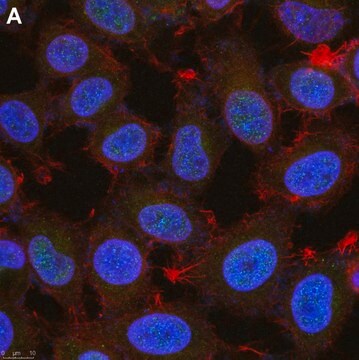
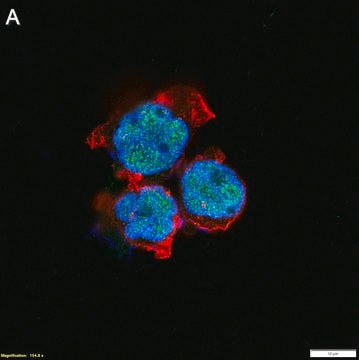
Immunocytochemistry Analysis: A 1:100 dilution from a representative lot detected Twist1 in HeLa cells.

Affinity Binding Assay: A representative lot of this antibody bound Twist1 peptide with a KD of 7.0 x 10⁻⁷ in an affinity binding assay.

Note: Actual optimal working dilutions must be determined by end user as specimens, and experimental conditions may vary with the end user

Biochem/physiol Actions

Clone 4L15 is a ZooMAb® Rabbit recombinant monoclonal antibody that specifically detects Twist1. It targets an epitope within 20 amino acids from the N-terminal region.

Physical form

Purified recombinant rabbit monoclonal antibody IgG, lyophilized in PBS, 5% Trehalose, normal appearance a coarse or translucent resin. The PBS/trehalose components in the ZooMAb formulation can have the appearance of a semi-solid (bead like gel) after lyophilization. This is a normal phenomenon. Please follow the recommended reconstitution procedure in the data sheet to dissolve the semi-solid, bead-like, gel-appearing material. The resulting antibody solution is completely stable and functional as proven by full functional testing. Contains no biocide or preservatives, such as azide, or any animal by-products. Larger pack sizes provided as multiples of 25 μL.

Preparation Note

Recommend storage of lyophilized product at 2-8°C; Before reconstitution, micro-centrifuge vials briefly to spin down material to bottom of the vial; Reconstitute each vial by adding 25 μL of filtered lab grade water or PBS; Reconstituted antibodies can be stored at 2-8°C, or -20°C for long term storage. Avoid repeated freeze-thaws.
Reconstitute lyophilized antibody pellet with 25μL of ultrapure water or Phosphate Buffered Saline (PBS). Please refer to our reconstitution protocol and the specific application guidance on the suggested starting dilutions and sample type.

Legal Information

ZooMAb is a registered trademark of Merck KGaA, Darmstadt, Germany

Disclaimer

Unless otherwise stated in our catalog or other company documentation accompanying the product(s), our products are intended for research use only and are not to be used for any other purpose, which includes but is not limited to, unauthorized commercial uses, in vitro diagnostic uses, ex vivo or in vivo therapeutic uses or any type of consumption or application to humans or animals.
Ta strona może zawierać tekst przetłumaczony maszynowo.

Porównaj podobne pozycje

Wyświetl pełne porównanie

Pokaż różnice

1 of 1

Ta pozycja
ZRB1395ZRB1324ZRB1936
antibody form

purified antibody

antibody form

purified antibody

antibody form

purified antibody

antibody form

purified antibody

species reactivity

mouse, human

species reactivity

mouse, human, rat

species reactivity

human

species reactivity

human, rat, mouse

biological source

rabbit

biological source

rabbit

biological source

rabbit

biological source

rabbit

conjugate

unconjugated

conjugate

unconjugated

conjugate

unconjugated

conjugate

unconjugated

clone

4L15, recombinant monoclonal

clone

4L14, recombinant monoclonal

clone

1L15, recombinant monoclonal

clone

1C18, recombinant monoclonal

isotype

IgG

isotype

IgG

isotype

IgG

isotype

IgG


Still not finding the right product?

Wypróbuj nasze narzędzie Narzędzie selektora produktów, aby zawęzić opcje.


Klasa składowania

13 - Non Combustible Solids

wgk

WGK 1

flash_point_f

Not applicable

flash_point_c

Not applicable


Wybierz jedną z najnowszych wersji:

Certyfikaty analizy (CoA)

Lot/Batch Number

Nie widzisz odpowiedniej wersji?

Jeśli potrzebujesz konkretnej wersji, możesz wyszukać konkretny certyfikat według numeru partii lub serii.

Masz już ten produkt?

Dokumenty związane z niedawno zakupionymi produktami zostały zamieszczone w Bibliotece dokumentów.

Odwiedź Bibliotekę dokumentów


Numer pozycji handlu globalnego

SKUNUMER GTIN
ZRB1203-4X25UL04065267314495
ZRB1203-25UL04065267314488

Questions

  1. Hi Can glycerol and azide be added to the antibody solution?

    1 answer
    1. It is recommended to reconstitute each vial of ZRB1203 by adding 25 µL of filtered lab grade water or PBS. Reconstituted antibodies can be stored at 2-8°C, or -20°C in single-use-size aliquots for long-term storage. Avoid repeated freeze-thaws. Alternative reconstitution & storage conditions would be at the discretion of the end-user, considering the following:

      As known, Glycerol at 50% is a cryoprotectant & adding it to the reconstituted antibody will dilute the antibody concentration. However, its effects on the binding affinity of this antibody were not tested in-house.

      Addition of Azide will certainly help control against contamination with certain microbes during long-term storage/handling at 2-8°C or higher but is not needed during long-term storage at -20C or below. Also, Azide may affect some downstream applications.

      Helpful?

Reviews

No rating value

Active Filters