Przejdź do zawartości
Merck

Przejdź do

479M-9

MDM2 (IF2) Mouse Monoclonal Antibody

Synonim(y):

Mouse double minute protein 2

Zaloguj się, aby wyświetlić ceny organizacyjne i kontraktowe.

Wybierz wielkość

Zmień widok
Gabaryty przesyłkiSKUDostępnośćCena netto

Informacje o tej pozycji

UNSPSC Code:
12352203
Conjugate:
unconjugated
Clone:
IF2, monoclonal
Application:
IHC (p)
Citations:
8
Informacje o cenach i dostępności nie są obecnie dostępne.
Pomoc techniczna
Potrzebujesz pomocy? Nasz zespół doświadczonych naukowców chętnie Ci pomoże.
Pozwól nam pomóc


biological source

mouse

Quality Level

conjugate

unconjugated

antibody form

culture supernatant

antibody product type

primary antibodies

clone

IF2, monoclonal

description

For In Vitro Diagnostic Use in Select Regions

form

buffered aqueous solution

species reactivity

human

packaging

vial of 0.1 mL concentrate (479M-94), vial of 0.1 mL concentrate Research Use Only (479M-94-RUO), vial of 0.5 mL concentrate (479M-95), vial of 1.0 mL concentrate (479M-96), vial of 1.0 mL concentrate Research Use Only (479M-96-RUO), vial of 1.0 mL pre-dilute Research Use Only (479M-97-RUO), vial of 1.0 mL pre-dilute ready-to-use (479M-97), vial of 7.0 mL pre-dilute ready-to-use (479M-98), vial of 7.0 mL pre-dilute ready-to-use Research Use Only (479M-98-RUO)

manufacturer/tradename

Cell Marque®

technique(s)

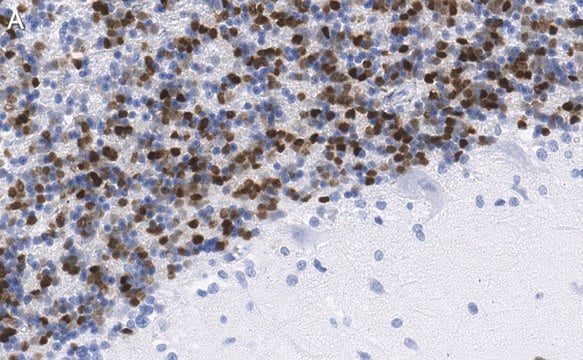
immunohistochemistry (formalin-fixed, paraffin-embedded sections): 1:25-1:50 (concentrated)

isotype

IgG

control

dedifferentiated liposarcoma, well-differentiated liposarcoma

shipped in

wet ice

storage temp.

2-8°C

visualization

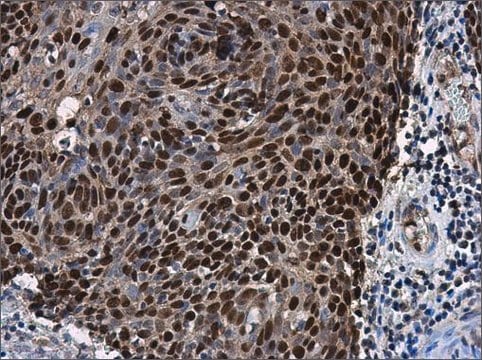
nuclear

General description

Mouse double minute protein 2 (MDM2) is a gene encoded on the 12q13-14 chromosomal sequence.1-5 It encodes for a 483 amino acid residue protein which binds to the amino-terminal transcription region of p53.2,5 MDM2 has been shown to negatively regulate the tumor-suppressor activity of p53 by three mechanisms: Blocking p53 transcription, binding to p53 causing it to be exported from the nucleus, and accelerating the destruction of p53.1 MDM2 up-regulation has been shown in liposarcoma while being absent in lipoma.2,4 Therefore, anti-MDM2 has been demonstrated to be a potentially useful tool in distinguishing well-differentiated liposarcoma (atypical lipomatous tumor) from lipoma, with the neoplastic cells positive in the former lesion and negative in lipoma.2,4

Physical form

Solution in Tris Buffer, pH 7.3-7.7, with 1% BSA and <0.1% Sodium Azide.

Preparation Note

Download the IFU specific to your product lot and format
Note: This requires a keycode which can be found on your packaging or product label.

Download the latest released IFU
Note: This IFU may not apply to your specific product lot.

Analysis Note

United States - IVD
Canada - RUO
European Union - IVD
Japan - RUO

Other Notes

For Technical Service please contact: 800-665-7284 or email: [email protected]

Legal Information

Cell Marque is a registered trademark of Merck KGaA, Darmstadt, Germany
Ta strona może zawierać tekst przetłumaczony maszynowo.


Still not finding the right product?

Wypróbuj nasze narzędzie Narzędzie selektora produktów, aby zawęzić opcje.


Wybierz jedną z najnowszych wersji:

Certyfikaty analizy (CoA)

Lot/Batch Number

Nie widzisz odpowiedniej wersji?

Jeśli potrzebujesz konkretnej wersji, możesz wyszukać konkretny certyfikat według numeru partii lub serii.

Masz już ten produkt?

Dokumenty związane z niedawno zakupionymi produktami zostały zamieszczone w Bibliotece dokumentów.

Odwiedź Bibliotekę dokumentów


J Momand et al.
Nucleic acids research, 26(15), 3453-3459 (1998-07-22)
The p53 tumor suppressor gene is inactivated in human tumors by several distinct mechanisms. The best characterized inactivation mechanisms are: (i) gene mutation; (ii) p53 protein association with viral proteins; (iii) p53 protein association with the MDM2 cellular oncoprotein. The
Matthieu Bui Nguyen Binh et al.
American journal of clinical pathology, 125(5), 693-697 (2006-05-19)
MDM2 and CDK4 immunostaining can be useful adjuncts in diagnosing liposarcoma among soft tissue neoplasms. We examined the reproducibility of MDM2 and CDK4 staining between 2 laboratories and between tissue microarrays and whole tissue sections. Sixty-two soft tissue tumors were
A Arici et al.
Indian journal of cancer, 50(3), 164-169 (2013-09-26)
Liposarcomas are among the most common soft tissue sarcomas in adulthood. The purpose of the study is to perform a histopathologic typing according to World Health Organization (WHO) classification of cases diagnosed with liposarcoma and to examine the difference of


Questions

Reviews

No rating value

Active Filters