Przejdź do zawartości
Merck

MABS1920

Anti-IRF-9 Antibody, clone 6F1-H5

clone 6F1-H5, from mouse

Synonim(y):

Interferon regulatory factor 9, IFN-alpha-responsive transcription factor subunit, ISGF3 p48 subunit, Interferon-stimulated gene factor 3 gamma, ISGF-3 gamma, Transcriptional regulator ISGF3 subunit gamma

Zaloguj się, aby wyświetlić ceny organizacyjne i kontraktowe.

Wybierz wielkość

25 μG

773,00 zł

100 μG

1810,00 zł

773,00 zł


Przewidywany termin wysyłki26 lutego 2026Szczegóły


Zamów zamówienie zbiorcze

Informacje o tej pozycji

UNSPSC Code:
12352203
NACRES:
NA.41
eCl@ss:
32160702
Conjugate:
unconjugated
Clone:
6F1-H5, monoclonal
Application:
ChIP, WB
Citations:
4

Przejdź do

Pomoc techniczna
Potrzebujesz pomocy? Nasz zespół doświadczonych naukowców chętnie Ci pomoże.
Pozwól nam pomóc

biological source

mouse

conjugate

unconjugated

antibody form

purified immunoglobulin

antibody product type

primary antibodies

clone

6F1-H5, monoclonal

species reactivity

mouse

should not react with

human

packaging

antibody small pack of 25 μg

technique(s)

ChIP: suitable, western blot: suitable

isotype

IgG2aκ

NCBI accession no.

UniProt accession no.

shipped in

ambient

target post-translational modification

unmodified

Quality Level

Gene Information

mouse ... Irf9(16391)

Powiązane kategorie

Porównaj podobne pozycje

Wyświetl pełne porównanie

Pokaż różnice

1 of 4

Ta pozycja
ABF202ABF188MABF268
clone

6F1-H5, monoclonal

clone

polyclonal

clone

polyclonal

clone

SL-12, monoclonal

biological source

mouse

biological source

rabbit

biological source

rabbit

biological source

mouse

antibody form

purified immunoglobulin

antibody form

affinity isolated antibody

antibody form

affinity isolated antibody

antibody form

purified antibody

species reactivity

mouse

species reactivity

human, mouse

species reactivity

human, rat

species reactivity

human, mouse

Gene Information

mouse ... Irf9(16391)

Gene Information

human ... IRF7(3665)

Gene Information

human ... IRF1(3659)

Gene Information

human ... IRF3(3661)

technique(s)

ChIP: suitable, western blot: suitable

technique(s)

immunofluorescence: suitable, immunohistochemistry: suitable, western blot: suitable

technique(s)

immunohistochemistry: suitable (paraffin), western blot: suitable

technique(s)

immunocytochemistry: suitable, immunoprecipitation (IP): suitable, western blot: suitable

General description

Interferon regulatory factor 9 (UniProt: Q61179; also known as IRF-9, IFN-alpha-responsive transcription factor subunit, ISGF3 p48 subunit, Interferon-stimulated gene factor 3 gamma, ISGF-3 gamma, Transcriptional regulator ISGF3 subunit gamma) is encoded by the Irf9 (also known as Isgf3g) gene (Gene ID: 16391) in murine species. IRF-9 is a transcription factor that mediates signaling by interferon-alpha and beta. It contains 1 IRF tryptophan pentad repeat DNA-binding domain Following binding of these interferons to cell surface receptors, JAK kinases (Tyk2 ad JAK1) are activated that lead to tyrosine phosphorylation of STAT1 and STAT2. IRF-9 then associates with phosphorylated STAT1:STAT2 dimer to form the interferon-stimulated gene factor 3 (ISFG3) complex that translocates to the nucleus and binds to the interferon stimulated response element (ISRE) to activate the transcription of interferon-stimulated genes. In mice, ablation of IRF-9 is shown to block the proliferation and migration of vascular smooth muscle cells (VSMC) and attenuates intimal thickening in response to injury. On the other hand, IRF-9 gain-of-function is reported to promote VSMC proliferation and migration that can aggravates arterial narrowing. (Ref.: Zhang, SM et al (2015). Nat Commun. 6:6882).
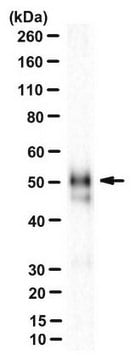
~51 kDa observed. 44.61 kDa calculated. Uncharacterized bands may be observed in some lysate(s).

Immunogen

Epitope: N-terminus
His-tagged full length recombinant longer version (465 amino acids) of murine Interferon regulatory factor 9.

Application

Anti-IRF-9, clone 6F1-H5, Cat. No. MABS1920, is a mouse monoclonal antibody that detects Interferon regulatory factor 9 (IRF-9). It has been tested for use in chromatin Immunoprecipitation and Western Blotting.
Chromatin Immunoprecipitation: Chromatin Immunoprecipitation was performed on a representative lot with wild -type or IRF9 knock-out bone marrow derived marcrophages (uninduced or treated with IFN beta). (Data courtesy of Prof. Thomas Decker, Ph.D., University of Vienna, Austria).
Research Category
Signaling

Biochem/physiol Actions

Clone 6F1-H5 detects interfereon regulatory factor 9 (IRF-9) of 51 kDa in murine species. May also detect shorter variants of IRF-9.

Physical form

Format: Purified
Protein G purified
Purified mouse monoclonal antibody IgG2a in buffer containing 0.1 M Tris-Glycine (pH 7.4), 150 mM NaCl with 0.05% sodium azide.

Preparation Note

Stable for 1 year at 2-8°C from date of receipt.

Analysis Note

Evaluated by Western Blotting in mouse spleen tissue lysate.

Western Blotting Analysis: 0.5 µg/mL of this antibody detected IRF-9 in 10 µg of mouse spleen tissue lysate.

Other Notes

Concentration: Please refer to lot specific datasheet.

Disclaimer

Unless otherwise stated in our catalog or other company documentation accompanying the product(s), our products are intended for research use only and are not to be used for any other purpose, which includes but is not limited to, unauthorized commercial uses, in vitro diagnostic uses, ex vivo or in vivo therapeutic uses or any type of consumption or application to humans or animals.
Ta strona może zawierać tekst przetłumaczony maszynowo.

Nie możesz znaleźć właściwego produktu?  

Wypróbuj nasz Narzędzie selektora produktów.

Klasa składowania

12 - Non Combustible Liquids

wgk

WGK 1


Certyfikaty analizy (CoA)

Poszukaj Certyfikaty analizy (CoA), wpisując numer partii/serii produktów. Numery serii i partii można znaleźć na etykiecie produktu po słowach „seria” lub „partia”.

Masz już ten produkt?

Dokumenty związane z niedawno zakupionymi produktami zostały zamieszczone w Bibliotece dokumentów.

Odwiedź Bibliotekę dokumentów

Nasiha S Ahmed et al.
Proceedings of the National Academy of Sciences of the United States of America, 119(1) (2022-01-06)
Macrophages induce a number of inflammatory response genes in response to stimulation with microbial ligands. In response to endotoxin Lipid A, a gene-activation cascade of primary followed by secondary-response genes is induced. Epigenetic state is an important regulator of the
Catera L Wilder et al.
Molecular systems biology, 19(5), e11294-e11294 (2023-03-18)
Type I interferons (IFN) induce powerful antiviral and innate immune responses via the transcription factor, IFN-stimulated gene factor (ISGF3). However, in some pathological contexts, type I IFNs are responsible for exacerbating inflammation. Here, we show that a high dose of
Camila Marques-da-Silva et al.
Cell reports, 40(3), 111098-111098 (2022-07-21)
Malaria is a devastating disease impacting over half of the world's population. Plasmodium parasites that cause malaria undergo obligatory development and replication in hepatocytes before infecting red blood cells and initiating clinical disease. While type I interferons (IFNs) are known
Ekaterini Platanitis et al.
Nature communications, 10(1), 2921-2921 (2019-07-04)
Cells maintain the balance between homeostasis and inflammation by adapting and integrating the activity of intracellular signaling cascades, including the JAK-STAT pathway. Our understanding of how a tailored switch from homeostasis to a strong receptor-dependent response is coordinated remains limited.

Questions

Reviews

No rating value

Active Filters

Nasz zespół naukowców ma doświadczenie we wszystkich obszarach badań, w tym w naukach przyrodniczych, materiałoznawstwie, syntezie chemicznej, chromatografii, analityce i wielu innych dziedzinach.

Skontaktuj się z zespołem ds. pomocy technicznej