Przejdź do zawartości
Merck

Przejdź do

MABS157

Anti-O-Linked N-Acetylglucosamine Antibody, clone RL2

clone RL2, from mouse

Synonim(y):

O-Linked N-Acetylglucosamine

Zaloguj się, aby wyświetlić ceny organizacyjne i kontraktowe.

Wybierz wielkość

Zmień widok
Gabaryty przesyłkiSKUDostępnośćCena netto
100 μg

Dostępne do wysyłki DZISIAJzKuehne + Nagel Sp. z o.o.

2110,00 zł

Informacje o tej pozycji

UNSPSC Code:
12352203
NACRES:
NA.41
eCl@ss:
32160702
Clone:
RL2, monoclonal
Technique(s):
affinity binding assay: suitable, electron microscopy: suitable, immunocytochemistry: suitable, immunoprecipitation (IP): suitable, western blot: suitable
Application:
EM, ICC, IP, WB, affinity binding assay
Citations:
11

2110,00 zł


Dostępne do wysyłki DZISIAJSzczegóły


Zamów zamówienie zbiorcze
Pomoc techniczna
Potrzebujesz pomocy? Nasz zespół doświadczonych naukowców chętnie Ci pomoże.
Pozwól nam pomóc


biological source

mouse

Quality Level

antibody form

purified immunoglobulin

antibody product type

primary antibodies

clone

RL2, monoclonal

species reactivity (predicted by homology)

all

technique(s)

affinity binding assay: suitable, electron microscopy: suitable, immunocytochemistry: suitable, immunoprecipitation (IP): suitable, western blot: suitable

isotype

IgG1κ

shipped in

wet ice

target post-translational modification

unmodified

Gene Information

human ... OGT(8473)

General description

Posttranslational modification of proteins by β-linked N-acetylglucosamine (β-GlcNAc) via the hydroxyl moieties on serine or threonine residues is termed O-linked β-GlcNAc or simply O-GlcNAc. O-GlcNAc is one of the most abundant posttranslational modifications within the nucleocytoplasmic compartments of all animals and plants. Unlike other types of protein glycosylations, O-GlcNAc occurs exclusively within the nuclear and cytoplasmic compartments and is generally not further modified to form more elongated structures. In addition, O-GlcNAcylation is a highly dynamic and reversible process. The O-GlcNAc transferase (OGT) attaches O-GlcNAc to proteins at specific serine or threonine residues, while O-GlcNAcase catalyzes the removal/hydrolysis of O-GlcNAc from proteins. In fact, a dynamic interplay between O-GlcNAcylation and serine/threonine phosphorylation plays an important role in regulating cellular signaling. Tau and RNA polymerase II (Pol II) are two well known proteins that undergo modification by O-GlcNAcylation. In Alzheimer’s diseased human brains, tau becomes extensively phosphorylated and less O-GlcNAcylated. Similarly, O-GlcNAc is removed and replaced with O-phosphate on the Poly II CTD when the elongation phase of transcription is initiated.
Variable, depending on the size(s) of the O-GlcNAcylated protein(s).

Immunogen

Pore complex-lamina fraction purified from rat liver nuclear envelopes corresponding to Rat O-Linked N-Acetylglucosamine.

Application

Anti-O-Linked N-Acetylglucosamine Antibody, clone RL2 is an antibody against O-Linked N-Acetylglucosamine for use in Western Blotting, Immunocytochemistry, Affinity Binding Assay, Electron Microscopy, Immunoprecipitation.
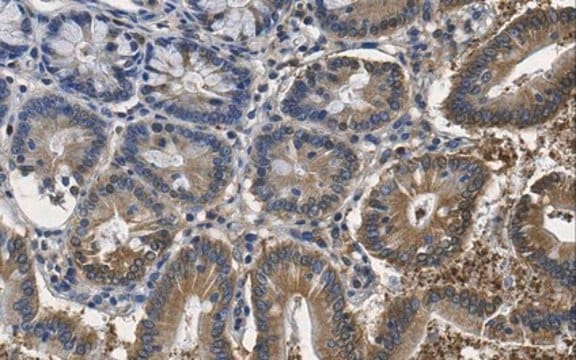
Immunocytochemistry Analysis: 4.0 µg/mL from a representative lot detected O-Linked N-Acetylglucosamine in HeLa cells.
Immunocytochemistry Analysis: A representative lot immunostained nuclear envelopes, but not the nuclear interior, of digitonin-permeabilized HeLa cells. Clone RL2 stained the nuclear interior only among Triton X-100-permeabilized HeLa cells without intact nuclear envelopes (Adam, S.A., et al. (1990). J. Cell Biol. 111(3):807-816).
Affinity Binding Assay: A representative lot was radiolabeled with 125I and studied for its binding characteristics toward isolated rat liver nuclear envelopes (Snow, C.M., et al. (1987). J. Cell Biol. 104(5):1143-1156).
Electron Microscopy: A representative lot localized the O-GlcNAc immunoreactivity in isolated rat liver nuclear envelopes (Snow, C.M., et al. (1987). J. Cell Biol. 104(5):1143-1156).
Western Blotting Analysis: A representative lot detected O-GlcNAcylated proteins in rat liver nuclear envelopes preparations (Snow, C.M., et al. (1987). J. Cell Biol. 104(5):1143-1156; Holt, G.D., et al. (1987). J. Cell Biol. 104(5):1157-1164).
Immunoprecipitation Analysis: A representative lot immunoprecipitated O-GlcNAcylated proteins from solubilized rat liver nuclear envelopes preparations. Pretreatment of nuclear envelopes preparations with galactosyltrarnsferase prevented the immunoprecipitation of glycoproteins by clone RL2 (Snow, C.M., et al. (1987). J. Cell Biol. 104(5):1143-1156; Holt, G.D., et al. (1987). J. Cell Biol. 104(5):1157-1164).

Biochem/physiol Actions

Specifically recoginzes O-linked N-Acetylglucosamine (O-GlcNAc) moieties on O-GlcNAcylated proteins and peptides. Exhibits little reactivity toward free GIcNAc and no reactivity toward GalNac. Galactosyltransferase treatment of O-GlcNAcylated proteins results in galactosylation of O-GlcNAc via β1-4 linkage and a complete loss of binding by clone RL2 (Holt, G.D., et al. (1987). J. Cell Biol. 104(5):1157-1164).
Target structure is not species-specific.

Physical form

Format: Purified

Analysis Note

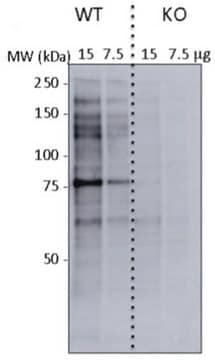
Evaluated by Western Blotting in HeLa cell lysate.

Western Blotting Analysis: 1.0 µg/mL of this antibody detected O-Linked N-Acetylglucosamine in 10 µg of HeLa cell lysate.

Other Notes

Concentration: Please refer to lot specific datasheet.
Ta strona może zawierać tekst przetłumaczony maszynowo.

Porównaj podobne pozycje

Wyświetl pełne porównanie

Pokaż różnice

1 of 1

Ta pozycja
MABS1253MABS1254O7764
Gene Information

human ... OGT(8473)

Gene Information

human ... OGT(8473)

Gene Information

human ... OGT(8473)

Gene Information

human ... OGT(8473)

antibody form

purified immunoglobulin

antibody form

purified immunoglobulin

antibody form

purified immunoglobulin

antibody form

purified immunoglobulin

biological source

mouse

biological source

mouse

biological source

mouse

biological source

mouse

clone

RL2, monoclonal

clone

RL1, monoclonal

clone

CTD110.6, monoclonal

clone

CTD110.6, monoclonal

Quality Level

100

Quality Level

100

Quality Level

100

Quality Level

200

technique(s)

affinity binding assay: suitable, immunocytochemistry: suitable, western blot: suitable, electron microscopy: suitable, immunoprecipitation (IP): suitable

technique(s)

affinity binding assay: suitable, electron microscopy: suitable, immunocytochemistry: suitable, immunofluorescence: suitable, immunohistochemistry: suitable, immunoprecipitation (IP): suitable, inhibition assay: suitable, western blot: suitable

technique(s)

ELISA: suitable, immunoprecipitation (IP): suitable, western blot: suitable

technique(s)

immunocytochemistry: suitable, immunohistochemistry: suitable, immunoprecipitation (IP): suitable, indirect ELISA: suitable, western blot: 0.2-0.4 μg/mL using total cell extract of HeLa cells


Still not finding the right product?

Wypróbuj nasze narzędzie Narzędzie selektora produktów, aby zawęzić opcje.


Klasa składowania

12 - Non Combustible Liquids

wgk

WGK 1

flash_point_f

Not applicable

flash_point_c

Not applicable


Certyfikaty analizy (CoA)

Poszukaj Certyfikaty analizy (CoA), wpisując numer partii/serii produktów. Numery serii i partii można znaleźć na etykiecie produktu po słowach „seria” lub „partia”.

Masz już ten produkt?

Dokumenty związane z niedawno zakupionymi produktami zostały zamieszczone w Bibliotece dokumentów.

Odwiedź Bibliotekę dokumentów


Toni Mueller et al.
Frontiers in aging, 1, 620382-620382 (2021-03-12)
O-GlcNAcylation is a protein posttranslational modification that results in the addition of O-GlcNAc to Ser/Thr residues. Since its discovery in the 1980s, it has been shown to play an important role in a broad range of cellular functions by modifying
Kent Miyazaki et al.
Clinical & experimental metastasis (2024-06-18)
Our previous studies revealed a novel link between gemcitabine (GEM) chemotherapy and elevated glutamine-fructose-6-phosphate transaminase 2 (GFPT2) expression in pancreatic cancer (PaCa) cells. GFPT2 is a rate-limiting enzyme in the hexosamine biosynthesis pathway (HBP). HBP can enhance metastatic potential by
Wei Qin et al.
Nature communications, 12(1), 4980-4980 (2021-08-19)
Proximity labeling (PL) with genetically-targeted promiscuous enzymes has emerged as a powerful tool for unbiased proteome discovery. By combining the spatiotemporal specificity of PL with methods for functional protein enrichment, we show that it is possible to map specific protein


Numer pozycji handlu globalnego

SKUNUMER GTIN
MABS15704055977301243

Questions

Reviews

No rating value

Active Filters