


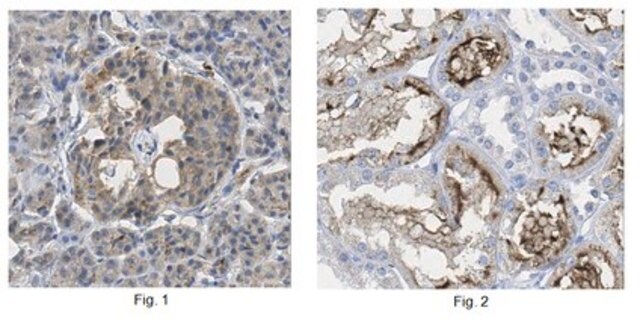
This is an engineered antibody expressed in E. coli, consisting of a single chain fragment variable fragment of human origin fused to His and FLAG tags. Binding to protein G beads has not been tested, but it is expected to bind to beads coated with anti-FLAG antibodies.
MABE917

Anti-DNA G-quadruplex structures Antibody, clone BG4
clone BG4, from Escherichia coli
Synonim(y):
DNA G-quadruplex (BG4)
Zaloguj się, aby wyświetlić ceny organizacyjne i kontraktowe.
Wybierz wielkość
Zmień widok
| Gabaryty przesyłki | SKU | Dostępność | Cena netto |
|---|---|---|---|
| 25 μL | Dostępne do wysyłki DZISIAJzKuehne + Nagel Sp. z o.o. | 906,00 zł | |
| 200 μL | Dostępne do wysyłki DZISIAJzKuehne + Nagel Sp. z o.o. | 1850,00 zł |
Informacje o tej pozycji
UNSPSC Code:
12352203
NACRES:
NA.41
eCl@ss:
32160702
Clone:
BG4, monoclonal
Species reactivity:
human
Application:
ChIP, ELISA, ICC
Citations:
23
906,00 zł
Dostępne do wysyłki DZISIAJSzczegóły
Rekombinowane, niezawierające konserwantów przeciwciało jest dostępne dla Twojego celu. Wypróbuj ZMS1070
Pomoc techniczna
Potrzebujesz pomocy? Nasz zespół doświadczonych naukowców chętnie Ci pomoże.
Pozwól nam pomócbiological source
Escherichia coli
Quality Segment
antibody form
purified antibody
antibody product type
primary antibodies
clone
BG4, monoclonal
species reactivity
human
packaging
antibody small pack of 25 μL
technique(s)
ChIP: suitable (ChIP-seq), ELISA: suitable, immunocytochemistry: suitable
shipped in
ambient
target post-translational modification
unmodified
General description
DNA G-quadruplex structures are associated with a number of important aspects of genome function, which include transcription, recombination and replication. Single-stranded guanine (G)-rich DNA can form stable secondary structures called G-quadruplexes (G-tetrads or G4), which can influence methylation at CpG islands (CGIs). G4 structure is reported to be tightly associated with CGI hypomethylation in the human genome. Four guanine bases can associate through Hoogsteen hydrogen bonding to form a square planar structure called a guanine tetrad (G-tetrad), and two or more G-tetrads can stack on top of each other to form a G-quadruplex. The quadruplex structure is further stabilized by the presence of a cation, especially potassium, which sits in a central channel between each pair of tetrads. A DNA G-tetrad can be formed within one DNA strand (intramolecular), between two DNA strands (bimolecular), or four DNA strands (tetramolecular). G4 DNA can arise anywhere in the genome where sufficiently long stretches of single-stranded G-rich DNA are exposed during replication, transcription or recombination. Chemical analysis of quadruplex-forming oligonucleotides has revealed the existence of a plethora of dynamic quadruplex structures with varying stabilities. The diverse nature of G4 DNA structures makes it an attractive topic in molecular biomedical research.(Ref.: Mao, SQ et al., (2018). Nat. Struc. Mol. Biol. 25(10); 951-957).
Immunogen
G-quadruplex oligonucleotides.
Application
Anti-DNA G-quadruplex structures, clone BG4 Antibody, Cat. No. MABE917, is a highly specific monoclonal antibody that targets DNA G-quadruplex structures and has been tested in and ELISA, ChIP-seq, and Immunocytochemistry.
ELISA Analysis: A representative lot detected DNA G-quadruplex structures in Anti-DNA G-quarduplex structures, BG4 (Courtesy of University of Cambridge).
ChIP-seq Analysis: A representative lot detected DNA G-quadruplex structures in ChIP-seq applications (Hansel-Hertsch, R., et. al. (2016). Nat Genet. 48(10):1267-72).
ELISA Analysis: A representative lot detected DNA G-quadruplex structures in ELISA applications (Biffi, G., et. al. (2013). Nat Chem. 5(3):182-6).
Immunocytochemistry Analysis: A representative lot detected DNA G-quadruplex structures in Immunocytochemistry applications (Biffi, G., et. al. (2013). Nat Chem. 5(3):182-6).
ChIP-seq Analysis: A representative lot detected DNA G-quadruplex structures in ChIP-seq applications (Hansel-Hertsch, R., et. al. (2016). Nat Genet. 48(10):1267-72).
ELISA Analysis: A representative lot detected DNA G-quadruplex structures in ELISA applications (Biffi, G., et. al. (2013). Nat Chem. 5(3):182-6).
Immunocytochemistry Analysis: A representative lot detected DNA G-quadruplex structures in Immunocytochemistry applications (Biffi, G., et. al. (2013). Nat Chem. 5(3):182-6).
Biochem/physiol Actions
Clone BG4 has a high affinity for intramolecular and intermolecular DNA G-quadruplexes with no detectable binding to a RNA hairpin, single-stranded DNA or double-stranded DNA.
Physical form
Format: Purified
Purified monoclonal antibody in PBS with 0.05% sodium azide.
Analysis Note
The Anti-DNA-G-quadruplex structures, clone BG4 antibody (Cat. No. MABE917) was resolved by SDS-PAGE, transferred to PVDF membrane and probed with Anti-FLAG epitope tag antibody (MAB3118).
Other Notes
Concentration: Please refer to lot specific datasheet.
Ta strona może zawierać tekst przetłumaczony maszynowo.
1 of 1
Ta pozycja | |||
|---|---|---|---|
| species reactivity human | species reactivity - | species reactivity yeast, human | species reactivity mouse, human |
| biological source Escherichia coli | biological source mouse | biological source mouse | biological source rabbit |
| antibody form purified antibody | antibody form purified immunoglobulin | antibody form purified immunoglobulin | antibody form affinity isolated antibody |
| clone BG4, monoclonal | clone 1H6, monoclonal | clone 1B3F12/A9, monoclonal | clone polyclonal |
| shipped in ambient | shipped in wet ice | shipped in ambient | shipped in wet ice |
| technique(s) ChIP: suitable (ChIP-seq), immunocytochemistry: suitable, ELISA: suitable | technique(s) ELISA: suitable, flow cytometry: suitable, immunocytochemistry: suitable, immunohistochemistry: suitable (paraffin) | technique(s) ChIP: suitable, western blot: suitable | technique(s) immunohistochemistry: suitable, western blot: suitable |
Still not finding the right product?
Wypróbuj nasze narzędzie Narzędzie selektora produktów, aby zawęzić opcje.
Klasa składowania
12 - Non Combustible Liquids
wgk
WGK 2
flash_point_f
Not applicable
flash_point_c
Not applicable
Certyfikaty analizy (CoA)
Poszukaj Certyfikaty analizy (CoA), wpisując numer partii/serii produktów. Numery serii i partii można znaleźć na etykiecie produktu po słowach „seria” lub „partia”.
Masz już ten produkt?
Dokumenty związane z niedawno zakupionymi produktami zostały zamieszczone w Bibliotece dokumentów.
Numer pozycji handlu globalnego
| SKU | NUMER GTIN |
|---|---|
| MABE917 | 04054839322433 |
| MABE917-25UL | 04054839420979 |
-
Does this antibody bind to protein G beads? Can it be precipitated with beads coated with anti-FLAG antibodies?
1 answer-
Helpful?
-
-
Is it possible to know the concentration of this antibody?
1 answer-
The concentration for this product is 0.25 mg/mL.
Helpful?
-