Przejdź do zawartości
Merck

Przejdź do

MABC602

Anti-Ferritin Heavy Chain Antibody, clone 1-2.3.1.2

clone 1-2.3.1.2, from mouse

Synonim(y):

Ferritin heavy chain, Ferritin H subunit, Cell proliferation-inducing gene 15 protein, Ferritin heavy chain, N-terminally processed

Zaloguj się, aby wyświetlić ceny organizacyjne i kontraktowe.

Wybierz wielkość

Zmień widok
Gabaryty przesyłkiSKUDostępnośćCena netto
100 μg

Przewidywany termin wysyłki20 maja 2026zKuehne + Nagel Sp. z o.o.

1880,00 zł

Informacje o tej pozycji

UNSPSC Code:
12352203
NACRES:
NA.41
eCl@ss:
32160702
Conjugate:
unconjugated
Clone:
1-2.3.1.2, monoclonal
Application:
IHC, WB
Citations:
1

1880,00 zł


Przewidywany termin wysyłki20 maja 2026Szczegóły

Rekombinowane, niezawierające konserwantów przeciwciało jest dostępne dla Twojego celu. Wypróbuj ZRB2695

Zamów zamówienie zbiorcze
Pomoc techniczna
Potrzebujesz pomocy? Nasz zespół doświadczonych naukowców chętnie Ci pomoże.
Pozwól nam pomóc


biological source

mouse

Quality Level

conjugate

unconjugated

antibody form

purified immunoglobulin

antibody product type

primary antibodies

clone

1-2.3.1.2, monoclonal

species reactivity

human

technique(s)

immunohistochemistry: suitable, western blot: suitable

isotype

IgG2aκ

NCBI accession no.

UniProt accession no.

shipped in

wet ice

target post-translational modification

unmodified

Gene Information

human ... FTH1(2495)

General description

Ferritin is a widely expressed, very large, multi-subunit, intracellular protein that stores iron and releases it in a controlled fashion. The protein is produced by almost all living organisms in some form. In humans, it acts as a buffer against iron deficiency and iron overload. Ferritin protein is a multi-subunit (24 oligomers) protein complex consisting of both large (heavy) and small (light) chains. It is primarily and intracellular protein.The subunits of Ferritin in vertebrates have an apparent molecular weight of 19 kDa or 21 kDa respectively; their sequences are about 50% homologous. When Ferritin is unbound by iron the protein is called Apoferritin. Mutations associated with the Ferritin Heavy Chain protein contribute to a syndrome called Hemochromatosis 5 which is a disorder of iron metabolism where too much iron is retained within the tissues resulting in a variety of syndromes which unfortunately manifest themselves late in life.
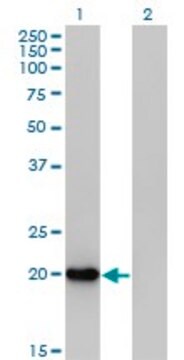
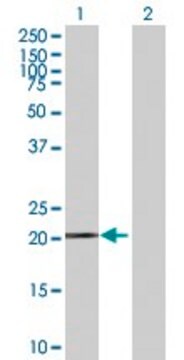
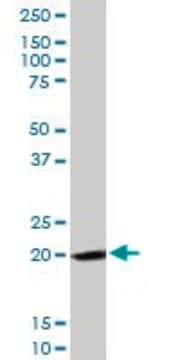
~21 kDa observed. Uncharacterized band may be observed at ~200 kDa

Immunogen

Recombinant protein corresponding to human Ferritin Heavy Chain.

Application

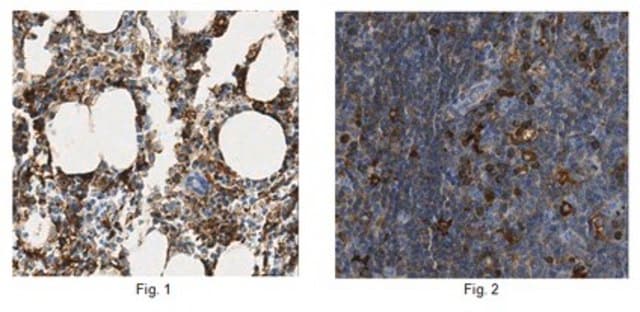
Immunohistochemistry Analysis: A 1:1,000 dilution from a representative lot detected Ferritin Heavy Chain in human bone marrow and human tonsil tissue.
Immunohistochemistry Analysis: A representative lot detected Ferritin Heavy Chain in erythroid blasts of acute myeloid leukaemia M6 tissue, macrophages in the lymph node tissue, and tumor & lung-associated macrophages (Wang, W., et al. (2013). Histopahtology. 62:931–940).
Research Category
Apoptosis & Cancer
Research Sub Category
Apoptosis - Additional
This Anti-Ferritin Heavy Chain Antibody, clone 1-2.3.1.2 is validated for use in Western Blotting and Immunohistochemistry for the detection of Ferritin Heavy Chain.

Physical form

Format: Purified
Protein G Purified
Purified mouse monoclonal IgG2aκ in buffer containing 0.1 M Tris-Glycine (pH 7.4), 150 mM NaCl with 0.05% sodium azide.

Preparation Note

Stable for 1 year at 2-8°C from date of receipt.

Analysis Note

Evaluated by Western Blotting in U251 cell lysate.

Western Blotting Analysis: 0.5 µg/mL of this antibody detected Ferritin Heavy Chain in 10 µg of U251 cell lysate.

Other Notes

Concentration: Please refer to lot specific datasheet.

Disclaimer

Unless otherwise stated in our catalog or other company documentation accompanying the product(s), our products are intended for research use only and are not to be used for any other purpose, which includes but is not limited to, unauthorized commercial uses, in vitro diagnostic uses, ex vivo or in vivo therapeutic uses or any type of consumption or application to humans or animals.
Ta strona może zawierać tekst przetłumaczony maszynowo.

Porównaj podobne pozycje

Wyświetl pełne porównanie

Pokaż różnice

1 of 1

Ta pozycja
SAB1405830F5012SAB4200598
antibody form

purified immunoglobulin

antibody form

purified immunoglobulin

antibody form

whole antiserum

antibody form

purified immunoglobulin

conjugate

unconjugated

conjugate

unconjugated

conjugate

unconjugated

conjugate

unconjugated

species reactivity

human

species reactivity

human

species reactivity

human

species reactivity

human

clone

1-2.3.1.2, monoclonal

clone

polyclonal

clone

polyclonal

clone

FTH24, monoclonal

biological source

mouse

biological source

mouse

biological source

rabbit

biological source

mouse

Gene Information

human ... FTH1(2495)

Gene Information

human ... FTH1(2495)

Gene Information

human ... FTH1(2495)

Gene Information

human ... FTH1(2495)


Still not finding the right product?

Wypróbuj nasze narzędzie Narzędzie selektora produktów, aby zawęzić opcje.


Klasa składowania

12 - Non Combustible Liquids

wgk

WGK 1

flash_point_f

Not applicable

flash_point_c

Not applicable


Certyfikaty analizy (CoA)

Poszukaj Certyfikaty analizy (CoA), wpisując numer partii/serii produktów. Numery serii i partii można znaleźć na etykiecie produktu po słowach „seria” lub „partia”.

Masz już ten produkt?

Dokumenty związane z niedawno zakupionymi produktami zostały zamieszczone w Bibliotece dokumentów.

Odwiedź Bibliotekę dokumentów


Dan Bracha et al.
Cell, 175(6), 1467-1480 (2018-12-01)
Liquid-liquid phase separation plays a key role in the assembly of diverse intracellular structures. However, the biophysical principles by which phase separation can be precisely localized within subregions of the cell are still largely unclear, particularly for low-abundance proteins. Here


Numer pozycji handlu globalnego

SKUNUMER GTIN
MABC60204053252986505

Questions

Reviews

No rating value

Active Filters