Przejdź do zawartości
Merck

Przejdź do

MABC128

Anti-FIP200 Antibody, clone 14E11.2

clone 14E11.2, from mouse

Synonim(y):

RB1-inducible coiled-coil protein, 1FAK family kinase-interacting protein of 200 kDa, FIP200

Zaloguj się, aby wyświetlić ceny organizacyjne i kontraktowe.

Wybierz wielkość

Zmień widok
Gabaryty przesyłkiSKUDostępnośćCena netto
100 μg

Przewidywany termin wysyłki26 maja 2026zKuehne + Nagel Sp. z o.o.

2120,00 zł

Informacje o tej pozycji

UNSPSC Code:
12352203
NACRES:
NA.41
eCl@ss:
32160702
Conjugate:
unconjugated
Clone:
14E11.2, monoclonal
Application:
ICC, WB
Citations:
4

2120,00 zł


Przewidywany termin wysyłki26 maja 2026Szczegóły


Zamów zamówienie zbiorcze
Pomoc techniczna
Potrzebujesz pomocy? Nasz zespół doświadczonych naukowców chętnie Ci pomoże.
Pozwól nam pomóc


biological source

mouse

Quality Level

conjugate

unconjugated

antibody form

purified antibody

antibody product type

primary antibodies

clone

14E11.2, monoclonal

species reactivity

human, mouse

technique(s)

immunocytochemistry: suitable, western blot: suitable

isotype

IgG2bκ

NCBI accession no.

UniProt accession no.

shipped in

wet ice

target post-translational modification

unmodified

Gene Information

human ... RB1CC1(9821)

General description

Focal adhesion kinase family interacting protein of 200 kDa (FIP200) is a novel protein inhibitor for focal adhesion kinase (FAK). FIP200 inhibits kinase activity and associated cellular functions, such as cell adhesion, spreading, and motility in fibroblasts by binding directly to FAK.

The previously assigned protein identifier Q86YR4 has been merged into Q8TDY2. Full details can be found on the UniProt database.
~200 kDa observed. An uncharacterized band may be observed at ~50 kDa in some cell lysates.

Immunogen

Epitope: Interaction domain
GST-tagged recombinant protein corresponding to the interaction domain of human FIP200.

Application

Anti-FIP200 Antibody, clone 14E11.2 is an antibody against FIP200 for use in Western Blotting, ICC.
Research Category
Apoptosis & Cancer
Research Sub Category
Apoptosis - Additional
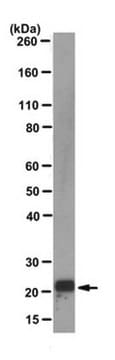
Western Blot Analysis: 1 µg/mL from a representative lot detected FIP200 in serum starved and non-serum starved HeLa cell lysate.

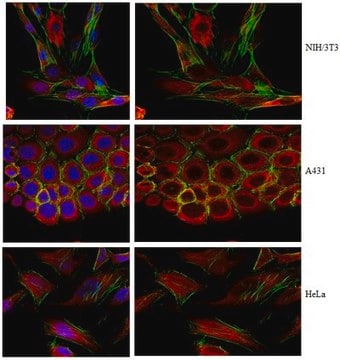
Immunocytochemistry Analysis: A 1:500 dilution from a representative lot detected FIP200 in NIH/3T3, A431, and HeLa cells.

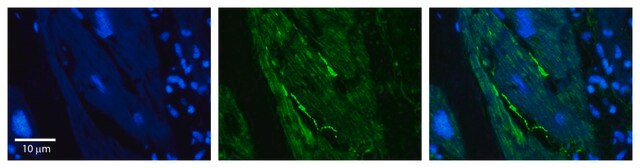
Immunocytochemistry Analysis: A 1:250 dilution from a representative lot detected FIP200 in untreated and chloroquinone-treated HUVEC cells.

Biochem/physiol Actions

This antibody binds to the interaction domain of FIP200, which is needed for the formation of the ULK-FIP200 complex under starved, autophagy conditions.

Physical form

Format: Purified
Protein G Purified
Purified mouse monoclonal IgG2bκ in buffer containing 0.1 M Tris-Glycine (pH 7.4), 150 mM NaCl with 0.05% sodium azide.

Preparation Note

Stable for 1 year at 2-8°C from date of receipt.

Analysis Note

Control
HeLa cell lysate
Evaluated by Western Blot in HeLa cell lysate.

Western Blot Analysis: 1 µg/mL of this antibody detected FIP200 in 10 µg of HeLa cell lysate.

Other Notes

Concentration: Please refer to the Certificate of Analysis for the lot-specific concentration.

Disclaimer

Unless otherwise stated in our catalog or other company documentation accompanying the product(s), our products are intended for research use only and are not to be used for any other purpose, which includes but is not limited to, unauthorized commercial uses, in vitro diagnostic uses, ex vivo or in vivo therapeutic uses or any type of consumption or application to humans or animals.
Ta strona może zawierać tekst przetłumaczony maszynowo.

Porównaj podobne pozycje

Wyświetl pełne porównanie

Pokaż różnice

1 of 1

Ta pozycja
AV50467ZRB1222MABE325
Gene Information

human ... RB1CC1(9821)

Gene Information

human ... RB1CC1(9821)

Gene Information

human ... BECN1(8678)

Gene Information

human ... CDKN1A(1026)

clone

14E11.2, monoclonal

clone

polyclonal

clone

1E22, recombinant monoclonal

clone

EA10, monoclonal

antibody form

purified antibody

antibody form

affinity isolated antibody

antibody form

purified antibody

antibody form

purified immunoglobulin

conjugate

unconjugated

conjugate

unconjugated

conjugate

unconjugated

conjugate

unconjugated

biological source

mouse

biological source

rabbit

biological source

rabbit (recombinant)

biological source

mouse

species reactivity

human, mouse

species reactivity

bovine, dog, human, rat, mouse, guinea pig, horse

species reactivity

human

species reactivity

human


Still not finding the right product?

Wypróbuj nasze narzędzie Narzędzie selektora produktów, aby zawęzić opcje.


Klasa składowania

12 - Non Combustible Liquids

wgk

WGK 1

flash_point_f

Not applicable

flash_point_c

Not applicable


Certyfikaty analizy (CoA)

Poszukaj Certyfikaty analizy (CoA), wpisując numer partii/serii produktów. Numery serii i partii można znaleźć na etykiecie produktu po słowach „seria” lub „partia”.

Masz już ten produkt?

Dokumenty związane z niedawno zakupionymi produktami zostały zamieszczone w Bibliotece dokumentów.

Odwiedź Bibliotekę dokumentów


Produkty

Autophagy is a regulated process involved in cell growth, development, and recycling of cytoplasmic components in cells.


Xiangfei Xue et al.
Clinical and translational medicine, 12(2), e747-e747 (2022-02-28)
Ferroptosis, a form of regulated cell death, is an important topic in the field of cancer research. However, the signalling pathways and factors that sensitise tumour cells to ferroptosis remain elusive. We determined the level of ferroptosis in cells by
Lingyan Wang et al.
Communications biology, 4(1), 921-921 (2021-07-31)
Retinoic acid-inducible gene I (RIG-I) senses viral RNA and instigates an innate immune signaling cascade to induce type I interferon expression. Currently, the regulatory mechanisms controlling RIG-I activation remain to be fully elucidated. Here we show that the FAK family
Hyun-Jeong Yang et al.
Nature communications, 7, 10884-10884 (2016-03-11)
While the formation of myelin by oligodendrocytes is critical for the function of the central nervous system, the molecular mechanism controlling oligodendrocyte differentiation remains largely unknown. Here we identify G protein-coupled receptor 37 (GPR37) as an inhibitor of late-stage oligodendrocyte


Numer pozycji handlu globalnego

SKUNUMER GTIN
MABC12804053252698811

Questions

Reviews

No rating value

Active Filters