Przejdź do zawartości
Merck

Przejdź do

MABC1115

Anti-PD-L1 Antibody, clone 5H1

clone 5H1, from mouse

Synonim(y):

Programmed cell death 1 ligand 1, B7-H1, B7 homolog 1, CD274, PDCD1 ligand 1, Programmed death ligand 1

Zaloguj się, aby wyświetlić ceny organizacyjne i kontraktowe.

Wybierz wielkość

Zmień widok
Gabaryty przesyłkiSKUDostępnośćCena netto
25 μL

Przewidywany termin wysyłki02 czerwca 2026zKuehne + Nagel Sp. z o.o.

750,00 zł
100 μL

Dostępne do wysyłki DZISIAJzKuehne + Nagel Sp. z o.o.

2090,00 zł

Informacje o tej pozycji

UNSPSC Code:
12352203
NACRES:
NA.41
eCl@ss:
32160702
Conjugate:
unconjugated
Clone:
5H1, monoclonal
Application:
ICC, IHC, WB
Citations:
-

750,00 zł


Przewidywany termin wysyłki02 czerwca 2026Szczegóły


Zamów zamówienie zbiorcze
Pomoc techniczna
Potrzebujesz pomocy? Nasz zespół doświadczonych naukowców chętnie Ci pomoże.
Pozwól nam pomóc


biological source

mouse

conjugate

unconjugated

antibody form

purified immunoglobulin

antibody product type

primary antibodies

clone

5H1, monoclonal

species reactivity

human

packaging

antibody small pack of 25 μL

technique(s)

immunocytochemistry: suitable, immunohistochemistry: suitable (paraffin), western blot: suitable

isotype

IgG1κ

NCBI accession no.

UniProt accession no.

target post-translational modification

unmodified

Gene Information

human ... CD274(29126)

General description

33.28 kDa calculated.
Programmed cell death 1 ligand 1 (UniProt Q9NZQ7; also known as B7-H1, B7 homolog 1, CD274, PD-L1, PDCD1 ligand 1, Programmed death ligand 1) is encoded by the CD274 (also known as B7H1, PDCD1L1, PDCD1LG1, PDL1) gene (Gene ID 29126) in human. PD-L1 is a single-pass type I membrane protein that plays a critical role in induction and maintenance of immune tolerance to self. It is expressed on activated T- and B-cells, dendritic cells, keratinocytes, and monocytes. Higher expression has also been reported in heart, skeletal muscle, placenta, and lung. PD-1 and PD-1 ligands 1 and 2 (PD-L1 and PD-L2) are B7:CD28 family members that regulate T cell activation and peripheral tolerance. When engaged together with the TCR, the interaction of PD-1 with its ligands delivers an inhibitory signal to T cell proliferation and cytokine production. While PD-L1 is broadly expressed in hematopoietic and nonhematopoietic cells, PD-L2 expression is highly restricted to antigen presenting cells (APCs), including dendritic cells (DCs) and macrophages. The PD-1 pathway plays a key role in the progressive loss of effector T cell responses during chronic HIV infection. Under some conditions, blockade of this pathway can restore many T cell functions. PD-L1 is initially produced with signal peptide (aa 1-18) sequence, which is subsequently cleaved off to produce the mature protein with a large extracellular (aa 19-238) region that contains an Ig-like V-type domain (aa 19-127) and an Ig-like C2-type domain (aa 133-225), followed by a transmembrane domain (aa 239-259) and a cytoplasmic tail (aa 260-290).

Immunogen

Full-length human recombinant PD-L1.
Epitope: extracellular domain

Application

Anti-PD-L1, clone 5H1, Cat. No. MABC1115, is a mouse monoclonal antibody that detects PD-L1 and has been tested for use in Immunocytochemistry, Immunohistochemistry (Paraffin), and Western Blotting.
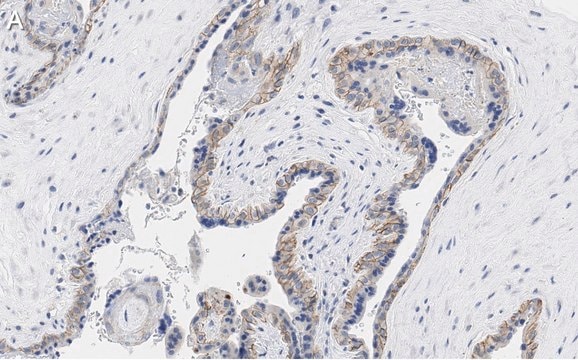
Immunohistochemistry (Paraffin) Analysis: A representative lot detected PD-L1 in Immunohistochemistry applications (Bigelow, E., et. al. (2013). J Vis Exp. 3;(71); Spranger, S., et. al. (2013). Sci Transl Med. 5(200):200ra116; Parra, E.R., et. al. (2018). Appl Immunohistochem Mol Morphol. 26(2):83-93; Andorsky, D.J., et. al. (2011). Clin Cancer Res. 17(13):4232-44; Sunshine, J.C., et. al. (2017). Clin Cancer Res. 23(16):4938-4944).

Western Blotting Analysis: A representative lot detected PD-L1 in Western Blotting applications (Parra, E.R., et. al. (2018). Appl Immunohistochem. Mol. Morphol. 26(2):83-93_.
Research Category
Apoptosis & Cancer

Biochem/physiol Actions

Clone 5H1 detects human Programmed cell death ligand 1 (PD-L1). It targets an epitope with in the extracellular domain.

Physical form

Format: Purified
Protein G purified
Purified mouse monoclonal antibody IgG1 in PBS without azide.

Preparation Note

Stable for 1 year at -20°C from date of receipt. Handling Recommendations: Upon receipt and prior to removing the cap, centrifuge the vial and gently mix the solution. Aliquot into microcentrifuge tubes and store at -20°C. Avoid repeated freeze/thaw cycles, which may damage IgG and affect product performance.

Analysis Note

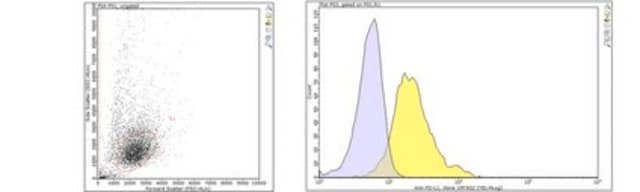
Evaluated by Immunocytochemistry in MDA-MB-231 cells.

Immunocytochemistry Analysis: A 1:50 dilution of this antibody detected PD-L1 in MDA-MB-231 cells.

Other Notes

Concentration: Please refer to lot specific datasheet.

Disclaimer

Unless otherwise stated in our catalog or other company documentation accompanying the product(s), our products are intended for research use only and are not to be used for any other purpose, which includes but is not limited to, unauthorized commercial uses, in vitro diagnostic uses, ex vivo or in vivo therapeutic uses or any type of consumption or application to humans or animals.
Ta strona może zawierać tekst przetłumaczony maszynowo.

Porównaj podobne pozycje

Wyświetl pełne porównanie

Pokaż różnice

1 of 1

Ta pozycja
ABF133MABC991ZRB1026
Gene Information

human ... CD274(29126)

Gene Information

human ... CD274(29126)

Gene Information

-

Gene Information

human ... CD274(29126)
mouse ... Cd274(60533)

antibody form

purified immunoglobulin

antibody form

affinity isolated antibody

antibody form

purified antibody

antibody form

purified antibody

conjugate

unconjugated

conjugate

unconjugated

conjugate

unconjugated

conjugate

unconjugated

biological source

mouse

biological source

rabbit

biological source

rat

biological source

rabbit (recombinant)

clone

5H1, monoclonal

clone

polyclonal

clone

10F.9G2, monoclonal

clone

3O12, recombinant monoclonal

species reactivity

human

species reactivity

human

species reactivity

mouse

species reactivity

human, mouse


Still not finding the right product?

Wypróbuj nasze narzędzie Narzędzie selektora produktów, aby zawęzić opcje.


Certyfikaty analizy (CoA)

Poszukaj Certyfikaty analizy (CoA), wpisując numer partii/serii produktów. Numery serii i partii można znaleźć na etykiecie produktu po słowach „seria” lub „partia”.

Masz już ten produkt?

Dokumenty związane z niedawno zakupionymi produktami zostały zamieszczone w Bibliotece dokumentów.

Odwiedź Bibliotekę dokumentów


Numer pozycji handlu globalnego

SKUNUMER GTIN
MABC1115-100UL04054839613760
MABC1115-25UL04054839613777

Questions

Reviews

No rating value

Active Filters