Przejdź do zawartości
Merck

Przejdź do

MAB874

Anti-Papillomavirus Antibody, 16, 18 E6 protein, clone C1P5

clone C1P5, Chemicon®, from mouse

Synonim(y):

HPV

Zaloguj się, aby wyświetlić ceny organizacyjne i kontraktowe.

Wybierz wielkość

Zmień widok
Gabaryty przesyłkiSKUDostępnośćCena netto
100 μg
Sprawdź dostępność w koszyku
1940,00 zł

Informacje o tej pozycji

UNSPSC Code:
12352203
NACRES:
NA.41
eCl@ss:
32160702
Clone:
C1P5, monoclonal
Species reactivity:
human
Application:
IHC, WB
Citations:
15

1940,00 zł


Sprawdź dostępność w koszyku

Zamów zamówienie zbiorcze
Pomoc techniczna
Potrzebujesz pomocy? Nasz zespół doświadczonych naukowców chętnie Ci pomoże.
Pozwól nam pomóc


biological source

mouse

Quality Level

antibody form

purified immunoglobulin

antibody product type

primary antibodies

clone

C1P5, monoclonal

species reactivity

human

manufacturer/tradename

Chemicon®

technique(s)

immunohistochemistry: suitable, western blot: suitable

isotype

IgG

shipped in

wet ice

General description

16.5-18 kDa
Human papilloma viruses (HPVs) can be classified as either high risk or low risk according to their association with cancer. HPV16 and HPV18 are the most common of the high risk group while HPV6 and HPV11 are among the low risk types. Approximately 90% of cervical cancers contain HPV DNA of the high risk types. Mutational analysis have shown that the E6 and E7 genes of the high risk HPVs are necessary and sufficient for HPV transforming function. The specific interactions of the E6 and E7 proteins with p53 and pRB, respectively, correlate with HPV high and low risk classifications. The high risk HPV E7 proteins bind to pRB with a higher affinity than do the low risk HPV proteins, and only the high risk HPV E6 proteins form detectable complexes with p53 in vitro.

Immunogen

C1P5 was made against HPV type 18 E6 protein produced in bacteria.
Epitope: 16, 18 E6 protein

Application

Detect Papillomavirus using this Anti-Papillomavirus Antibody, 16, 18 E6 protein, clone C1P5 validated for use in IH & WB.
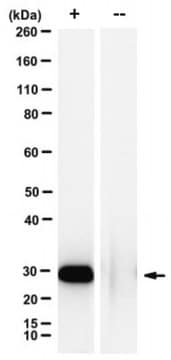
Immunoblotting: Reactive with a 16.5-18 kDa band in reduced westerns of overexpressing cells lines corresponding to HPV E6 protein in cells derived from human cervical carcinoma. {Banks, et al 1987}

Immunohistochemistry: Shows reactivity on formalin fixed tissue. Dilute with buffer pH 7.5-8.0 to desired working volumes. For extensive dilution, protein containing or other stabilizing medium should be used.

Immunopreciptiation: Immunoprecipiates 16.5 kDa band from human cervical carcinoma extracts {Banks, et al, 1987}.

Final working dilutions must be determined by end user.
Research Category
Infectious Diseases
Research Sub Category
Infectious Diseases - Viral

Biochem/physiol Actions

Recognizes Human papilloma virus type 18 early E6 protein. The antibody cross reacts with E6 protein from HPV type 16.

Physical form

Format: Purified
Protein A Purified mouse immunoglobulin in 20 mM sodium phosphate, 250 mM NaCl, pH. 7.6, with 0.1% sodium azide as a preservative.
Protein A purified

Preparation Note

Maintain for 1 year at 2–8°C from date of shipment. For maximum recovery of product, centrifuge the original vial after thawing and prior to removing the cap.

Analysis Note

Control
Human cervical carcinoma extract

Other Notes

Concentration: Please refer to the Certificate of Analysis for the lot-specific concentration.

Legal Information

CHEMICON is a registered trademark of Merck KGaA, Darmstadt, Germany

Disclaimer

Unless otherwise stated in our catalog or other company documentation accompanying the product(s), our products are intended for research use only and are not to be used for any other purpose, which includes but is not limited to, unauthorized commercial uses, in vitro diagnostic uses, ex vivo or in vivo therapeutic uses or any type of consumption or application to humans or animals.
Ta strona może zawierać tekst przetłumaczony maszynowo.

Porównaj podobne pozycje

Wyświetl pełne porównanie

Pokaż różnice

1 of 1

Ta pozycja
MAB885MABC1639MAB837
species reactivity

human

species reactivity

human

species reactivity

human

species reactivity

human

antibody form

purified immunoglobulin

antibody form

purified antibody

antibody form

purified antibody

antibody form

purified antibody

biological source

mouse

biological source

mouse

biological source

mouse

biological source

mouse

clone

C1P5, monoclonal

clone

Cam Vir-1, monoclonal

clone

3C10G8, monoclonal

clone

1H8, monoclonal

shipped in

wet ice

shipped in

wet ice

shipped in

2-8°C

shipped in

wet ice

technique(s)

immunohistochemistry: suitable, western blot: suitable

technique(s)

immunohistochemistry: suitable (paraffin), immunoprecipitation (IP): suitable, western blot: suitable

technique(s)

immunocytochemistry: suitable, immunofluorescence: suitable, immunoprecipitation (IP): suitable, western blot: suitable

technique(s)

ELISA: suitable, immunohistochemistry: suitable, western blot: suitable


Still not finding the right product?

Wypróbuj nasze narzędzie Narzędzie selektora produktów, aby zawęzić opcje.


Klasa składowania

12 - Non Combustible Liquids

wgk

WGK 2

flash_point_f

Not applicable

flash_point_c

Not applicable


Certyfikaty analizy (CoA)

Poszukaj Certyfikaty analizy (CoA), wpisując numer partii/serii produktów. Numery serii i partii można znaleźć na etykiecie produktu po słowach „seria” lub „partia”.

Masz już ten produkt?

Dokumenty związane z niedawno zakupionymi produktami zostały zamieszczone w Bibliotece dokumentów.

Odwiedź Bibliotekę dokumentów


Ni Sima et al.
PloS one, 8(9), e74594-e74594 (2013-09-24)
NEDD9, a focal adhesion scaffolding protein, has been recently proposed to regulate invasion and metastasis in some cancer types, but unknown in cervical cancer. The aim of this study was to determine if NEDD9 was involved in the progression and
Hannah N Coleman et al.
ISRN obstetrics and gynecology, 2012, 854237-854237 (2012-04-24)
CD8 T-cell responses were examined in subjects with incident (new following negative visits) or prevalent (lasting ≥ 4 months) human papillomavirus type 16 (HPV16) or human papillomavirus (HPV18) infection. The groups were chosen from a cohort of women being followed
L Banks et al.
The Journal of general virology, 68 ( Pt 5), 1351-1359 (1987-05-01)
We recently reported the expression of human papillomavirus type 18 (HPV-18) E6 protein in bacteria and the production of anti-E6 polyclonal antibodies. This work has now been extended with the production of a panel of monoclonal antibodies against the HPV-18


Numer pozycji handlu globalnego

SKUNUMER GTIN
MAB87404053252358715

Questions

Reviews

No rating value

Active Filters