
MAB3560-C

Anti-8-Oxoguanine, clone 483.15 Antibody (Ascites Free)
clone 483.15, from mouse
Synonim(y):
8-Oxoguanine
Wybierz wielkość
| Gabaryty przesyłki | SKU | Dostępność | Cena netto |
|---|---|---|---|
| 100 μg | Dostępne do wysyłki DZISIAJzKuehne + Nagel Sp. z o.o. | 2600,00 zł |
Informacje o tej pozycji
biological source
mouse
Quality Segment
antibody form
purified immunoglobulin
antibody product type
primary antibodies
clone
483.15, monoclonal
species reactivity
rat, human, monkey, bovine, mouse
species reactivity (predicted by homology)
all
technique(s)
ELISA: suitable, immunocytochemistry: suitable, immunohistochemistry: suitable
isotype
IgMκ
shipped in
dry ice
target post-translational modification
unmodified
Gene Information
human ... OGG1(4968)
General description
Immunogen
Application
Immunohistochemistry Analysis: A representative lot detected increased nuclear 8-oxoguanine (8-oxoG) immunoreactivity in paraffin-embedded coronal hippocampus sections from mice induced to express mutated mitochondrial isoform Uracil–DNA glycosylase by fluorescent immunohistochemistry (Lauritzen, K.H., et al. (2011). DNA Repair (Amst). 10(6):639-653).
Immunohistochemistry Analysis: A representative lot detected significantly increased nuclear 8-oxoguanine (8-oxoG) immunoreactivity in ovaries excised from neonatal mice upon exposure to ovotoxic agent 4-vinylcyclohexene diepoxide (VCD), methoxychlor (MXC), or menadione (MEN) in culture by fluorescent immunohistochemistry (Sobinoff, A.P., et al. (2010). Toxicol. Sci. 118(2):653-666).
Immunocytochemistry Analysis: A representative lot detected significantly increased 8-oxoguanine (8-oxoG) immunoreactivity in RINm5F rat insulinoma cells upon IL-1beta or ROS-inducer menadione treatment (Mehmeti, I., et al. (2011). Biochim. Biophys. Acta. 1813(10):1827-1835).
Immunocytochemistry Analysis: A representative lot detected significantly increased nuclear 8-oxoguanine (8-oxoG) immunoreactivity in AC16 human cardiomyocytes upon infection by the hemoflagellate protozoan parasite Trypanosoma cruzi (Ba, X., et al. (2010). J. Biol. Chem. 285(15):11596-11606).
Immunocytochemistry Analysis: Representative lots detected nutrient-deprivation-induced enhancement of nuclear 8-oxoguanine (8-oxoG) immunoreactivity in HeLa and COS-7 cells by fluorescent immunocytochemistry (Conlon, K.A., et al. (2003). DNA Repair (Amst). 2(12):1337-1352; Conlon, K.A., et al. (2000). J. Histotechnol. 23(1):37-44).
ELISA Analysis: Specificity of a representative lot against 8-oxoguanine was confirmed by competitive ELISA. Competition by dGMP, dAMP, dCMP or TMP was only observed when the concentrations were increased to the millimolar range.
Biochem/physiol Actions
Physical form
Analysis Note
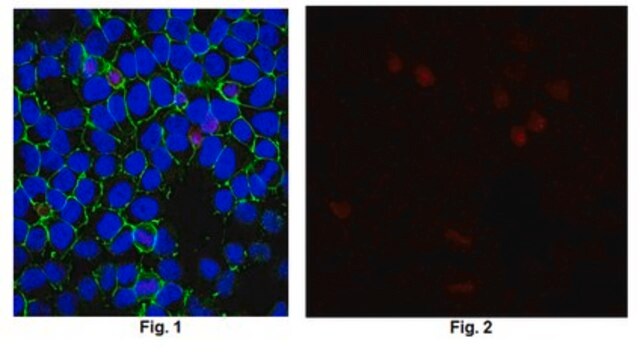
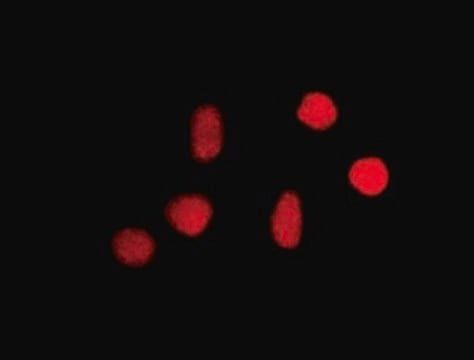
Immunocytochemistry Analysis: A 1:50 dilution of this antibody detected 8-Oxoguanine in HeLa cells.
Other Notes
1 of 1
Ta pozycja | |||
|---|---|---|---|
| biological source mouse | biological source mouse | biological source goat | biological source mouse |
| Gene Information human ... OGG1(4968) | Gene Information human ... OGG1(4968) | Gene Information - | Gene Information - |
| antibody form purified immunoglobulin | antibody form ascites fluid | antibody form serum | antibody form purified antibody |
| clone 483.15, monoclonal | clone 483.15, monoclonal | clone polyclonal | clone NO2-52, monoclonal |
| species reactivity rat, human, monkey, bovine, mouse | species reactivity monkey, human, primate | species reactivity human | species reactivity mouse, rat |
| Quality Level 100 | Quality Level 100 | Quality Level 100 | Quality Level 100 |


Still not finding the right product?
Wypróbuj nasze narzędzie Narzędzie selektora produktów, aby zawęzić opcje.
Klasa składowania
12 - Non Combustible Liquids
wgk
WGK 2
flash_point_f
Not applicable
flash_point_c
Not applicable
Certyfikaty analizy (CoA)
Poszukaj Certyfikaty analizy (CoA), wpisując numer partii/serii produktów. Numery serii i partii można znaleźć na etykiecie produktu po słowach „seria” lub „partia”.
Masz już ten produkt?
Dokumenty związane z niedawno zakupionymi produktami zostały zamieszczone w Bibliotece dokumentów.
Powiązane treści
"Mods – modifications – small alterations can have a big impact on form and function. In the motorsports world, stock vehicles are modified to enhance their performance. Modifications, or mods, to the engine, drive train, intake and exhaust components add up to provide phenomenal performance gains that can be measured as horsepower and torque increases, which yield a competitive advantage, and result in reduced run times. In biology, proteins undergo modifications that alter their function. Some proteins require the modifications in order to perform their function effectively, whether it’s a pro-protein that is cleaved to produce an active enzyme, or a protein that is phosphorylated to facilitate a signaling process. Other proteins, such as histones, undergo modifications that regulate gene expression and alter cellular function. There are several post translational modifications such as acetylation, methylation, phosphorylation, and ubiquitination that impact protein function and activity. As a result, the analysis of proteins and their post-translational modifications are particularly important for the study of normal and disease-associated processes. New antibodies to detect phospho Histidines are now available from EMD Millipore."
Alzheimer’s Disease is a progressively deteriorating disease. It manifests itself with memory loss, confusion, problems with judgment, planning, concentration, and personality changes; and in it’s later stages, a decline in physical abilities. The disease’s causes, cures, and preventions are unknown; however, key proteins likely involved in the degenerative mechanism have been identified. Alzheimer’s Disease is characterized by neuronal loss, alterations in neurotransmitter systems, and the presence of neurofibrillary tangles composed of abnormally hyperphosphorylated tau proteins. A prominent feature of Alzheimer’s Disease is the formation of senile plaques in selected regions of the brain. The center of these plaques are composed mainly of fibrillary aggregates of a common, but not well understood, b amyloid peptides (Aβ). The Aβ peptides are generated from the larger amyloid-β precursor protein (APP) by the sequential action of β- and γ-secretase, and it is generally accepted that oligomeric forms of this Aβ are neurotoxic, resulting in disease progression.
Numer pozycji handlu globalnego
| SKU | NUMER GTIN |
|---|---|
| MAB3560-C | 04055977296419 |