Przejdź do zawartości
Merck

Przejdź do

CBL412X

Anti-Tubulin β-III Antibody, clone TU-20, Alexa Fluor488 Conjugated

clone TU-20, from mouse, ALEXA FLUOR 488

Synonim(y):

Tubulin beta-4, Tubulin beta-III, tubulin, beta 3, tubulin, beta 4

Zaloguj się, aby wyświetlić ceny organizacyjne i kontraktowe.

Wybierz wielkość

Zmień widok
Gabaryty przesyłkiSKUDostępnośćCena netto
40 μL

Przewidywany termin wysyłki20 maja 2026zKuehne + Nagel Sp. z o.o.

2310,00 zł

Informacje o tej pozycji

UNSPSC Code:
12352203
NACRES:
NA.41
eCl@ss:
32160702
Conjugate:
ALEXA FLUOR 488
Clone:
TU-20, monoclonal
Application:
ICC, IF, IHC, IP, WB
Citations:
4

2310,00 zł


Przewidywany termin wysyłki20 maja 2026Szczegóły


Zamów zamówienie zbiorcze
Pomoc techniczna
Potrzebujesz pomocy? Nasz zespół doświadczonych naukowców chętnie Ci pomoże.
Pozwól nam pomóc


biological source

mouse

Quality Level

conjugate

ALEXA FLUOR 488

antibody form

purified immunoglobulin

antibody product type

primary antibodies

clone

TU-20, monoclonal

species reactivity

human, mouse, pig, bovine, primate, rat

technique(s)

immunocytochemistry: suitable, immunofluorescence: suitable, immunohistochemistry: suitable, immunoprecipitation (IP): suitable, western blot: suitable

isotype

IgG1

NCBI accession no.

UniProt accession no.

shipped in

wet ice

target post-translational modification

unmodified

Gene Information

human ... TUBB3(10381)

General description

50 kDa
Tubulin is one of several members of a small family of globular proteins which polymerize to form cytoskeletal structures called microtubules. The most common members of the tubulin family are α-tubulin and β-tubulin. Tubulin dimers, typically composed of α- and β-tubulin subunits, assemble onto microtubules forming large polymers. β-III tubulin is a unique microtubule subunit that is found expressed almost exclusively in neurons. Due to the unique expression pattern of β-III tubulin it is often utilized as a marker to identify neuronal cells from other brain cells such as glia which do not express it. β-III tubulin also serves as a cytoarchitectural marker since it is primarily found within neurite extensions.

Immunogen

Epitope: C-terminus

Application

Detect Tubulin β-III using this Anti-Tubulin β-III Antibody, clone TU-20, Alexa Fluor488 Conjugated validated for use in IC, IF, WB, IH & IP.
Immunohistochemistry: 5-10 µg/mL on frozen brain tissue.
Although this conjugated antibody will work for Western blotting and Immunoprecipitation, we recommend catalog number CBL412 if these are your primary applications.
Optimal working concentration must be determined by end user.
Research Category
Neuroscience
Research Sub Category
Neurofilament & Neuron Metabolism

Biochem/physiol Actions

Reactivity with other species has not been determined.
This antibody reacts with the C-terminus of the beta-III isoform of tubulin, which is known to be neuron specific. Does not identify beta tubulin found in glial cells.

Physical form

Protein G Purified
Purified immunoglobulin in 0.02M Phosphate buffer, 0.25M NaCl containing 0.05% sodium azide.

Preparation Note

Stable for 6 months at 2-8°C from date of receipt.

Analysis Note

Control
Rat Cortex Cells.
Routinely tested cortical neurons in Immunocytochemistry.
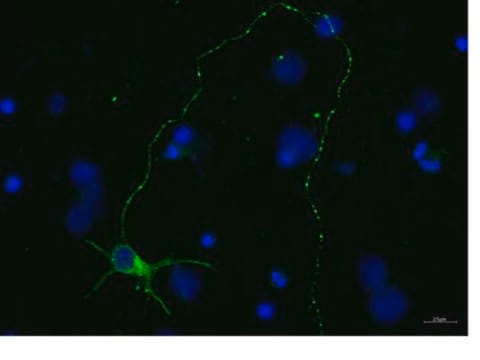
Immunocytochemical Analysis: 1:250 dilution of this lot detected β-III tubulin in rat cortex cell culture.

Other Notes

Concentration: Please refer to the Certificate of Analysis for the lot-specific concentration.

Legal Information

ALEXA FLUOR is a trademark of Life Technologies

Disclaimer

Unless otherwise stated in our catalog or other company documentation accompanying the product(s), our products are intended for research use only and are not to be used for any other purpose, which includes but is not limited to, unauthorized commercial uses, in vitro diagnostic uses, ex vivo or in vivo therapeutic uses or any type of consumption or application to humans or animals.
Ta strona może zawierać tekst przetłumaczony maszynowo.

Porównaj podobne pozycje

Wyświetl pełne porównanie

Pokaż różnice

1 of 1

Ta pozycja
T8578SAB4500088T8328
biological source

mouse

biological source

mouse

biological source

rabbit

biological source

mouse

conjugate

ALEXA FLUOR 488

conjugate

unconjugated

conjugate

unconjugated

conjugate

unconjugated

antibody form

purified immunoglobulin

antibody form

purified from hybridoma cell culture

antibody form

affinity isolated antibody

antibody form

purified from hybridoma cell culture

Gene Information

human ... TUBB3(10381)

Gene Information

human ... TUBB3(10381)
mouse ... Tubb3(22152)
rat ... Tubb3(246118)

Gene Information

human ... TUBB3(10381)

Gene Information

human ... TUBB(203068)

species reactivity

human, mouse, pig, bovine, primate, rat

species reactivity

human, mouse, rat

species reactivity

human, mouse, rat

species reactivity

human, mouse, rat, bovine

clone

TU-20, monoclonal

clone

2G10, monoclonal

clone

polyclonal

clone

AA2, monoclonal


Still not finding the right product?

Wypróbuj nasze narzędzie Narzędzie selektora produktów, aby zawęzić opcje.


Klasa składowania

12 - Non Combustible Liquids

wgk

WGK 2


Certyfikaty analizy (CoA)

Poszukaj Certyfikaty analizy (CoA), wpisując numer partii/serii produktów. Numery serii i partii można znaleźć na etykiecie produktu po słowach „seria” lub „partia”.

Masz już ten produkt?

Dokumenty związane z niedawno zakupionymi produktami zostały zamieszczone w Bibliotece dokumentów.

Odwiedź Bibliotekę dokumentów


Shin-Ichiro Sekine et al.
Stem cell research, 24, 40-43 (2017-10-17)
Idiopathic basal ganglia calcification (IBGC), also known as Fahr disease or primary familial brain calcifications (PFBC), is a rare neurodegenerative disorder characterized by calcium deposits in basal ganglia and other brain regions, causing neuropsychiatric and motor symptoms. We established human
Angela R Dixon et al.
Toxicology in vitro : an international journal published in association with BIBRA, 29(3), 564-574 (2015-01-03)
With m-Dinitrobenzene (m-DNB) as a selected model neurotoxicant, we demonstrate how to assess neurotoxicity, using morphology based measurement of neurite degeneration, in a conventional "full-contact" and a modern "restricted-contact" co-culture of rat cortical neurons and astrocytes. In the "full-contact" co-culture
Elena Romano et al.
Stem cell research, 57, 102580-102580 (2021-10-24)
Human induced pluripotent stem cells (iPSCs) have great promise in regenerative medicine. However, several limitations, including immune-incompatibility, have raised concerns regarding their clinical application. Recent studies have shown that human iPSCs and their derivatives lose their immunogenicity when major histocompatibility


Numer pozycji handlu globalnego

SKUNUMER GTIN
CBL412X04053252371592

Questions

Reviews

No rating value

Active Filters