Przejdź do zawartości
Merck

Przejdź do

ABN76

Anti-Neurofilament H (200 kDa) Antibody

rabbit polyclonal

Synonim(y):

Neurofilament heavy polypeptide, Neurofilament H

Zaloguj się, aby wyświetlić ceny organizacyjne i kontraktowe.

Wybierz wielkość

Zmień widok
Gabaryty przesyłkiSKUDostępnośćCena netto
100 μg

Przewidywany termin wysyłki15 maja 2026zKuehne + Nagel Sp. z o.o.

1950,00 zł

Informacje o tej pozycji

UNSPSC Code:
12352203
eCl@ss:
32160702
NACRES:
NA.41
Clone:
polyclonal
Species reactivity:
mouse, human, rat, bovine
Application:
IHC, WB
Citations:
3

1950,00 zł


Przewidywany termin wysyłki15 maja 2026Szczegóły

Rekombinowane, niezawierające konserwantów przeciwciało jest dostępne dla Twojego celu. Wypróbuj ZRB1347

Zamów zamówienie zbiorcze
Pomoc techniczna
Potrzebujesz pomocy? Nasz zespół doświadczonych naukowców chętnie Ci pomoże.
Pozwól nam pomóc


Nazwa produktu

Anti-Neurofilament H (200 kDa) Antibody, from rabbit, purified by affinity chromatography

biological source

rabbit

Quality Level

antibody form

affinity isolated antibody

antibody product type

primary antibodies

clone

polyclonal

purified by

affinity chromatography

species reactivity

mouse, human, rat, bovine

technique(s)

immunohistochemistry: suitable (paraffin), western blot: suitable

NCBI accession no.

UniProt accession no.

shipped in

wet ice

target post-translational modification

unmodified

Gene Information

bovine ... Nefh(528842)
human ... NEFH(4744)
mouse ... Nefh(380684)
rat ... Nefh(24587)

General description

Neurofilaments are a type of intermediate filament that serve as major elements of the cytoskeleton supporting the axon cytoplasm. They are the most abundant fibrillar components of the axon, being on average 3-10 times more frequent than axonal microtubules. Neurofilaments (10nm in dia.) are built from three intertwined protofibrils which are themselves composed of two tetrameric protofilament complexes of monomeric proteins. The neurofilament triplet proteins (68/70, 160, and 200 kDa) occur in both the central and peripheral nervous system and are usually neuron specific. The 68/70 kDa NF-L protein can self-assemble into a filamentous structure, however the 160 kDa NF-M and 200 kDa NF-H proteins require the presence of the 68/70 kDa NF-L protein to co-assemble. Neuromas, ganglioneuromas, gangliogliomas, ganglioneuroblastomas and neuroblastomas stain positively for neurofilaments. Although typically restricted to neurons, neurofilaments have been detected in paragangliomas, adrenal and extra-adrenal pheochromocytomas, carcinoids, neuroendocrine carcinomas of the skin, and oat cell carcinomas of the lung. For moreinformation, see the Nervous System Cell Type Specific Marker chart on the Millipore website.
~200 kDa observed

Immunogen

GST-tagged recombinant protein corresponding to bovine Neurofilament H.

Application

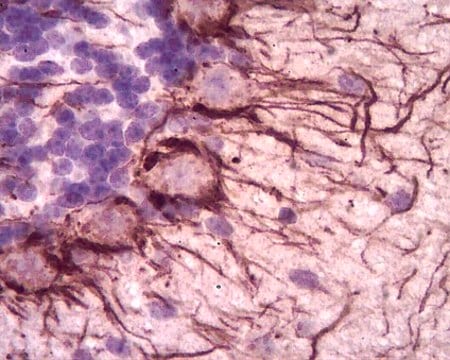
Immunohistochemistry Analysis: A 1 µg/mL dilution from a representative lot detected Neurofilament H in normal rat cerebellum tissue.
This Anti-Neurofilament H (200 kDa) Antibody is validated for use in WB, IH(P) for the detection of Neurofilament H (200 kDa).

Analysis Note

Control
Bovine cerebellum tissue lysate
Evaluated by Western Blot in bovine cerebellum tissue lysate.

Western Blot Analysis: 0.1 µg/mL of this antibody detected Neurofilament H in bovine cerebellum tissue lysate.

Other Notes

Concentration: Please refer to the Certificate of Analysis for the lot-specific concentration.
Replaces: AB1982
Ta strona może zawierać tekst przetłumaczony maszynowo.

Porównaj podobne pozycje

Wyświetl pełne porównanie

Pokaż różnice

1 of 1

Ta pozycja
MAB5266MAB5256AB1991
Quality Level

100

Quality Level

100, 300

Quality Level

100

Quality Level

100

antibody form

affinity isolated antibody

antibody form

purified immunoglobulin

antibody form

purified immunoglobulin

antibody form

serum

biological source

rabbit

biological source

mouse

biological source

mouse

biological source

rabbit

species reactivity

mouse, human, rat, bovine

species reactivity

human, mouse, monkey, rat, pig

species reactivity

rat, pig, human

species reactivity

avian, reptile

Gene Information

bovine ... Nefh(528842)
human ... NEFH(4744)
mouse ... Nefh(380684)
rat ... Nefh(24587)

Gene Information

human ... NEFH(4744)
mouse ... Nefh(380684)
pig ... Nefh(100156492)
rat ... Nefh(24587)
rhesus monkey ... Nefh(717705)

Gene Information

human ... NEFH(4744)
pig ... Nefh(100156492)
rat ... Nefh(24587)

Gene Information

human ... NEFH(4744)

clone

polyclonal

clone

N52, monoclonal

clone

NE14, monoclonal

clone

polyclonal


Still not finding the right product?

Explore all of our products under

lub

Wypróbuj nasze narzędzie Narzędzie selektora produktów, aby zawęzić opcje.


Klasa składowania

12 - Non Combustible Liquids

wgk

WGK 1

flash_point_f

Not applicable

flash_point_c

Not applicable


Certyfikaty analizy (CoA)

Poszukaj Certyfikaty analizy (CoA), wpisując numer partii/serii produktów. Numery serii i partii można znaleźć na etykiecie produktu po słowach „seria” lub „partia”.

Masz już ten produkt?

Dokumenty związane z niedawno zakupionymi produktami zostały zamieszczone w Bibliotece dokumentów.

Odwiedź Bibliotekę dokumentów


Greg A Weir et al.
Brain : a journal of neurology, 140(10), 2570-2585 (2017-10-04)
See Basbaum (doi:10.1093/brain/awx227) for a scientific commentary on this article. Peripheral neuropathic pain arises as a consequence of injury to sensory neurons; the development of ectopic activity in these neurons is thought to be critical for the induction and
Allison M Barry et al.
Pain, 164(10), 2196-2215 (2023-06-15)
Dorsal root ganglia (DRG) neurons have been well described for their role in driving both acute and chronic pain. Although nerve injury is known to cause transcriptional dysregulation, how this differs across neuronal subtypes and the impact of sex is
Ana Feliú et al.
The Journal of neuroscience : the official journal of the Society for Neuroscience, 37(35), 8385-8398 (2017-07-29)
The failure to undergo remyelination is a critical impediment to recovery in multiple sclerosis. Chondroitin sulfate proteoglycans (CSPGs) accumulate at demyelinating lesions creating a nonpermissive environment that impairs axon regeneration and remyelination. Here, we reveal a new role for 2-arachidonoylglycerol


Numer pozycji handlu globalnego

SKUNUMER GTIN
ABN7604053252632051

Questions

Reviews

No rating value

Active Filters