Przejdź do zawartości
Merck

Przejdź do

ABN492

Anti-EPAC2 Antibody

from rabbit, purified by affinity chromatography

Synonim(y):

Rap guanine nuclear exchange factor 4, RAPGEF4, cAMPGEF-II, CGEF2, Exchange factor directly activated by cAMP 2

Zaloguj się, aby wyświetlić ceny organizacyjne i kontraktowe.

Informacje o tej pozycji

UNSPSC Code:
12352203
NACRES:
NA.41
eCl@ss:
32160702
Conjugate:
unconjugated
Clone:
polyclonal
Application:
IHC, WB
Citations:
2


biological source

rabbit

Quality Level

conjugate

unconjugated

antibody form

affinity isolated antibody

antibody product type

primary antibodies

clone

polyclonal

purified by

affinity chromatography

species reactivity

mouse, rat

species reactivity (predicted by homology)

human (immunogen homology)

technique(s)

immunohistochemistry: suitable, western blot: suitable

UniProt accession no.

shipped in

wet ice

target post-translational modification

unmodified

Gene Information

human ... RAPGEF4(11069)

General description

Exchange factor directly activated by cAMP 2 (EPAC2), also known as Rap guanine nuclear exchange factor 4 (RAPGEF4) and cAMP-regulated guanine nucleotide exchange factor II (cAMPGEF-II), belong to a family of cyclic adenosine monophosphate (cAMP) binding proteins that act as a guanine nucleotide exchange factor (GEF) for RAP1A, RAP1B, and RAP2A small GTPases that are activated through cAMP binding. EPAC2 signaling plays a role in numerous cellular processes such as integrin-mediated cell adhesion, muscle contraction, learning and memory, cell proliferation, exocytosis and inflammation. EPAC2 has been found to induce synapse remodeling and depression, with mutations in its gene being found in patients with autism. EPAC2 is predominantly expressed in brain and adrenal gland.
~129 kDa observed. Uncharacterized bands may appear in some lysate(s). Uniprot describes 3 isoforms at ~79 kDa, ~100 kDa, and ~116 kDa

Immunogen

KLH-conjugated linear peptide corresponding to human EPAC2.

Application

Anti-EPAC2 Antibody is a highly specific rabbit polyclonal antibody, that targets Epac & has been tested in western blotting & IHC.
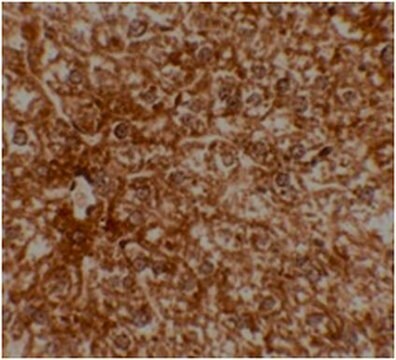
Immunohistochemistry Analysis: 2.5 µg/mL from a representative lot detected EPAC2 in mouse liver tissue.
Research Category
Neuroscience
Research Sub Category
Developmental Neuroscience

Physical form

Antigen Affinity Purified
Purified rabbit polyclonal in buffer containing PBS with up to 0.1% sodium azide.

Preparation Note

Stable for 1 year at 2-8°C from date of receipt.

Analysis Note

Control
Rat liver tissue lysate
Evaluated by Western Blotting/Peptide Inhibition Assay in rat liver tissue lysate.

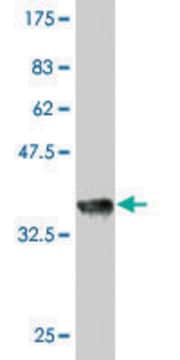
Western Blotting/Peptide Inhibition Assay Analysis: 1 µg/mL of this antibody detected EPAC2 in 15 µg of rat liver tissue lysate.

Other Notes

Concentration: Please refer to the Certificate of Analysis for the lot-specific concentration.

Disclaimer

Unless otherwise stated in our catalog or other company documentation accompanying the product(s), our products are intended for research use only and are not to be used for any other purpose, which includes but is not limited to, unauthorized commercial uses, in vitro diagnostic uses, ex vivo or in vivo therapeutic uses or any type of consumption or application to humans or animals.
Ta strona może zawierać tekst przetłumaczony maszynowo.

Porównaj podobne pozycje

Wyświetl pełne porównanie

Pokaż różnice

1 of 1

Ta pozycja
ABN470HPA006426WH0009693M1
Quality Level

100

Quality Level

100

Quality Level

100

Quality Level

100

antibody form

affinity isolated antibody

antibody form

affinity isolated antibody

antibody form

affinity isolated antibody

antibody form

purified immunoglobulin

biological source

rabbit

biological source

rabbit

biological source

rabbit

biological source

mouse

conjugate

unconjugated

conjugate

unconjugated

conjugate

unconjugated

conjugate

unconjugated

clone

polyclonal

clone

polyclonal

clone

polyclonal

clone

1E8, monoclonal

Gene Information

human ... RAPGEF4(11069)

Gene Information

human ... RAPGEF3(10411)

Gene Information

human ... RAPGEF1(2889)

Gene Information

human ... RAPGEF2(9693)


Still not finding the right product?

Wypróbuj nasze narzędzie Narzędzie selektora produktów, aby zawęzić opcje.


wgk

WGK 2

flash_point_f

Not applicable

flash_point_c

Not applicable

Klasa składowania

12 - Non Combustible Liquids


Certyfikaty analizy (CoA)

Poszukaj Certyfikaty analizy (CoA), wpisując numer partii/serii produktów. Numery serii i partii można znaleźć na etykiecie produktu po słowach „seria” lub „partia”.

Masz już ten produkt?

Dokumenty związane z niedawno zakupionymi produktami zostały zamieszczone w Bibliotece dokumentów.

Odwiedź Bibliotekę dokumentów


Michel Rasmussen et al.
Journal of neurochemistry, 157(6), 2173-2186 (2020-11-25)
The hereditary disease Retinitis pigmentosa results in severe vision loss due to photoreceptor degeneration by unclear mechanisms. In several disease models, the second messenger cGMP accumulates in the degenerating photoreceptors, where it may over-activate specific cGMP-interacting proteins, like cGMP-dependent protein
Michel Rasmussen et al.
International journal of molecular sciences, 23(9) (2022-05-15)
The disease retinitis pigmentosa (RP) leads to photoreceptor degeneration by a yet undefined mechanism(s). In several RP mouse models (i.e., rd mice), a high cyclic GMP (cGMP) level within photoreceptors is detected, suggesting that cGMP plays a role in degeneration.


Numer pozycji handlu globalnego

SKUNUMER GTIN
ABN49204053252907005

Questions

Reviews

No rating value

Active Filters