Przejdź do zawartości
Merck

Przejdź do

ABN2264

Anti-SNTF (cleaved spectrin)

serum, from rabbit

Synonim(y):

Spectrin alpha chain non-erythrocytic 1, Alpha-II spectrin, Fodrin alpha chain, Spectrin non-erythroid alpha subunit, Calpain-derived alpha-II spectrin N-terminal fragment

Zaloguj się, aby wyświetlić ceny organizacyjne i kontraktowe.

Wybierz wielkość

Zmień widok
Gabaryty przesyłkiSKUDostępnośćCena netto
50 μL

Przewidywany termin wysyłki17 czerwca 2026zKuehne + Nagel Sp. z o.o.

1810,00 zł

Informacje o tej pozycji

UNSPSC Code:
12352203
NACRES:
NA.41
eCl@ss:
32160702
Clone:
polyclonal
Species reactivity:
human, mouse, porcine
Application:
ELISA, IHC, WB
Citations:
1

1810,00 zł


Przewidywany termin wysyłki17 czerwca 2026Szczegóły


Zamów zamówienie zbiorcze
Pomoc techniczna
Potrzebujesz pomocy? Nasz zespół doświadczonych naukowców chętnie Ci pomoże.
Pozwól nam pomóc


biological source

rabbit

antibody form

serum

antibody product type

primary antibodies

clone

polyclonal

species reactivity

human, mouse, porcine

species reactivity (predicted by homology)

bovine (based on 100% sequence homology), rat (based on 100% sequence homology)

technique(s)

ELISA: suitable, immunohistochemistry: suitable, western blot: suitable

isotype

IgG

NCBI accession no.

UniProt accession no.

target post-translational modification

proteolytically cleaved (Tyr1176-Gly1177)

Gene Information

human ... SPTAN1(6709)

General description

Spectrin alpha chain, non-erythrocytic 1 (UniProt: Q13813; also known as Alpha-II spectrin, Fodrin alpha chain, Spectrin, non-erythroid alpha subunit) is encoded by the SPTAN1 (also known as NEAS, SPTA2) gene (Gene ID: 6709) in human. Non-erythroid Spectrin plays a role in stabilizing membrane structures, maintaining cell shape and linking the cytoskeleton to plasma membranes or intracellular vesicles. Alpha II-spectrin is a structural protein abundant in neurons of the central nervous system and is cleaved into signature fragments by proteases involved in necrotic and apoptotic cell death. It is one of the primary targets cleaved by activated caspases during apoptosis. The full-length protein can be cleaved to yield an N-terminal product of ~150 kDa, and C-terminal products of ~120 and ~35 kDa. Alpha II- spectrin is involved in secretion, interacts with calmodulin in a calcium-dependent manner and is thus candidate for the calcium-dependent movement of the cytoskeleton at the membrane. It has two calcium-binding regions (aa 2336-2347 and 2379-2390). Its mu-calpain cleavage site is localized at Tyr-Gly (aa 1176-1177). Phosphorylation of Tyrosine 1176 is shown to reduce sensitivity to cleavage by calpain in vitro. Plasma levels of calpain-cleaved Alpha II-Spectrin, N-terminal fragment (SNTF) serve as a useful marker for mild to severe traumatic brain injury and SNTF immunostaining can also reveal previously undetected traumatic brain injury. Mutations in SPTAN1 gene are known to cause early infantile epileptic encephalopathy that is characterized by seizures associated with hypsarrhythmia, profound mental retardation with lack of visual attention and speech development. (Ref.: Siman, R., et al. (2013). Front. Neurol. 4; Article 190; Johnson VE., et al (2016). Acta Neuropathol. 131(1); 115-135).
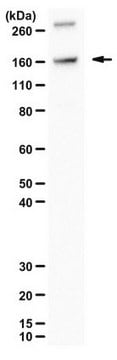
~160 kDa observed. Calculated molecular weight of full length protein is 284.54 kDa Uncharacterized bands may be observed in some lysate(s).

Immunogen

Epitope: unknown
KLH-conjugated linear peptide corresponding to calpain-generated neoepitope in SNTF (CAQQEVY).


Application

Anti-SNTF (cleaved spectrin), Cat. No. ABN2264, is a highly specific rabbit polyclonal antibody that targets cleaved Spectrin alpha chain, non-erythrocytic 1 and has been tested for use in ELISA, Immunohistochemistry, and Western Blotting.
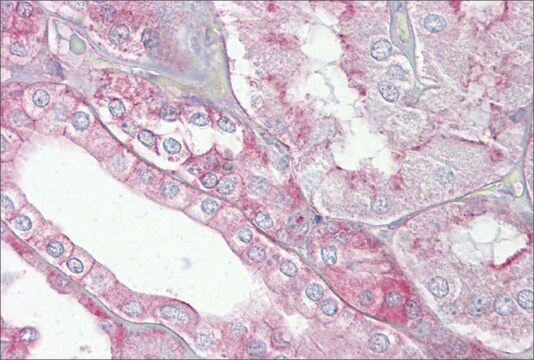
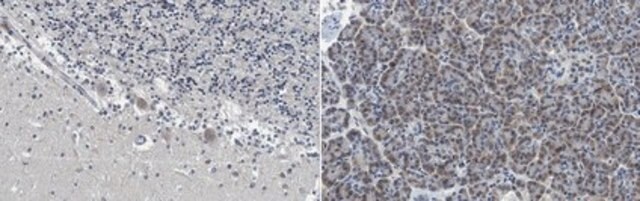
Immunohistochemistry Analysis: A representative lot detected SNTF (cleaved spectrin) in swine and human brain sections (Johnson, V.E., et. al. (2016). Acta Neuropathol. 131(1):115-35).

Western Blotting Analysis: A representative lot detected SNTF (cleaved spectrin) in Western Blotting applications (Roberts-Lewis, J.M., et. al. (1994). J Neurosci. 14(6):3934-44).

Enzyme Immunoassay Analysis (ELISA): A representative lot detected SNTF (cleaved spectrin) in detection antibody for human serum samples (Siman, R., et. al. (2013). Front Neurol. 4:190).
Research Category
Neuroscience

Biochem/physiol Actions

This rabbit polyclonal antibody specifically detects calpain-generated neoepitope in SNTF. It targets a neoepitope of 6 amino acids at the carboxyl-end of the stable calpain-derived alpha-spectrin.

Physical form

Rabbit polyclonal antiserum with 0.05% sodium azide.
Unpurified

Preparation Note

Stable for 1 year at -20°C from date of receipt. Handling Recommendations: Upon receipt and prior to removing the cap, centrifuge the vial and gently mix the solution. Aliquot into microcentrifuge tubes and store at -20°C. Avoid repeated freeze/thaw cycles, which may damage IgG and affect product performance.

Analysis Note

Evaluated by Western Blotting in mouse brain extract incubated with calcium chloride to activate calpain.

Western Blotting Analysis: A 1:10,000 dilution of this antibody detected Spectrin alpha chain, non-erythrocytic 1 in Mouse Brain extract incubated with calcium chloride to activate Calpain.

Other Notes

Concentration: Please refer to lot specific datasheet.

Disclaimer

Unless otherwise stated in our catalog or other company documentation accompanying the product(s), our products are intended for research use only and are not to be used for any other purpose, which includes but is not limited to, unauthorized commercial uses, in vitro diagnostic uses, ex vivo or in vivo therapeutic uses or any type of consumption or application to humans or animals.
Ta strona może zawierać tekst przetłumaczony maszynowo.

Porównaj podobne pozycje

Wyświetl pełne porównanie

Pokaż różnice

1 of 1

Ta pozycja
MAB1622SAB2102292MABN1727
biological source

rabbit

biological source

mouse

biological source

rabbit

biological source

mouse

antibody form

serum

antibody form

purified immunoglobulin

antibody form

affinity isolated antibody

antibody form

purified immunoglobulin

species reactivity

human, mouse, porcine

species reactivity

pig, guinea pig, rabbit, mouse, chicken, rat, human

species reactivity

mouse, rabbit, dog, human, rat, bovine, pig, horse

species reactivity

human, rat

clone

polyclonal

clone

AA6, monoclonal

clone

polyclonal

clone

N393/76, monoclonal

technique(s)

ELISA: suitable, western blot: suitable, immunohistochemistry: suitable

technique(s)

ChIP: suitable, immunohistochemistry: suitable, immunoprecipitation (IP): suitable, western blot: suitable

technique(s)

immunohistochemistry: suitable, immunoprecipitation (IP): suitable, western blot: suitable

technique(s)

immunohistochemistry (formalin-fixed, paraffin-embedded sections): suitable, western blot: suitable

Gene Information

human ... SPTAN1(6709)

Gene Information

human ... SPTAN1(6709)

Gene Information

human ... SPTAN1(6709)

Gene Information

human ... SPTBN1(6711)


Still not finding the right product?

Wypróbuj nasze narzędzie Narzędzie selektora produktów, aby zawęzić opcje.


Certyfikaty analizy (CoA)

Poszukaj Certyfikaty analizy (CoA), wpisując numer partii/serii produktów. Numery serii i partii można znaleźć na etykiecie produktu po słowach „seria” lub „partia”.

Masz już ten produkt?

Dokumenty związane z niedawno zakupionymi produktami zostały zamieszczone w Bibliotece dokumentów.

Odwiedź Bibliotekę dokumentów


Aicha Saadane et al.
The American journal of pathology, 191(10), 1805-1821 (2021-07-03)
This study tested the hypothesis that diabetes promotes a greater than normal cytosolic calcium level in rod cells that activates a Ca2+-sensitive protease, calpain, resulting in oxidative stress and inflammation, two pathogenic factors of early diabetic retinopathy. Nondiabetic and 2-month


Questions

Reviews

No rating value

Active Filters