
ABN1723

Anti-RTN3 (R458)
from rabbit
Synonim(y):
Reticulon-3, HAP, Homolog of ASY protein, Neuroendocrine-specific protein-like 2, Neuroendocrine-specific protein-like II, NSP-like protein 2, NSP-like protein II, NSPLII
Informacje o tej pozycji
biological source
rabbit
conjugate
unconjugated
antibody form
unpurified
antibody product type
primary antibodies
clone
polyclonal
species reactivity
mouse, human
species reactivity (predicted by homology)
rat (based on 100% sequence homology), chimpanzee (based on 100% sequence homology)
technique(s)
immunofluorescence: suitable, immunohistochemistry: suitable, immunoprecipitation (IP): suitable, western blot: suitable
NCBI accession no.
UniProt accession no.
shipped in
dry ice
target post-translational modification
unmodified
Gene Information
human ... RTN3(10313)
General description
Immunogen
Application
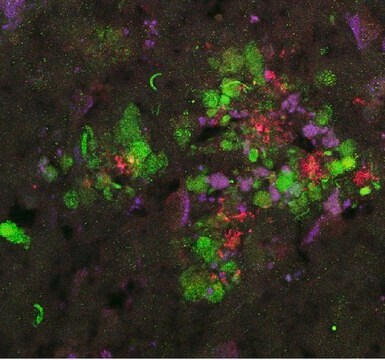
Immunohistochemistry Analysis: A 1:2,000 dilution from a representative lot immunostained dystrophic neurites in Alzheimer′s diseased (AD) human frozen brain tissue sections (Courtesy of Wanxia He, The Cleveland Clinic Foundation, U.S.A.).
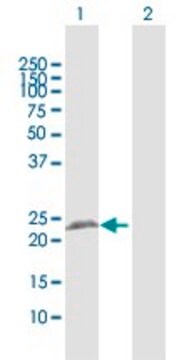
Western Blotting Analysis: A 1:2,000 dilution from a representative lot detected RTN3 isoforms in 50 µg of brain tissue lysate from a wild-type, but not RTN3-knockout, mouse (Courtesy of Wanxia He, The Cleveland Clinic Foundation, U.S.A.).
Immunofluorescence Analysis: A representative lot detected RTN3 immunoreactivity partially co-localized with that of BACE1 in mouse brain tissue sections (He, W., et al. (2004). Nat. Med.10(9):959-965).
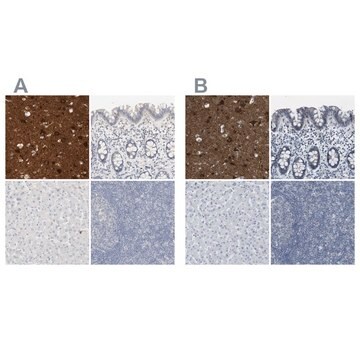
Immunohistochemistry Analysis: A representative lot detected RTN3 immunoreactivity enriched in grey matter neuronal cell bodies of human brain tissue sections (He, W., et al. (2004). Nat. Med.10(9):959-965).
Immunoprecipitation Analysis: A representative lot co-immunoprecipitated BACE1 with RTN3 from HEK293 and human frontal cortex membrane extracts (He, W., et al. (2004). Nat. Med.10(9):959-965).
Western Blotting Analysis: A representative lot detected RTN3 isoforms expression in multiple mouse tissues, including broadly expressed ~25 kDa RTN3-A1 (UniProt Q9ES97-3), ~100 kDa fat tissue-specific RTN3-AL (UniProt Q9ES97-1), ~95 kDa brain-specific RTN3-B, and ~27 kDa RTN3-A2 (UniProt Q9ES97-4) in spinal cord. RTN3 target bands were not detected in tissue samples from RTN3-knockout mice (Shi, Q., et al. (2014). J. Neurosci. 34(42):13954-13962; He, W., et al. (2004). Nat. Med.10(9):959-965).
Western Blotting Analysis: A representative lot detected RTN3 isoform 3 (UniProt O95197-3) wild-type and mutant constructs expression. Membrane integration was affected by L71K/L72K mutation or deletion of N-terminal 97 a.a., while truncation of the first 61 a.a. did not affect embrane integration. Western blotting analysis of protease K-digested HEK293 microsomal preparation indicated a cytoplasmic orientation of the C-terminal end (He, W., et al. (2007). J. Biol. Chem. 282(40):29144-29151).
Western Blotting Analysis: A representative lot detected RTN3 in BACE1 immunoprecipitate from HEK293 membrane extract. A bimodal distribution showing RTN3 enrichment in subcellular fractions containing Golgi proteins and those containing ER markers was seen (He, W., et al. (2004). Nat. Med.10(9):959-965).
Western Blotting Analysis: A representative lot detected RNAi-mediated RTN3-knockdown in Swedish mutant APP-expressing 125.3 cells (He, W., et al. (2004). Nat. Med.10(9):959-965).
Neuroscience
Biochem/physiol Actions
Physical form
Preparation Note
Handling Recommendations: Upon receipt and prior to removing the cap, centrifuge the vial and gently mix the solution. Aliquot into microcentrifuge tubes and store at -20°C. Avoid repeated freeze/thaw cycles, which may damage IgG and affect product performance.
Analysis Note
Western Blotting Analysis: A 1:500 dilution of this antibody detected RTN3 isoforms in 50 µg of brain tissue lysate from a wild-type, but not RTN3-knockout, mouse.
Other Notes
Disclaimer
1 of 1
Ta pozycja | |||
|---|---|---|---|
| antibody form unpurified | antibody form purified immunoglobulin | antibody form affinity isolated antibody | antibody form purified immunoglobulin |
| conjugate unconjugated | conjugate unconjugated | conjugate unconjugated | conjugate unconjugated |
| biological source rabbit | biological source rabbit | biological source rabbit | biological source mouse |
| shipped in dry ice | shipped in dry ice | shipped in wet ice | shipped in dry ice |
| technique(s) immunofluorescence: suitable, immunoprecipitation (IP): suitable, immunohistochemistry: suitable, western blot: suitable | technique(s) western blot: 1 μg/mL | technique(s) immunofluorescence: 0.25-2 μg/mL, immunohistochemistry: 1:50-1:200 | technique(s) indirect ELISA: suitable, western blot: 1-5 μg/mL |
| clone polyclonal | clone polyclonal | clone polyclonal | clone 6A11, monoclonal |

Still not finding the right product?
Wypróbuj nasze narzędzie Narzędzie selektora produktów, aby zawęzić opcje.
Klasa składowania
12 - Non Combustible Liquids
wgk
WGK 1
flash_point_f
Not applicable
flash_point_c
Not applicable
Certyfikaty analizy (CoA)
Poszukaj Certyfikaty analizy (CoA), wpisując numer partii/serii produktów. Numery serii i partii można znaleźć na etykiecie produktu po słowach „seria” lub „partia”.
Masz już ten produkt?
Dokumenty związane z niedawno zakupionymi produktami zostały zamieszczone w Bibliotece dokumentów.