Przejdź do zawartości
Merck

Przejdź do

ABE208

Anti-β-Catenin Antibody

from rabbit, purified by affinity chromatography

Synonim(y):

catenin (cadherin-associated protein), beta 1, 88kDa, catenin (cadherin-associated protein), beta 1 (88kD)

Zaloguj się, aby wyświetlić ceny organizacyjne i kontraktowe.

Wybierz wielkość

Zmień widok
Gabaryty przesyłkiSKUDostępnośćCena netto
100 μg

Przewidywana wysyłka DZISIAJzKuehne + Nagel Sp. z o.o.

1950,00 zł

Informacje o tej pozycji

UNSPSC Code:
12352203
NACRES:
NA.41
eCl@ss:
32160702
Conjugate:
unconjugated
Clone:
polyclonal
Application:
ICC, IP, WB
Citations:
7

1950,00 zł


Przewidywana wysyłka DZISIAJSzczegóły

Rekombinowane, niezawierające konserwantów przeciwciało jest dostępne dla Twojego celu. Wypróbuj ZRB05665

Zamów zamówienie zbiorcze
Pomoc techniczna
Potrzebujesz pomocy? Nasz zespół doświadczonych naukowców chętnie Ci pomoże.
Pozwól nam pomóc

biological source

rabbit

Quality Level

conjugate

unconjugated

antibody form

affinity isolated antibody

antibody product type

primary antibodies

clone

polyclonal

purified by

affinity chromatography

species reactivity

mouse, human, rat, horse

species reactivity (predicted by homology)

ox (based on 100% sequence homology), equine (based on 100% sequence homology)

technique(s)

immunocytochemistry: suitable, immunoprecipitation (IP): suitable, western blot: suitable

Szukasz podobnych produktów? Odwiedź Przewodnik dotyczący porównywania produktów

General description

β-catenin is the founding member of the β -catenin family. This protein is comprised of 12 ARM repeats and is considered to have dual function depending on its localization. Cytoplasmic β -catenin is a critical component of E-cadherin/catening adhesion complexes and is involved in regulating cadherin-dependent cell-cell interactions.When localized to the nucleus, β -catenin serves a regulatory role by binding with transcription factors from the TCF/LEF family, activating transcription. Expression of β -catenin has been reported in a variety of hair follicle cells such as cells found in the inner and outer portions of the root sheaths, and the basal and peripheral matrix cells. It has also been observed in colon tissue. Defects in expression have been linked to the development of several tumors and cancers such as; colorectal cancer (CRC), medulloblastoma (MDB), ovarian cancer (OC), and pilomatrixoma (PTR).
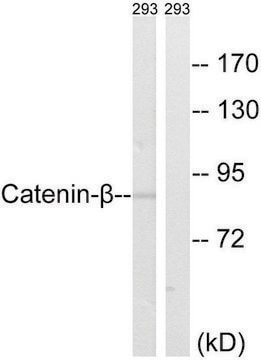
~86kDa observed.

Immunogen

Epitope: Consensus GSK3 phosphorylation site of human β-Catenin
KLH-conjugated linear peptide corresponding to the consensus GSK3 phosphorylation site of human β-Catenin.

Application

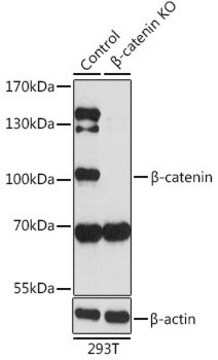
Anti-β-Catenin Antibody is a Rabbit Polyclonal Antibody for detection of β-Catenin also known as catenin (cadherin-associated protein) beta 1 (88kD) & has been validated in WB, ICC & IP.
Immunoprecipitation Analysis: 10 µg from a representative lot immunoprecipitated β-Catenin from A431 lysate.

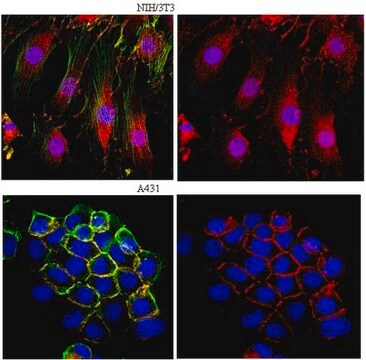
Immunocytochemistry Analysis: 1:500 dilution from a representative lot detected β-Catenin in NIH/3T3 and A431 cells.
Research Category
Epigenetics & Nuclear Function
Research Sub Category
Transcription Factors

Biochem/physiol Actions

Antibody recognizes β-Catenin at the N-terminus.

Physical form

Affinity purified
Purified rabbit polyclonal in buffer containing 0.1 M Tris-Glycine (pH 7.4), 150 mM NaCl with 0.05% sodium azide.

Preparation Note

Stable for 1 year at 2-8°C from date of receipt.

Analysis Note

Control
A431 cell lysate
Evaluated by Western Blot in A431 cell lysate.

Western Blot Analysis: 0.05 µg/mL of this antibody detected β-Catenin on 10 µg of A431 cell lysate.

Other Notes

Concentration: Please refer to the Certificate of Analysis for the lot-specific concentration.
Replaces: 04-1002

Disclaimer

Unless otherwise stated in our catalog or other company documentation accompanying the product(s), our products are intended for research use only and are not to be used for any other purpose, which includes but is not limited to, unauthorized commercial uses, in vitro diagnostic uses, ex vivo or in vivo therapeutic uses or any type of consumption or application to humans or animals.
Ta strona może zawierać tekst przetłumaczony maszynowo.

Nie możesz znaleźć właściwego produktu?  

Wypróbuj nasz Narzędzie selektora produktów.

Klasa składowania

12 - Non Combustible Liquids

wgk

WGK 1

flash_point_f

Not applicable

flash_point_c

Not applicable


Certyfikaty analizy (CoA)

Poszukaj Certyfikaty analizy (CoA), wpisując numer partii/serii produktów. Numery serii i partii można znaleźć na etykiecie produktu po słowach „seria” lub „partia”.

Masz już ten produkt?

Dokumenty związane z niedawno zakupionymi produktami zostały zamieszczone w Bibliotece dokumentów.

Odwiedź Bibliotekę dokumentów

Shuai Yuan et al.
Cell cycle (Georgetown, Tex.), 21(2), 187-201 (2021-12-18)
The present study aimed to investigate the role of neohesperidin (NH) in mice with steroid-induced femoral head necrosis (SONFH) and in bone marrow stromal cells (BMSCs). The SONFH model was established. The effects of NH on SONFH mice were detected
Sanna Vattulainen-Collanus et al.
Journal of cell science, 129(4), 693-705 (2016-01-09)
Tie2-promoter-mediated loss of peroxisome proliferator-activated receptor gamma (PPARγ, also known as PPARG) in mice leads to osteopetrosis and pulmonary arterial hypertension. Vascular disease is associated with loss of PPARγ in pulmonary microvascular endothelial cells (PMVEC); we evaluated the role of
Daniel T Malleske et al.
Stem cells (Dayton, Ohio), 36(12), 1905-1916 (2018-09-02)
The wingless/integrase-1 (WNT)/β-catenin signaling pathway is active in several chronic lung diseases including idiopathic pulmonary fibrosis, asthma, and chronic obstructive pulmonary disease. Although this WNT/β-catenin pathway activity is associated with an increase in mucus cell frequency and a decrease in
Mi-Hyeon You et al.
Cells, 10(11) (2021-11-28)
The activation of metastatic reprogramming is vital for cancer metastasis, but little is known about its mechanism. This study investigated the potential role of death-associated protein kinase 1 (DAPK1) in thyroid cancer progression. We generated knockdown (KD) DAPK1 using siRNA
Yu Shi et al.
Development (Cambridge, England), 150(10) (2023-05-02)
Fluorescent protein (FP) tagging is a key method for observing protein distribution, dynamics and interaction with other proteins in living cells. However, the typical approach using overexpression of tagged proteins can perturb cell behavior and introduce localization artifacts. To preserve

Numer pozycji handlu globalnego

SKUNUMER GTIN
ABE20804053252376825

Questions

Reviews

No rating value

Active Filters

Nasz zespół naukowców ma doświadczenie we wszystkich obszarach badań, w tym w naukach przyrodniczych, materiałoznawstwie, syntezie chemicznej, chromatografii, analityce i wielu innych dziedzinach.

Skontaktuj się z zespołem ds. pomocy technicznej