Przejdź do zawartości
Merck

Przejdź do

ABC926

Anti-TRIM11 Antibody

from rabbit, purified by affinity chromatography

Synonim(y):

E3 ubiquitin-protein ligase TRIM11, Protein BIA1, RING finger protein 92, Tripartite motif-containing protein 11, TRIM11

Zaloguj się, aby wyświetlić ceny organizacyjne i kontraktowe.

Wybierz wielkość

Zmień widok
Gabaryty przesyłkiSKUDostępnośćCena netto
100 μg

Przewidywany termin wysyłki19 maja 2026zKuehne + Nagel Sp. z o.o.

1940,00 zł

Informacje o tej pozycji

UNSPSC Code:
12352203
NACRES:
NA.41
eCl@ss:
32160702
Conjugate:
unconjugated
Clone:
polyclonal
Application:
IHC, WB
Citations:
2

1940,00 zł


Przewidywany termin wysyłki19 maja 2026Szczegóły


Zamów zamówienie zbiorcze
Pomoc techniczna
Potrzebujesz pomocy? Nasz zespół doświadczonych naukowców chętnie Ci pomoże.
Pozwól nam pomóc


biological source

rabbit

Quality Level

conjugate

unconjugated

antibody form

affinity isolated antibody

antibody product type

primary antibodies

clone

polyclonal

purified by

affinity chromatography

species reactivity

mouse, human

species reactivity (predicted by homology)

canine (based on 100% sequence homology), rhesus macaque (based on 100% sequence homology)

technique(s)

immunohistochemistry: suitable (paraffin), western blot: suitable

NCBI accession no.

UniProt accession no.

shipped in

wet ice

target post-translational modification

unmodified

Gene Information

human ... TRIM11(81559)
mouse ... Trim11(94091)

General description

E3 ubiquitin-protein ligase TRIM11 (UniProt Q96F44; also known as Protein BIA1, RING finger protein 92, Tripartite motif-containing 11, Tripartite motif-containing protein 11) is encoded by the TRIM11 (also known as BIA1, RNF92) gene (Gene ID 81559) in human. TRIM11 belongs to a family of more than 70 TRIM/RBCC proteins characterized by their shared tripartite motif structure, also known as the RBCC (RING finger, B-box, and coiled-coil) domain. The B-box and coiled coil regions are believed to participate in protein-protein interactions and formation of macromolecular complexes. TRIM proteins are involved in diverse cellular processes, including cell proliferation, differentiation, oncogenesis, and apoptosis. The presence of a RING domain suggests that TRIM proteins function as E3 ubiquitin ligases. The neuroprotective peptide humanin, activator-recruited cofactor (ARC) 105-kDa component (ARC105), the transcription factors Pax6 and PHOX2B are all known subrates targeted by TRIM11-mediated degradation through the ubiquitin-proteasome system. In addition, TRIM11 is also reported to interfere with the early steps of HIV-1 replication in host cells in a RING domain-dependent manner.
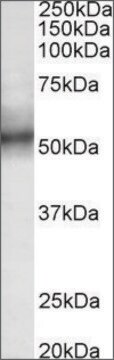
~53 kDa observed. 52.8 kDa (isoform 1), 43.0 kDa (isoform 2), and 52.6 kDa (isoform 3) calculated.

Immunogen

KLH-conjugated linear peptide corresponding to human TRIM11.

Application

Detect TRIM11 using this rabbit polyclonal Anti-TRIM11 Antibody, Cat. No. ABC926, validated for use in Western Blotting and Immunohistochemistry (Paraffin).
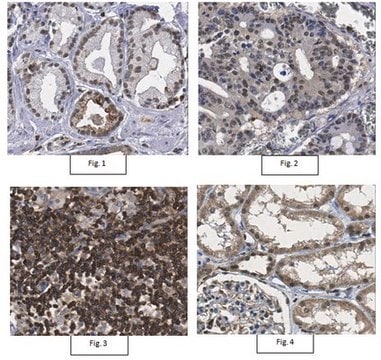
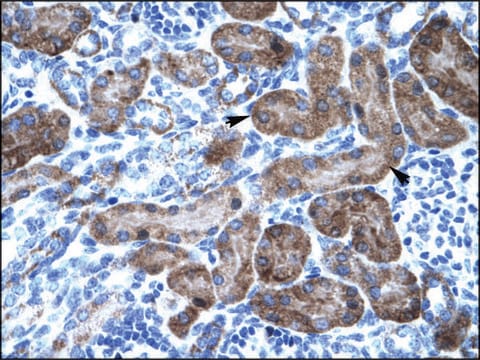
Immunohistochemistry Analysis: A 1:50-250 dilution from a representative lot detected TRIM11 in human prostate cancer, human colon cancer, human melanoma, and human kidney tissue.
Research Category
Apoptosis & Cancer
Research Sub Category
Apoptosis - Additional

Biochem/physiol Actions

This antibody is expected to react with all three spliced isoforms of human TRIM11.

Physical form

Affinity purified
Purified rabbit polyclonal antibody in buffer containing 0.1 M Tris-Glycine (pH 7.4), 150 mM NaCl with 0.05% sodium azide.

Preparation Note

Stable for 1 year at 2-8°C from date of receipt.

Analysis Note

Evaluated by Western Blotting in murine macrophage RAW264.7 cell lysate.

Western Blotting Analysis: 1.0 µg/mL of this antibody detected TRIM11 in 10 µg of murine macrophage RAW264.7 cell lysate.

Other Notes

Concentration: Please refer to lot specific datasheet.

Disclaimer

Unless otherwise stated in our catalog or other company documentation accompanying the product(s), our products are intended for research use only and are not to be used for any other purpose, which includes but is not limited to, unauthorized commercial uses, in vitro diagnostic uses, ex vivo or in vivo therapeutic uses or any type of consumption or application to humans or animals.
Ta strona może zawierać tekst przetłumaczony maszynowo.

Porównaj podobne pozycje

Wyświetl pełne porównanie

Pokaż różnice

1 of 1

Ta pozycja
SAB2501855AV34717MABC945
Quality Level

100

Quality Level

-

Quality Level

100

Quality Level

100

conjugate

unconjugated

conjugate

unconjugated

conjugate

unconjugated

conjugate

unconjugated

biological source

rabbit

biological source

goat

biological source

rabbit

biological source

mouse

antibody form

affinity isolated antibody

antibody form

affinity isolated antibody

antibody form

affinity isolated antibody

antibody form

purified immunoglobulin

UniProt accession no.

Q96F44

UniProt accession no.

Q96F44

UniProt accession no.

Q9BZY9

UniProt accession no.

O75382

clone

polyclonal

clone

polyclonal

clone

polyclonal

clone

13D12.1, monoclonal


Still not finding the right product?

Wypróbuj nasze narzędzie Narzędzie selektora produktów, aby zawęzić opcje.


Klasa składowania

12 - Non Combustible Liquids

wgk

WGK 1

flash_point_f

Not applicable

flash_point_c

Not applicable


Certyfikaty analizy (CoA)

Poszukaj Certyfikaty analizy (CoA), wpisując numer partii/serii produktów. Numery serii i partii można znaleźć na etykiecie produktu po słowach „seria” lub „partia”.

Masz już ten produkt?

Dokumenty związane z niedawno zakupionymi produktami zostały zamieszczone w Bibliotece dokumentów.

Odwiedź Bibliotekę dokumentów


Powiązane treści

A major focus of breast cancer research is to understand the mechanisms responsible for disease progression and drug resistance. Toward that end, it has been found that approximately two thirds of all human breast carcinomas overexpress the Estrogen Receptor α (ERα) protein and it remains the primary pharmacological target for endocrine therapy1,2. The normal cellular function of ERα is as a transcription factor that mediates a wide variety of physiological processes, many of which are dependent upon phosphorylation of the receptor at specific amino acid residues3,4. Indeed, ERα is known to be phosphorylated at a multitude of different sites, yet how these all correlate to disease remains unclear5. Here, we interrogated multiple sites of ERα for phosphorylation status by screening an extensive panel of different breast cancer patient samples and other non-breast cancer tissue microarray (TMA) slide samples to determine their relevance to disease.


Liang Chen et al.
Nature communications, 9(1), 1223-1223 (2018-03-28)
The proteasome is a complex protease critical for protein quality control and cell regulation, and its dysfunction is associated with cancer and other diseases. However, the mechanisms that control proteasome activity  in normal and malignant cells remain unclear. Here we report
Guixin Zhu et al.
Cell reports, 33(9), 108418-108418 (2020-12-03)
Neurodegenerative diseases are characterized by the formation and propagation of protein aggregates, especially amyloid fibrils. However, what normally suppresses protein misfolding and aggregation in metazoan cells remains incompletely understood. Here, we show that TRIM11, a member of the metazoan tripartite


Numer pozycji handlu globalnego

SKUNUMER GTIN
ABC92604055977176872

Questions

Reviews

No rating value

Active Filters