Przejdź do zawartości
Merck

Przejdź do

AB5585-I

Anti-Recoverin Antibody

from rabbit, purified by affinity chromatography

Synonim(y):

Cancer-associated retinopathy protein, Cancer-associated retinopathy antigen, Protein CAR, Recoverin

Zaloguj się, aby wyświetlić ceny organizacyjne i kontraktowe.

Wybierz wielkość

Zmień widok
Gabaryty przesyłkiSKUDostępnośćCena netto
100 μg
Sprawdź dostępność w koszyku
1850,00 zł

Informacje o tej pozycji

UNSPSC Code:
12352203
NACRES:
NA.41
eCl@ss:
32160702
Conjugate:
unconjugated
Clone:
polyclonal
Application:
IHC, WB
Citations:
3

1850,00 zł


Sprawdź dostępność w koszyku
Rekombinowane, niezawierające konserwantów przeciwciało jest dostępne dla Twojego celu. Wypróbuj ZRB1107

Zamów zamówienie zbiorcze
Pomoc techniczna
Potrzebujesz pomocy? Nasz zespół doświadczonych naukowców chętnie Ci pomoże.
Pozwól nam pomóc


biological source

rabbit

Quality Level

conjugate

unconjugated

antibody form

affinity isolated antibody

antibody product type

primary antibodies

clone

polyclonal

purified by

affinity chromatography

species reactivity

human, rat

species reactivity (predicted by homology)

mouse (based on 100% sequence homology)

technique(s)

immunohistochemistry: suitable, western blot: suitable

NCBI accession no.

UniProt accession no.

shipped in

wet ice

target post-translational modification

unmodified

Gene Information

mouse ... Rcvrn(19674)

General description

Recoverin (UniProt P35243; also known as Cancer-associated retinopathy antigen, Cancer-associated retinopathy protein, Protein CAR) is encoded by the RCVRN (also known as RCV1) gene (Gene ID 5957) in human. The photoreceptor protein recoverin is a member of the EF-hand neuronal calcium sensor (NCS) proteins. Recoverin is initially produced as a 200-amino acid protein whose N-terminal initiator methionine is removed posttranslationally. Recoverin is composed of four EF-hand domains (a.a. 25-60, 61-96, 97-132, 147-182), with the second and third EF-hand regions mediating low- and high-affinity calcium binding, respectively. In photoreceptor cells, recoverin functions as a Ca2+-dependent inhibitor of G-protein-coupled receptor kinase 1 (GRK1). Recoverin plays an important role in mediating calcium-dependent rod and cone light adaptation. Recoverin delays the rod & cone response under dim light when [Ca2+] is high by inhibiting GRK1-catalyzed visual pigment phosphorylation, but has little effect during light adaptation when [Ca2+]i is lowered.
~23 kDa observed.

Immunogen

Epitope: EF-hand 4
KLH-conjugated linear peptide corresponding to a sequence from the EF-hand 4 domain of human recoverin.

Application

Anti-Recoverin Antibody detects level of Recoverin and has been published and validated for use in Western Blotting, Immunohistochemistry.
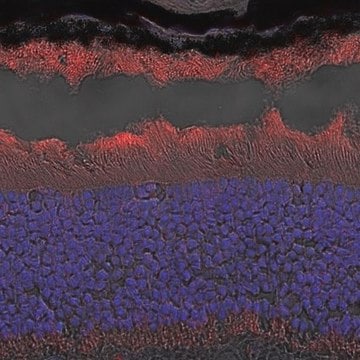
Immunohistochemistry Analysis: A 1:1,000 dilution from a representative lot detected Recoverin in human and rat retina tissue sections.
Research Category
Neuroscience
Research Sub Category
Sensory & PNS

Physical form

Affinity purified
Purified rabbit polyclonal antibody in buffer containing 0.1 M Tris-Glycine (pH 7.4), 150 mM NaCl with 0.05% sodium azide.

Preparation Note

Stable for 1 year at 2-8°C from date of receipt.

Analysis Note

Evaluated by Western Blotting in human retina tissue lysate.

Western Blotting Analysis: 0.25 µg/mL of this antibody detected Recoverin in 10 µg of human retina tissue lysate.

Other Notes

Concentration: Please refer to lot specific datasheet.

Disclaimer

Unless otherwise stated in our catalog or other company documentation accompanying the product(s), our products are intended for research use only and are not to be used for any other purpose, which includes but is not limited to, unauthorized commercial uses, in vitro diagnostic uses, ex vivo or in vivo therapeutic uses or any type of consumption or application to humans or animals.
Ta strona może zawierać tekst przetłumaczony maszynowo.

Porównaj podobne pozycje

Wyświetl pełne porównanie

Pokaż różnice

1 of 1

Ta pozycja
MABN2396MZRB1448ABE1302
biological source

rabbit

biological source

mouse

biological source

rabbit (recombinant)

biological source

rabbit

antibody form

affinity isolated antibody

antibody form

purified antibody

antibody form

purified antibody

antibody form

affinity isolated antibody

Quality Level

100

Quality Level

100

Quality Level

200

Quality Level

100

conjugate

unconjugated

conjugate

unconjugated

conjugate

unconjugated

conjugate

unconjugated

species reactivity

human, rat

species reactivity

porcine, bovine, human, rat, mouse

species reactivity

human, bovine

species reactivity

human

shipped in

wet ice

shipped in

-

shipped in

ambient

shipped in

wet ice


Still not finding the right product?

Explore all of our products under

lub

Wypróbuj nasze narzędzie Narzędzie selektora produktów, aby zawęzić opcje.


Klasa składowania

12 - Non Combustible Liquids

wgk

WGK 1

flash_point_f

Not applicable

flash_point_c

Not applicable


Certyfikaty analizy (CoA)

Poszukaj Certyfikaty analizy (CoA), wpisując numer partii/serii produktów. Numery serii i partii można znaleźć na etykiecie produktu po słowach „seria” lub „partia”.

Masz już ten produkt?

Dokumenty związane z niedawno zakupionymi produktami zostały zamieszczone w Bibliotece dokumentów.

Odwiedź Bibliotekę dokumentów


Powiązane treści

Alzheimer’s Disease is a progressively deteriorating disease. It manifests itself with memory loss, confusion, problems with judgment, planning, concentration, and personality changes; and in it’s later stages, a decline in physical abilities. The disease’s causes, cures, and preventions are unknown; however, key proteins likely involved in the degenerative mechanism have been identified. Alzheimer’s Disease is characterized by neuronal loss, alterations in neurotransmitter systems, and the presence of neurofibrillary tangles composed of abnormally hyperphosphorylated tau proteins. A prominent feature of Alzheimer’s Disease is the formation of senile plaques in selected regions of the brain. The center of these plaques are composed mainly of fibrillary aggregates of a common, but not well understood, b amyloid peptides (Aβ). The Aβ peptides are generated from the larger amyloid-β precursor protein (APP) by the sequential action of β- and γ-secretase, and it is generally accepted that oligomeric forms of this Aβ are neurotoxic, resulting in disease progression.


Biju B Thomas et al.
Frontiers in neuroscience, 15, 752958-752958 (2021-11-13)
End-stage age-related macular degeneration (AMD) and retinitis pigmentosa (RP) are two major retinal degenerative (RD) conditions that result in irreversible vision loss. Permanent eye damage can also occur in battlefields or due to accidents. This suggests there is an unmet
Chien-Hui Lo et al.
The Journal of clinical investigation, 134(13) (2024-07-01)
Mitochondria-related neurodegenerative diseases have been implicated in the disruption of primary cilia function. Mutation in an intrinsic mitochondrial complex I component NDUFAF2 has been identified in Leigh syndrome, a severe inherited mitochondriopathy. Mutations in ARMC9, which encodes a basal body
Bin Lin et al.
Investigative ophthalmology & visual science, 61(11), 34-34 (2020-09-19)
To study if human embryonic stem cell-derived photoreceptors could survive and function without the support of retinal pigment epithelium (RPE) after transplantation into Royal College of Surgeons rats, a rat model of retinal degeneration caused by RPE dysfunction. CSC14 human


Numer pozycji handlu globalnego

SKUNUMER GTIN
AB5585-I04055977314182

Questions

Reviews

No rating value

Active Filters