Przejdź do zawartości
Merck

Przejdź do

AB5454

Anti-TUC-4 Protein Antibody

serum, Chemicon®

Synonim(y):

ULIP-1 Protein, CRMP-4, DRP-3, Dihydropyrimidinase-like 3

Zaloguj się, aby wyświetlić ceny organizacyjne i kontraktowe.

Wybierz wielkość

Zmień widok
Gabaryty przesyłkiSKUDostępnośćCena netto
100 μL

Przewidywany termin wysyłki26 maja 2026zKuehne + Nagel Sp. z o.o.

2180,00 zł

Informacje o tej pozycji

UNSPSC Code:
12352203
NACRES:
NA.41
eCl@ss:
32160702
Conjugate:
unconjugated
Clone:
polyclonal
Application:
ICC, IHC, IP, WB
Citations:
26

2180,00 zł


Przewidywany termin wysyłki26 maja 2026Szczegóły


Pomoc techniczna
Potrzebujesz pomocy? Nasz zespół doświadczonych naukowców chętnie Ci pomoże.
Pozwól nam pomóc


biological source

rabbit

Quality Segment

conjugate

unconjugated

antibody form

serum

antibody product type

primary antibodies

clone

polyclonal

species reactivity

feline, monkey, human, mouse, rat

manufacturer/tradename

Chemicon®

technique(s)

immunocytochemistry: suitable, immunohistochemistry: suitable, immunoprecipitation (IP): suitable, western blot: suitable

NCBI accession no.

UniProt accession no.

shipped in

dry ice

target post-translational modification

unmodified

Gene Information

human ... DPYSL3(1809)

General description

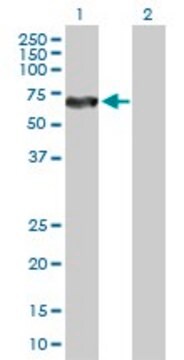
64 & 74 kDa
TUC (TOAD [Turned On After Division]/ Ulip/CRMP) is a family of proteins that have emerged as strong candidates for a role in neuronal growth cone signaling. The TUC-4 family members reach their highest expression levels in early post-mitotic neurons during their peak periods of axonal growth. TUC-4 is not expressed in neural progenitors or adult neurons (with minor exception). Data suggests that TUC-4 plays a role in axonal outgrowth, pathfinding and possibly in the process that permits growing axons to choose proper routes and targets (Quinn, 1999). The TUC-4 protein is expressed primarily within the cytoplasm of postmitotic neurons as they begin their migration out of the ventricular zone into the developing cortical plate (Minturn, 1995a). TUC-4 is expressed in neuronal cell bodies, neurites, and along the most distal regions of neuronal growth cones, including the lamellipodia and filopodia (Minturn, 1995b). Expression of TUC-4 is observed by day E12 in rats coincident with the expression of the early neuronal marker class III beta-tubulin (Quinn, 1999). TUC-4 expression is rarely observed in neuronal cells expressing the mitotic marker PCNA (Minturn, 1995a). The expression of TUC-4 has been shown to be upregulated in response to NGF in rats (Minturn, 1995b) and in response to retinoic acid in a human neuroblastoma cell line (SMS-KCNR; Gaetano, 1997).

Immunogen

Synthetic peptide corresponding to amino acids 499 to 511 of TUC-4a and amino acids 612-624 of TUC-4b (YDGPVFDLTTTPK)

Application

Anti-TUC-4 Protein Antibody detects level of TUC-4 Protein & has been published & validated for use in IC, IH, IP & WB.
Immunohistochemistry: 1:1,000-1:5,000 using PFA (DAB detection).
Immunocytochemistry: 1:1,000-1:5,000 (DAB detection).
Western blot: 1:2,500-1:25,000 using alkaline phosphatase.
Immunoprecipitation

Optimal working dilutions must be determined by end user.

Biochem/physiol Actions

Specifically recognizes the TUC-4 (Ulip-1/CRMP-4/DRP-3) splice variants, TUC-4a (64 kDa) and the N-terminally extended TUC-4b (75 kDa) (Quinn, 2003). AB5454 has been reported to label early postmitotic neurons in prenatal rat brain. Labeling is observed primarily within the cytoplasm along the most distal regions of neuronal growth cones including lamellipodia and filopodia. The antibody is not reactive with the proteins TUC-1 (Ulip-3/CRMP-1), TUC-2 (Ulip-2/CRMP-2) or TUC-3 (Ulip-4/CRMP-3). It does not label neural progenitors or radial glia.

Physical form

Rabbit Serum. Liquid containing 0.2% sodium azide.

Analysis Note

Control
POSITIVE CONTROL: Fetal brain/spinal cord tissue. Human neuroblastoma cell line SMS-KCNR or rat PC12 cells.

Other Notes

Concentration: Please refer to the Certificate of Analysis for the lot-specific concentration.

Legal Information

CHEMICON is a registered trademark of Merck KGaA, Darmstadt, Germany
Ta strona może zawierać tekst przetłumaczony maszynowo.

Porównaj podobne pozycje

Wyświetl pełne porównanie

Pokaż różnice

1 of 1

Ta pozycja
SAB1408954HPA010948SAB1411116
conjugate

unconjugated

conjugate

unconjugated

conjugate

unconjugated

conjugate

unconjugated

Quality Level

100

Quality Level

-

Quality Level

100

Quality Level

100

biological source

rabbit

biological source

mouse

biological source

rabbit

biological source

rabbit

antibody form

serum

antibody form

purified immunoglobulin

antibody form

affinity isolated antibody

antibody form

purified immunoglobulin

clone

polyclonal

clone

polyclonal

clone

polyclonal

clone

polyclonal

technique(s)

immunocytochemistry: suitable, immunoprecipitation (IP): suitable, immunohistochemistry: suitable, western blot: suitable

technique(s)

western blot: 1 μg/mL

technique(s)

immunoblotting: 0.04-0.4 μg/mL, immunofluorescence: 0.25-2 μg/mL, immunohistochemistry: 1:1000-1:2500

technique(s)

western blot: 1 μg/mL


Still not finding the right product?

Wypróbuj nasze narzędzie Narzędzie selektora produktów, aby zawęzić opcje.


Klasa składowania

12 - Non Combustible Liquids

wgk

WGK 1

flash_point_f

Not applicable

flash_point_c

Not applicable


Certyfikaty analizy (CoA)

Poszukaj Certyfikaty analizy (CoA), wpisując numer partii/serii produktów. Numery serii i partii można znaleźć na etykiecie produktu po słowach „seria” lub „partia”.

Masz już ten produkt?

Dokumenty związane z niedawno zakupionymi produktami zostały zamieszczone w Bibliotece dokumentów.

Odwiedź Bibliotekę dokumentów


Numer pozycji handlu globalnego

SKUNUMER GTIN
AB545404053252368431

Questions

Reviews

No rating value

Active Filters