Przejdź do zawartości
Merck

Przejdź do

AB2283

Anti-Tbr2 Antibody

from rabbit, purified by affinity chromatography

Synonim(y):

eomesodermin (Xenopus laevis) homolog, eomesodermin homolog (Xenopus laevis), t box, brain, 2

Zaloguj się, aby wyświetlić ceny organizacyjne i kontraktowe.

Wybierz wielkość

Zmień widok
Gabaryty przesyłkiSKUDostępnośćCena netto
100 μg

Dostępne do wysyłki DZISIAJzKuehne + Nagel Sp. z o.o.

2050,00 zł

Informacje o tej pozycji

UNSPSC Code:
12352203
NACRES:
NA.41
eCl@ss:
32160702
Conjugate:
unconjugated
Clone:
polyclonal
Application:
IHC
Citations:
36

2050,00 zł


Dostępne do wysyłki DZISIAJSzczegóły


Zamów zamówienie zbiorcze
Pomoc techniczna
Potrzebujesz pomocy? Nasz zespół doświadczonych naukowców chętnie Ci pomoże.
Pozwól nam pomóc


biological source

rabbit

Quality Level

conjugate

unconjugated

antibody form

affinity isolated antibody

antibody product type

primary antibodies

clone

polyclonal

purified by

affinity chromatography

species reactivity

human, mouse

technique(s)

immunohistochemistry: suitable

NCBI accession no.

UniProt accession no.

shipped in

wet ice

target post-translational modification

unmodified

Gene Information

human ... EOMES(8320)
mouse ... Eomes(13813)

General description

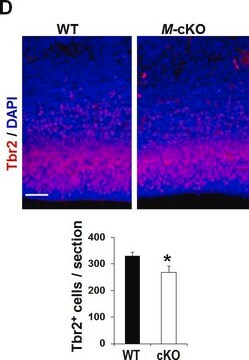
Tbr2 (a T-domain transcription factor) is a member of a conserved protein family that shares a common DNA-binding domain, the T-box. T-box genes encode transcription factors involved in the regulation of developmental processes. Trb2 has been shown to play a role in the development of the neocortex and functions in the differentiation pathway of radial glia to postmitotic projection neuron.

Immunogen

Epitope: Internal Domain
KLH-conjugated linear peptide corresponding to mouse Tbr2.

Application

Research Category
Neuroscience
Research Sub Category
Developmental Neuroscience
This Anti-Tbr2 Antibody is validated for use in IH for the detection of Tbr2.

Biochem/physiol Actions

This antibody recognizes Tbr2.

Physical form

Affinity purified
Purified rabbit polyclonal in buffer containing 0.1 M Tris-Glycine (pH 7.4, 150 mM NaCl) with 0.05% sodium azide.

Preparation Note

Stable for 1 year at 2-8°C from date of receipt.

Analysis Note

Control
Human Brain Tissue
Evaluated by Immunohistochemistry of human brain tissue.

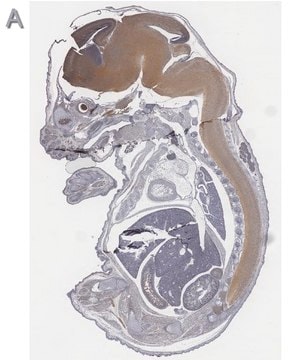
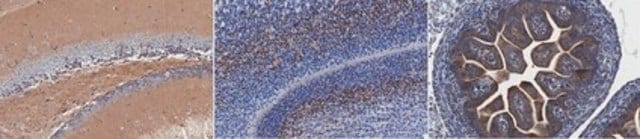
Immunohistochemistry Analysis: A 1:300 dilution of Anti-Tbr2 antibody from a previous lot detected Tbr2 in mouse and human brain tissue.

Other Notes

Concentration: Please refer to the Certificate of Analysis for the lot-specific concentration.

Disclaimer

Unless otherwise stated in our catalog or other company documentation accompanying the product(s), our products are intended for research use only and are not to be used for any other purpose, which includes but is not limited to, unauthorized commercial uses, in vitro diagnostic uses, ex vivo or in vivo therapeutic uses or any type of consumption or application to humans or animals.
Ta strona może zawierać tekst przetłumaczony maszynowo.

Porównaj podobne pozycje

Wyświetl pełne porównanie

Pokaż różnice

1 of 1

Ta pozycja
ZRB1368ABN1687WH0010716M1
conjugate

unconjugated

conjugate

unconjugated

conjugate

unconjugated

conjugate

unconjugated

antibody form

affinity isolated antibody

antibody form

purified antibody

antibody form

affinity isolated antibody

antibody form

purified immunoglobulin

Quality Level

100

Quality Level

200

Quality Level

-

Quality Level

100

biological source

rabbit

biological source

rabbit (recombinant)

biological source

rabbit

biological source

mouse

species reactivity

human, mouse

species reactivity

human, mouse

species reactivity

mouse

species reactivity

human

technique(s)

immunohistochemistry: suitable

technique(s)

affinity binding assay: suitable, immunocytochemistry: suitable, immunohistochemistry: suitable, western blot: suitable

technique(s)

immunofluorescence: suitable, immunohistochemistry: suitable (paraffin), western blot: suitable

technique(s)

immunofluorescence: suitable, indirect ELISA: suitable, western blot: 1-5 μg/mL


Still not finding the right product?

Explore all of our products under

lub

Wypróbuj nasze narzędzie Narzędzie selektora produktów, aby zawęzić opcje.


Klasa składowania

12 - Non Combustible Liquids

wgk

WGK 1

flash_point_f

Not applicable

flash_point_c

Not applicable


Certyfikaty analizy (CoA)

Poszukaj Certyfikaty analizy (CoA), wpisując numer partii/serii produktów. Numery serii i partii można znaleźć na etykiecie produktu po słowach „seria” lub „partia”.

Masz już ten produkt?

Dokumenty związane z niedawno zakupionymi produktami zostały zamieszczone w Bibliotece dokumentów.

Odwiedź Bibliotekę dokumentów


Dan Xu et al.
PLoS biology, 16(12), e2006613-e2006613 (2018-12-20)
Mutations of WD repeat domain 62 (WDR62) lead to autosomal recessive primary microcephaly (MCPH), and down-regulation of WDR62 expression causes the loss of neural progenitor cells (NPCs). However, how WDR62 is regulated and hence controls neurogenesis and brain size remains
Joanna Yeung et al.
The Journal of neuroscience : the official journal of the Society for Neuroscience, 36(35), 9057-9069 (2016-09-02)
Pax6 is a prominent gene in brain development. The deletion of Pax6 results in devastated development of eye, olfactory bulb, and cortex. However, it has been reported that the Pax6-null Sey cerebellum only has minor defects involving granule cells despite
Melanie Schoof et al.
Acta neuropathologica communications, 7(1), 199-199 (2019-12-07)
CREB (cyclic AMP response element binding protein) binding protein (CBP, CREBBP) is a ubiquitously expressed transcription coactivator with intrinsic histone acetyltransferase (KAT) activity. Germline mutations within the CBP gene are known to cause Rubinstein-Taybi syndrome (RSTS), a developmental disorder characterized


Numer pozycji handlu globalnego

SKUNUMER GTIN
AB228304053252729454

Questions

Reviews

No rating value

Active Filters