

The exact sequence for the immunogen for AB1783 is not available as it is considered proprietary. However, we do know that the immunogen used to create AB1783 is located at the C-terminus of Rat EAAT2 (GLT-1) within the cytoplasm.
AB1783

Anti-Glutamate Transporter Antibody, Glial
serum, Chemicon®
Synonim(y):
GLT-1, EAAT2
Zaloguj się, aby wyświetlić ceny organizacyjne i kontraktowe.
Wybierz wielkość
Zmień widok
| Gabaryty przesyłki | SKU | Dostępność | Cena netto |
|---|---|---|---|
| 50 μL | Dostępne do wysyłki DZISIAJzKuehne + Nagel Sp. z o.o. | 2110,00 zł |
Informacje o tej pozycji
UNSPSC Code:
12352203
NACRES:
NA.41
eCl@ss:
32160702
Conjugate:
unconjugated
Clone:
polyclonal
Application:
IF, IHC, WB
Citations:
145
2110,00 zł
Dostępne do wysyłki DZISIAJSzczegóły
Rekombinowane, niezawierające konserwantów przeciwciało jest dostępne dla Twojego celu. Wypróbuj ZRB1630
Pomoc techniczna
Potrzebujesz pomocy? Nasz zespół doświadczonych naukowców chętnie Ci pomoże.
Pozwól nam pomócbiological source
guinea pig
Quality Level
conjugate
unconjugated
antibody form
serum
antibody product type
primary antibodies
clone
polyclonal
species reactivity
human, mouse, rat
manufacturer/tradename
Chemicon®
technique(s)
immunofluorescence: suitable, immunohistochemistry: suitable (paraffin), western blot: suitable
NCBI accession no.
UniProt accession no.
shipped in
dry ice
target post-translational modification
unmodified
Gene Information
human ... SLC1A2(6506)
General description
Glutamate transporters (GluT) function to remove L-glutamate (Glu), the primary excitatory neurotransmitter in the mammalian central nervous system (CNS), from the synaptic cleft. By clearing the synapse in this manner Glu can be recycled for later use, the proper diffusion gradient can be maintained and excitotoxicity can be prevented. There have been reports of many different members of a GluT multigene family; GLT1, GLAST, EAAC1 and EAAT2. mRNA has been identified in brain for each of these proteins.
EAAT2 transports L-glutamate and also L- and D-aspartate. It is essential for terminating the postsynaptic action of glutamate by rapidly removing released glutamate from the synaptic cleft. Acts as a symport by cotransporting sodium.
EAAT2 transports L-glutamate and also L- and D-aspartate. It is essential for terminating the postsynaptic action of glutamate by rapidly removing released glutamate from the synaptic cleft. Acts as a symport by cotransporting sodium.
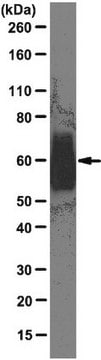
~62 kDa
Immunogen
Epitope: C-terminus
Synthetic peptide from the carboxy-terminus of rat GLT-1.
Application
Detect Glutamate Transporter using this Anti-Glutamate Transporter Antibody, Glial validated for use in IH(P), IF & WB.
Evaluated by Western Blot on mouse brain membrane lysates.
Western Blot: 1:500 dilution of this antibody detected GLT-1 on 10 ug of mouse brain membrane lysates.
Immunohistochemistry:
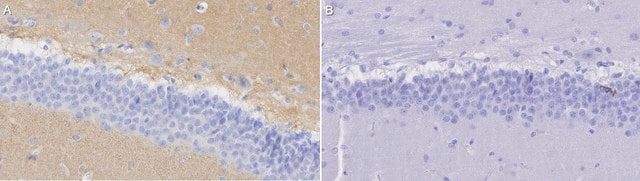
1:1,000-1:4,000 dilution from a previuos lot used a DAB detection system on adult rat forebrain fixed with 4% paraformaldehyde.
Immunohistochemistry:
1:5,000-10,000 dilution from a previuos lot used a cyanine conjugated secondary antibody.
Enzymatic detection requires substantially higher primary antibody dilutions. Lightly fixed 4% PFA material is recommended.
Notes:
Male Sprague-Dawley rats (b.wt. 100-150g) were anesthetized with sodium pentobarbital and perfused via the ascending aorta with 50 mL of Ca2+-free Tyrode+s solution followed by a formalin-picric acid fixative (4% paraformaldehyde with 0.4% picric acid in 0.16 M phosphate buffer, pH 6.9) for 6 minutes. Tissues were rapidly dissected out, postfixed in the same fixative for 90 minutes and rinsed for at least 24 hours in 0.1 M phosphate buffer (pH 7.4) containing 10% sucrose. Sections were cut (14 um) in a cryostat and incubated at 4°C overnight with AB1783 (1:5,000-1:10,000). After rinsing in PBS sections were incubated for 60 minutes at room temperature with Cy3-conjugated secondary antibodies. After mounting in a mixture of PBS and glycerol (1:3) containing 0.1% p-phenylenediamine, sections were examined with a Nikon Microphot-SA epifluorescence microscope.
Optimal working dilutions must be determined by the end user.
Western Blot: 1:500 dilution of this antibody detected GLT-1 on 10 ug of mouse brain membrane lysates.
Immunohistochemistry:
1:1,000-1:4,000 dilution from a previuos lot used a DAB detection system on adult rat forebrain fixed with 4% paraformaldehyde.
Immunohistochemistry:
1:5,000-10,000 dilution from a previuos lot used a cyanine conjugated secondary antibody.
Enzymatic detection requires substantially higher primary antibody dilutions. Lightly fixed 4% PFA material is recommended.
Notes:
Male Sprague-Dawley rats (b.wt. 100-150g) were anesthetized with sodium pentobarbital and perfused via the ascending aorta with 50 mL of Ca2+-free Tyrode+s solution followed by a formalin-picric acid fixative (4% paraformaldehyde with 0.4% picric acid in 0.16 M phosphate buffer, pH 6.9) for 6 minutes. Tissues were rapidly dissected out, postfixed in the same fixative for 90 minutes and rinsed for at least 24 hours in 0.1 M phosphate buffer (pH 7.4) containing 10% sucrose. Sections were cut (14 um) in a cryostat and incubated at 4°C overnight with AB1783 (1:5,000-1:10,000). After rinsing in PBS sections were incubated for 60 minutes at room temperature with Cy3-conjugated secondary antibodies. After mounting in a mixture of PBS and glycerol (1:3) containing 0.1% p-phenylenediamine, sections were examined with a Nikon Microphot-SA epifluorescence microscope.
Optimal working dilutions must be determined by the end user.
Research Category
Neuroscience
Neuroscience
Research Sub Category
Ion Channels & Transporters
Ion Channels & Transporters
Biochem/physiol Actions
Glial Glutamate Transporter GLT-1 (EAAT2). The antibody has been tested on central nervous system tissue. Preabsorption of the antiserum with the immunogen peptide (Catalog number AG391) completely abolishes the immunostaining.
Physical form
Guinea pig antiserum containing no preservatives.
Unpurified
Preparation Note
Stable for 1 year at -20ºC from date of receipt.
Analysis Note
Control
Rat brain tissue
Rat brain tissue
Evaluated by Western Blot on mouse brain membrane lysates.
Other Notes
Concentration: Please refer to the Certificate of Analysis for the lot-specific concentration.
Legal Information
CHEMICON is a registered trademark of Merck KGaA, Darmstadt, Germany
Disclaimer
Unless otherwise stated in our catalog or other company documentation accompanying the product(s), our products are intended for research use only and are not to be used for any other purpose, which includes but is not limited to, unauthorized commercial uses, in vitro diagnostic uses, ex vivo or in vivo therapeutic uses or any type of consumption or application to humans or animals.
Ta strona może zawierać tekst przetłumaczony maszynowo.
1 of 1
Ta pozycja | |||
|---|---|---|---|
| conjugate unconjugated | conjugate unconjugated | conjugate - | conjugate unconjugated |
| biological source guinea pig | biological source mouse | biological source guinea pig | biological source rabbit |
| Quality Level 100 | Quality Level 100 | Quality Level 100 | Quality Level 100 |
| antibody form serum | antibody form purified immunoglobulin | antibody form serum | antibody form purified immunoglobulin |
| UniProt accession no. | UniProt accession no. | UniProt accession no. | UniProt accession no. |
| species reactivity human, mouse, rat | species reactivity mouse, human | species reactivity rat | species reactivity human |
Still not finding the right product?
Wypróbuj nasze narzędzie Narzędzie selektora produktów, aby zawęzić opcje.
Klasa składowania
10 - Combustible liquids
wgk
WGK 1
Certyfikaty analizy (CoA)
Poszukaj Certyfikaty analizy (CoA), wpisując numer partii/serii produktów. Numery serii i partii można znaleźć na etykiecie produktu po słowach „seria” lub „partia”.
Masz już ten produkt?
Dokumenty związane z niedawno zakupionymi produktami zostały zamieszczone w Bibliotece dokumentów.
Powiązane treści
Glutamate is an excitatory neurotransmitter found in the synaptic vesicles of glutamatergic synapses. The post-synaptic neurons in these synapses contain ionotropic and metabotropic glutamate receptors. Glutamate binds to AMPA (α-amino-3-hydroxy-5- methylisoxazole-4-propionic acid) subtype glutamate receptors, leading to sodium influx into the post-synaptic cell and resulting in neuronal excitability and synaptic transmission. The NMDA (N-methyl-d-aspartate) subtype glutamate receptors, on the other hand, regulate synaptic plasticity, and can influence learning and memory. The metabotropic g-protein coupled mGluRs modulate downstream calcium signaling pathways and indirectly influence the synapse’s excitability. The synaptic architecture includes intracellular scaffolding proteins (PSD-95, GRIP), intercellular cell adhesion molecules (NCAMs, N-Cadherins), and a variety of signaling proteins (CaMKII/PKA, PP1/PP2B). Processes critical for synaptic transmission and plasticity are influenced by these molecules and their interactions. When the function of these molecules is disrupted, it leads to synaptic dysfunction and degeneration, and can contribute to dementia as seen in Alzheimer’s disease.
Noncell-autonomous photoreceptor degeneration in a zebrafish model of choroideremia.
Krock, BL; Bilotta, J; Perkins, BD
Proceedings of the National Academy of Sciences of the USA null
R C Roberts et al.
Neuroscience, 277, 522-540 (2014-07-30)
The process of glutamate release, activity, and reuptake involves the astrocyte, the presynaptic and postsynaptic neurons. Glutamate is released into the synapse and may occupy and activate receptors on both neurons and astrocytes. Glutamate is rapidly removed from the synapse
Activity of D-amino acid oxidase is widespread in the human central nervous system.
Sasabe, J; Suzuki, M; Imanishi, N; Aiso, S
Frontiers in synaptic neuroscience null
Numer pozycji handlu globalnego
| SKU | NUMER GTIN |
|---|---|
| AB1783 | 04053252509391 |
-
Could you provide the exact sequence of the immunogen for the antibody AB1783?
1 answer-
Helpful?
-