Przejdź do zawartości
Merck

Przejdź do

495604

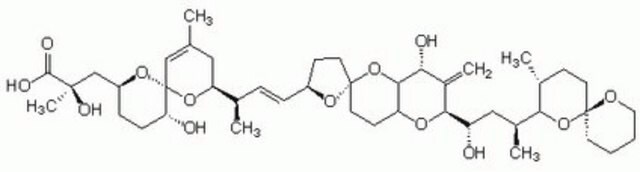
Okadaic acid

from Prorocentrum sp., ≥95% (HPLC), solid (glassy), protein phosphatase 1 inhibitor, Calbiochem

Synonim(y):

Okadaic Acid, Prorocentrum sp., OA

Zaloguj się, aby wyświetlić ceny organizacyjne i kontraktowe.

Wybierz wielkość

Zmień widok
Gabaryty przesyłkiSKUDostępnośćCena netto

Informacje o tej pozycji

Wzór empiryczny (zapis Hilla):
C44H68O13
Numer CAS:
Masa cząsteczkowa:
805.00
UNSPSC Code:
12352106
NACRES:
NA.77
MDL number:
Assay:
≥95% (HPLC)
Form:
solid (glassy)
Quality level:
Storage condition:
OK to freeze, protect from light
Aby zapytać o ten produkt 495604, skontaktuj się z lokalnym biurem lub sprzedawcą firmy Merck. Skontaktuj się z zespołem ds. pomocy technicznej
Pomoc techniczna
Potrzebujesz pomocy? Nasz zespół doświadczonych naukowców chętnie Ci pomoże.
Pozwól nam pomóc


Nazwa produktu

Okadaic Acid, Prorocentrum sp., Okadaic Acid, CAS 78111-17-8, is a highly potent inhibitor of protein phosphatase 1 (IC50 = 10-15 nM) and 2A (IC50 = 0.1 nM).

Quality Level

assay

≥95% (HPLC)

form

solid (glassy)

manufacturer/tradename

Calbiochem®

storage condition

OK to freeze, protect from light

color

colorless

solubility

DMF: soluble, chloroform: soluble, ethanol: soluble, methanol: soluble

shipped in

ambient

storage temp.

−20°C

SMILES string

O1[C@]7(O[C@@H](CC[C@H]7O)C[C@](O)(C)C(=O)O)C=C(C[C@H]1[C@H](C)\C=C\[C@@H]2O[C@@]3(OC4[C@H](O[C@@H](C(=C)[C@H]4O)[C@@H](O)C[C@@H](C5O[C@]6(OCCCC6)CC[C@H]5C)C)CC3)CC2)C

InChI

1S/C44H68O13/c1-25-21-34(55-44(23-25)35(46)12-11-31(54-44)24-41(6,50)40(48)49)26(2)9-10-30-14-18-43(53-30)19-15-33-39(57-43)36(47)29(5)38(52-33)32(45)22-28(4)37-27(3)13-17-42(56-37)16-7-8-20-51-42/h9-10,23,26-28,30-39,45-47,50H,5,7-8,11-22,24H2,1-4,6H3,(H,48,49)/b10-9+/t26-,27-,28+,30+,31+,32+,33-,34+,35-,36-,37?,38+,39?,41-,42+,43-,44-/m1/s1

InChI key

QNDVLZJODHBUFM-AAWJMCDUSA-N

General description

An ionophore-like polyether derivative of a C38 fatty acid compound isolated from the dinoflagellates that have fed on the marine sponge Halinchrondria okadai. It is a potent non-comepetitive, reversible inhibitor of serine/threonine-specific protein phosphatases 1 (PP1, IC50 = 10-15 nM, rabbit skeletal muscle, catalytic subunit) and 2A (PP2A, IC50 = 0.1 nM, rabbit skeletal muscle, catalytic subunit). It has only a trivial effect on protein phosphatase 2B (IC50 = 5 µM), a Ca2+/calmodulin-dependent enzyme, while PP2C, a Mg2+ dependent enzyme, is unaffected. Okadaic acid has no significant effect on the activities of tyrosine phosphatases, alkaline phosphatase, acid phosphatase, and inositol trisphosphatase. It is also a non-phorbol ester-type tumor promoter on mouse skin. Useful for the study of protein phosphatases and of PP1/PP2A in cell extracts, as well as in intact cells. Induces apoptosis in human breast carcinoma (MB-231 and MCF-7) and in myeloid cells, but inhibits glucocorticoid-induced apoptosis in T-cell hybridomas. Has marked contractile effect on smooth muscles and heart muscles. Implicated as a causative agent of diarrhetic shellfish poisoning.

Biochem/physiol Actions

Cell permeable: no
Primary Target
Protein phosphatase
Product does not compete with ATP.
Reversible: no
Target IC50: 10-15 nM and 0.1 nM against protein phosphatase 1 and protein phosphatase 2A, respectively

Packaging

Packaged under inert gas

Preparation Note

Following reconstitution, aliquot and freeze (-20°C). Stock solutions are stable for up to 1 month at -20°C.

Other Notes

Due to the nature of the Hazardous Materials in this shipment, additional shipping charges may be applied to your order. Certain sizes may be exempt from the additional hazardous materials shipping charges. Please contact your local sales office for more information regarding these charges.
Gjertsen, B.T., et al. 1994. J. Cell Sci.107, 3363.
Kiguchi, K., et al. 1994. Cell Growth Differentiation5, 995.
Ohaka, Y., et al. 1993. Biochem. Biophys. Res. Commun. 197, 916.
Gopalakrishna, R., et al. 1992. Biochem. Biophys. Res. Commun. 189, 950.
Kreienbuhl, P., et al. 1992. Blood80, 2911.
Nomura, M., et al. 1992. Biochemistry31, 11915.
Song, Q., et al. 1992. J. Cell Physiol.153, 550.
Tada, Y., et al. 1992. Immunopharmacol.24, 17.
Cohen, P., et al. 1990. Trends Biochem. Sci.15, 98.
Cohen, P. 1989. Annu. Rev. Biochem.58, 453.
Cohen, P., and Cohen, P.T. 1989. J. Biol. Chem.264, 21435.
Haystead, T.A., et al. 1989. Nature337, 78.

Legal Information

CALBIOCHEM is a registered trademark of Merck KGaA, Darmstadt, Germany

Disclaimer

Toxicity: Toxic (F)
Ta strona może zawierać tekst przetłumaczony maszynowo.

Porównaj podobne pozycje

Wyświetl pełne porównanie

Pokaż różnice

1 of 1

Ta pozycja
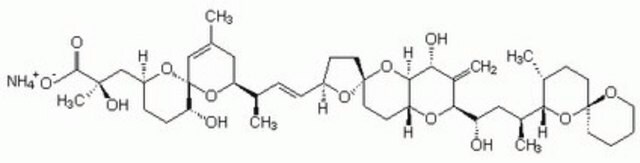
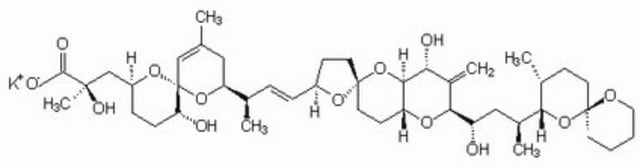
459616459618459620
assay

≥95% (HPLC)

assay

≥98% (TLC)

assay

≥95% (HPLC)

assay

≥98% (TLC)

form

solid (glassy)

form

solid

form

solid

form

solid

manufacturer/tradename

Calbiochem®

manufacturer/tradename

Calbiochem®

manufacturer/tradename

Calbiochem®

manufacturer/tradename

Calbiochem®

Quality Level

100

Quality Level

100

Quality Level

100

Quality Level

100

storage temp.

−20°C

storage temp.

−20°C

storage temp.

−20°C

storage temp.

−20°C

storage condition

OK to freeze, protect from light

storage condition

OK to freeze, protect from light

storage condition

OK to freeze, protect from light

storage condition

OK to freeze, protect from light


Still not finding the right product?

Explore all of our products under


pictograms

Skull and crossbones

signalword

Danger

Hazard Classifications

Acute Tox. 3 Dermal - Acute Tox. 3 Inhalation - Acute Tox. 3 Oral - Skin Irrit. 2

Klasa składowania

6.1C - Combustible acute toxic Cat.3 / toxic compounds or compounds which causing chronic effects

wgk

WGK 3

flash_point_f

Not applicable

flash_point_c

Not applicable


Certyfikaty analizy (CoA)

Poszukaj Certyfikaty analizy (CoA), wpisując numer partii/serii produktów. Numery serii i partii można znaleźć na etykiecie produktu po słowach „seria” lub „partia”.

Masz już ten produkt?

Dokumenty związane z niedawno zakupionymi produktami zostały zamieszczone w Bibliotece dokumentów.

Odwiedź Bibliotekę dokumentów


Sosuke Yagishita et al.
Neurology international, 16(3), 653-662 (2024-06-26)
The tau protein is a microtubule-associated protein that promotes microtubule stabilization. The phosphorylation of the tau protein has been linked to its dissociation from microtubules. Here, we examined the relationship between neuronal depolarization activity and tau protein phosphorylation by employing
Bence Hajdú et al.
Biomolecules, 12(11) (2022-11-12)
Autophagy-dependent cellular survival is tightly regulated by both kinases and phosphatases. While mTORC1 inhibits autophagy by phosphorylating ULK1, PP2A is able to remove this phosphate group from ULK1 and promotes the key inducer of autophagosome formation. However, ULK1 inhibits mTORC1
Viviana Job et al.
iScience, 25(7), 104596-104596 (2022-07-06)
Two-partner secretion (TPS) is widespread in the bacterial world. The pore-forming TPS toxin ExlA of Pseudomonas aeruginosa is conserved in pathogenic and environmental Pseudomonas. While P. chlororaphis and P. entomophila displayed ExlA-dependent killing, P. putida did not cause damage to eukaryotic cells. ExlA


Numer pozycji handlu globalnego

SKUNUMER GTIN
495604-25UG04055977199758
495604-100UG04055977199741
495604-500UG04055977199765

Questions

Reviews

No rating value

Active Filters