Przejdź do zawartości
Merck

Przejdź do

217714

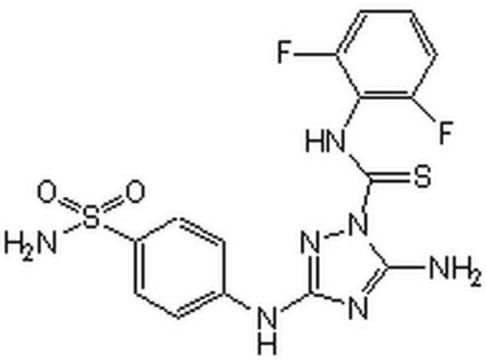
Cdk1/2 Inhibitor III

The Cdk1/2 Inhibitor III, also referenced under CAS 443798-55-8, controls the biological activity of Cdk1/2. This small molecule/inhibitor is primarily used for Phosphorylation & Dephosphorylation applications.

Synonim(y):

Cdk1/2 Inhibitor III, 5-Amino-3-((4-(aminosulfonyl)phenyl)amino)-N-(2,6-difluorophenyl)-1H-1,2,4-triazole-1-carbothioamide

Zaloguj się, aby wyświetlić ceny organizacyjne i kontraktowe.

Wybierz wielkość

Zmień widok
Gabaryty przesyłkiSKUDostępnośćCena netto
1 mg

Dostępne do wysyłki DZISIAJzKuehne + Nagel Sp. z o.o.

631,00 zł

Informacje o tej pozycji

Wzór empiryczny (zapis Hilla):
C15H13F2N7O2S2
Numer CAS:
Masa cząsteczkowa:
425.44
MDL number:
UNSPSC Code:
12352200
NACRES:
NA.77
Assay:
≥95% (HPLC)
Form:
solid
Quality level:
Storage condition:
OK to freeze, protect from light

631,00 zł


Dostępne do wysyłki DZISIAJSzczegóły


Pomoc techniczna
Potrzebujesz pomocy? Nasz zespół doświadczonych naukowców chętnie Ci pomoże.
Pozwól nam pomóc


Quality Level

assay

≥95% (HPLC)

form

solid

manufacturer/tradename

Calbiochem®

storage condition

OK to freeze, protect from light

color

white

solubility

DMSO: 10 mg/mL, THF: soluble, acetone: soluble

shipped in

ambient

storage temp.

2-8°C

SMILES string

Fc1c(c(ccc1)F)NC(=S)[n]2nc(nc2N)Nc3ccc(cc3)[S](=O)(=O)N

InChI

1S/C15H13F2N7O2S2/c16-10-2-1-3-11(17)12(10)21-15(27)24-13(18)22-14(23-24)20-8-4-6-9(7-5-8)28(19,25)26/h1-7H,(H,21,27)(H2,19,25,26)(H3,18,20,22,23)

InChI key

ARIOBGGRZJITQX-UHFFFAOYSA-N

General description

A cell-permeable triazolo-diamine compound that displays anti-proliferative properties in various human cancer cells (IC50 = 20 nM, 35 nM and 92 nM in HCT-116, HeLa, and A375 cells, respectively). Acts as a highly potent, reversible, ATP-competitive inhibitor of Cdk1/cyclin B and Cdk2/cyclin A (IC50 = 600 pM and 500 pM, respectively) with selectivity over VEGF-R2 (IC50 = 32 nM), GSK-3β (IC50 = 140 nM), and a panel of eight other kinases (IC50 ≥ 1 µM).

Biochem/physiol Actions

Cell permeable: yes
Primary Target
Cdk1/cyclin B, Cdk2/cyclin A
Product competes with ATP.
Reversible: yes
Target IC50: 20 nM, 35 nM and 92 nM for anti-proliferative properties in HCT-116, HeLa, and A375 cells, respectively; 600 pM and 500 pM, against Cdk1/cyclin B and Cdk2/cyclin A, respectively

Packaging

Packaged under inert gas

Preparation Note

Following reconstitution, aliquot and freeze (-20°C). Stock solutions are stable for up to 6 months at -20°C.

Other Notes

Lin, R., et al. 2005.J. Med. Chem.48, 4208.

Legal Information

CALBIOCHEM is a registered trademark of Merck KGaA, Darmstadt, Germany

Disclaimer

Toxicity: Harmful (C)
Ta strona może zawierać tekst przetłumaczony maszynowo.

Porównaj podobne pozycje

Wyświetl pełne porównanie

Pokaż różnice

1 of 1

Ta pozycja
219478238803238811
assay

≥95% (HPLC)

assay

≥90% (HPLC)

assay

≥98% (HPLC)

assay

≥95% (HPLC)

form

solid

form

solid

form

solid

form

solid

Quality Level

100

Quality Level

100

Quality Level

100

Quality Level

100

manufacturer/tradename

Calbiochem®

manufacturer/tradename

Calbiochem®

manufacturer/tradename

Calbiochem®

manufacturer/tradename

Calbiochem®

storage temp.

2-8°C

storage temp.

2-8°C

storage temp.

2-8°C

storage temp.

2-8°C

solubility

DMSO: 10 mg/mL, acetone: soluble, THF: soluble

solubility

DMSO: 10 mg/mL

solubility

DMSO: 10 mg/mL

solubility

DMSO: 10 mg/mL, ethanol: 5 mg/mL


Klasa składowania

11 - Combustible Solids

wgk

WGK 1

flash_point_f

Not applicable

flash_point_c

Not applicable


Certyfikaty analizy (CoA)

Poszukaj Certyfikaty analizy (CoA), wpisując numer partii/serii produktów. Numery serii i partii można znaleźć na etykiecie produktu po słowach „seria” lub „partia”.

Masz już ten produkt?

Dokumenty związane z niedawno zakupionymi produktami zostały zamieszczone w Bibliotece dokumentów.

Odwiedź Bibliotekę dokumentów


Sungsoo Kim et al.
Scientific reports, 12(1), 16810-16810 (2022-10-08)
External signaling controls cell-cycle entry until cells irreversibly commit to the cell cycle to ensure faithful DNA replication. This process is tightly regulated by cyclin-dependent kinases (CDKs) and the retinoblastoma protein (Rb). Here, using live-cell sensors for CDK4/6 and CDK2
Ana Domingo-Muelas et al.
Cellular and molecular life sciences : CMLS, 80(1), 36-36 (2023-01-11)
Cell differentiation involves profound changes in global gene expression that often has to occur in coordination with cell cycle exit. Because cyclin-dependent kinase inhibitor p27 reportedly regulates proliferation of neural progenitor cells in the subependymal neurogenic niche of the adult mouse
Yilin Fan et al.
Cell reports, 36(4), 109436-109436 (2021-07-29)
Contact inhibition of cell proliferation regulates tissue size and prevents uncontrolled cell expansion. When cell density increases, contact inhibition can force proliferating cells into quiescence. Here we show that the variable memory of local cell density experienced by a mother


Numer pozycji handlu globalnego

SKUNUMER GTIN
217714-1MG04055977202397

Questions

Reviews

No rating value

Active Filters