
17-10394

Aktywacja Rac1/cdc42 Test Pulldown z kulkami magnetycznymi
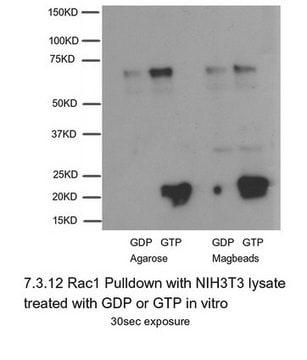
The Rac1/cdc42 Activation Magnetic Beads Pulldown Assay provides an effective method for detecting Rac & Cdc42 activity in cell lysates with higher yield & easier process utilizing magenetic bead properties.
Wybierz wielkość
| Gabaryty przesyłki | SKU | Dostępność | Cena netto |
|---|---|---|---|
| 30 assays | Przewidywana wysyłka DZISIAJzKuehne + Nagel Sp. z o.o. | 3800,00 zł |
Informacje o tej pozycji
3800,00 zł
Przewidywana wysyłka DZISIAJSzczegóły
Quality Level
species reactivity
human, rat, mouse
manufacturer/tradename
Upstate®
technique(s)
activity assay: suitable, affinity binding assay: suitable (G-protein)
NCBI accession no.
UniProt accession no.
shipped in
dry ice
Gene Information
human ... RAC1(5879)
General description
Application
Cell Signaling
Signaling
Biochem/physiol Actions
Anti-Rac1, clone 23A8: Species Cross-reactivity: Human, mouse and rat. Other species cross-reactivity unknown.
Anti-cdc42 Species Cross-reactivity: Human, mouse, rat and dog. Other species cross-reactivity unknown.
Preparation Note
Analysis Note
Other Notes
Anti-Rac1, clone 23A8: One vial containing 250 ug of purified IgG2akappa in 250 uL of storage buffer (0.1 M Tris-glycine, pH 7.4, 0.15 M NaCl, containing 0.05% sodium azide).
Anti-cdc42, mouse monoclonal IgG1: One vial containing 50 ug of purified mouse IgG1 in 200 uL of 10 mM sodium phosphate, pH 7.5, 75 mM NaCl, 0.75 mM sodium azide, 0.5 mg/mL BSA and 50% glycerol.
Mg2+ Lysis/Wash Buffer, 5X, Catalog # 20-168 : Two vials, each vial containing 18 mL of 5X MLB: 125 mM HEPES, pH 7.5, 750 mM NaCl, 5% Igepal CA-630, 50 mM MgCl2, 5 mM EDTA and 10% glycerol.
100X GTPγS, 10mM, Catalog # 20-176: One vial containing 50 μL of 10 mM GTPγS, 100X stock, in 50 mM Tris-HCl, pH 7.8, non-hydrolyzable analog of GTP. Sufficient to label 5 mL of cell lysates.
100X GDP, 100mM, Catalog # 20-177: One vial containing 50 μL of 100 mM GDP, 100X stock, in 50 mM Tris-HCl, pH 7.8. GDP (Guanosine 5′-Diphosphate) for in vitro labeling of G-proteins in the inactive form. Sufficient to label 5ml of cell lysates.
Legal Information
Disclaimer
1 of 1
Ta pozycja | |||
|---|---|---|---|
| technique(s) activity assay: suitable, affinity binding assay: suitable (G-protein) | technique(s) activity assay: suitable, affinity binding assay: suitable (G-protein) | technique(s) activity assay: suitable (G-protein activation), affinity binding assay: suitable | technique(s) affinity binding assay: suitable |
| shipped in dry ice | shipped in wet ice | shipped in dry ice | shipped in dry ice |
| UniProt accession no. | UniProt accession no. | UniProt accession no. | UniProt accession no. |
| Gene Information human ... RAC1(5879) | Gene Information human ... RAC1(5879) | Gene Information human ... RAC1(5879) | Gene Information human ... CDC42(998) |
| manufacturer/tradename Upstate® | manufacturer/tradename Upstate® | manufacturer/tradename Upstate® | manufacturer/tradename Upstate® |
| species reactivity human, rat, mouse | species reactivity human, mouse, rat | species reactivity rat, mouse, human | species reactivity - |




signalword
Danger
Klasa składowania
10 - Combustible liquids
wgk
WGK 3
hcodes
Hazard Classifications
Aquatic Acute 1 - Aquatic Chronic 2 - ED ENV 1 - Eye Dam. 1
Certyfikaty analizy (CoA)
Poszukaj Certyfikaty analizy (CoA), wpisując numer partii/serii produktów. Numery serii i partii można znaleźć na etykiecie produktu po słowach „seria” lub „partia”.
Masz już ten produkt?
Dokumenty związane z niedawno zakupionymi produktami zostały zamieszczone w Bibliotece dokumentów.
Powiązane treści
Numer pozycji handlu globalnego
| SKU | NUMER GTIN |
|---|---|
| 17-10394 | 04053252930980 |