コンテンツへスキップ
Merck

スキップする

07-307

Anti-phospho-STAT1 (Tyr701) Antibody

Upstate®, from rabbit

別名:

Transcription factor ISGF-3 components p91/p84, signal transducer and activator of transcription 1, signal transducer and activator of transcription 1, 91kD, signal transducer and activator of transcription 1, 91kDa, signal transducer and activator of tr

ログインで組織・契約価格をご覧ください。

サイズを選択してください

表示を変更する
容量カタログ番号在庫状況単価

この商品について

UNSPSC Code:
12352203
NACRES:
NA.41
eCl@ss:
32160702
Clone:
polyclonal
Species reactivity:
mouse, chicken, human, rat
Application:
WB
Citations:
25
この製品は、Merck Milliporeウェブサイトでのみ注文できます。
テクニカルサービス
お困りのことがあれば、経験豊富なテクニカルサービスチームがお客様をサポートします。
お手伝いします


biological source

rabbit

Quality Level

antibody form

affinity purified immunoglobulin

antibody product type

primary antibodies

clone

polyclonal

purified by

affinity chromatography

species reactivity

mouse, chicken, human, rat

manufacturer/tradename

Upstate®

technique(s)

western blot: suitable

isotype

IgG

NCBI accession no.

UniProt accession no.

shipped in

dry ice

target post-translational modification

phosphorylation (pTyr701)

Gene Information

human ... STAT1(6772)

General description

92 kDa
STAT proteins (Signal Transduction and Activators of Transcription) are latent cytoplasmic transcription factors that have the dual function of signal transduction and activation of transcription. STATs are activated by tyrosine phosphorylation in response to different ligands, after which they translocate to the cell nucleus. The N-terminal region is highly homologous among the STAT proteins and surrounds a completely conserved arginine residue. STATs are a part of the JAK-STAT signaling pathway – a major pathway of the immune system. All cytokines transduce critical signals through this pathway. STAT 1, is activated by a number of different ligands, including IFNalpha, IFNgamma, EGF, PDGF and IL6. Phosphorylation of tyrosine 701 is required for STAT 1 dissociation from IFNGR1, homodimerization, and nuclear translocation. Tyrosine 701 phosphorylation impairment results in loss of STAT 1 functions.

Immunogen

Epitope: Tyr701
KLH-conjugated synthetic peptide (C-DDPKRTG[pY]IKTE) corresponding to amino acids 694-705 of mouse STAT1, containing a N-terminal cysteine.

Application

Anti-phospho-STAT1 (Tyr701) Antibody is a Rabbit Polyclonal Antibody for detection of phospho-STAT1 (Tyr701) also known as Transcription factor ISGF-3 components p91/p84 & has been validated in WB.
Research Category
Epigenetics & Nuclear Function
Research Sub Category
Transcription Factors

Biochem/physiol Actions

Other species cross-reactivity is unknown.
Phosphorylated STAT1

Physical form

Immunoaffinity Chromatography
Immunoaffinity purified IgG in 0.02 M PBS containing 0.1% Sodium Azide + 50% Glycerol and 5 mg/mL BSA.

Preparation Note

Stable for 1 year at -20°C from date of receipt.
Handling Recommendations: Upon receipt, and prior to removing the cap, centrifuge the vial and gently mix the solution. Aliquot into microcentrifuge tubes and store at -20°C. Avoid repeated freeze/thaw cycles, which may damage IgG and affect product performance. Note: Variability in freezer temperatures below -20°C may cause glycerol-containing solutions to become frozen during storage.

Analysis Note

Control
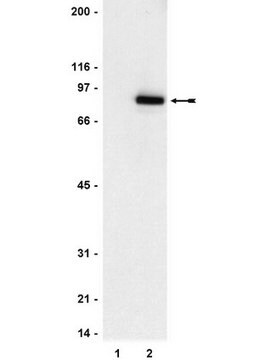
Mouse 3T3-L1 adipocytes stimulated with leukemia inhibitory factor (LIF).
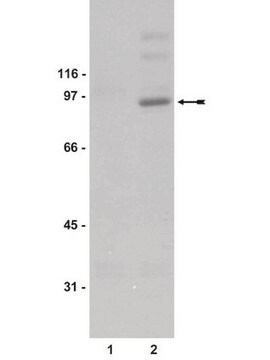
Routinely evaluated by immunoblot in RIPA lysates from CNTF-treated SK-N-MC cells.

Western Blot Analysis:
A 1:500-1:2000 dilution of this lot detected phosphorylated STAT1 in RIPA lysates from CNTF-treated SK-N-MC cells.

Other Notes

Concentration: Please refer to the Certificate of Analysis for the lot-specific concentration.

Legal Information

UPSTATE is a registered trademark of Merck KGaA, Darmstadt, Germany

Disclaimer

Unless otherwise stated in our catalog or other company documentation accompanying the product(s), our products are intended for research use only and are not to be used for any other purpose, which includes but is not limited to, unauthorized commercial uses, in vitro diagnostic uses, ex vivo or in vivo therapeutic uses or any type of consumption or application to humans or animals.

類似品目との比較

比較内容をすべて表示

相違点を表示

1 of 1

当該品目
05-106404-88605-485
biological source

rabbit

biological source

mouse

biological source

rabbit

biological source

mouse

antibody form

affinity purified immunoglobulin

antibody form

purified immunoglobulin

antibody form

culture supernatant

antibody form

purified immunoglobulin

clone

polyclonal

clone

5C9.2, monoclonal

clone

A11W, monoclonal

clone

9E12, monoclonal

species reactivity

mouse, chicken, human, rat

species reactivity

rat, mouse, human

species reactivity

rat, chimpanzee, human, mouse, bovine

species reactivity

canine, human, mouse

shipped in

dry ice

shipped in

wet ice

shipped in

dry ice

shipped in

dry ice

Gene Information

human ... STAT1(6772)

Gene Information

human ... STAT1(6772)
mouse ... Stat1(20846)

Gene Information

bovine ... Stat5A(282375)

Gene Information

human ... STAT3(6774)


Still not finding the right product?

製品選択ツール}で選択肢を絞り込んでください。


保管分類

10 - Combustible liquids

wgk

WGK 2


適用法令

試験研究用途を考慮した関連法令を主に挙げております。化学物質以外については、一部の情報のみ提供しています。 製品を安全かつ合法的に使用することは、使用者の義務です。最新情報により修正される場合があります。WEBの反映には時間を要することがあるため、適宜SDSをご参照ください。

07-307:

jan


試験成績書(COA)

製品のロット番号・バッチ番号を入力して、試験成績書(COA) を検索できます。ロット番号・バッチ番号は、製品ラベルに「Lot」または「Batch」に続いて記載されています。

以前この製品を購入いただいたことがある場合

文書ライブラリで、最近購入した製品の文書を検索できます。

文書ライブラリにアクセスする


関連コンテンツ

The Janus kinase (JAK)/signal transducers and activators of transcription (STAT) signaling pathway plays an important role in cell proliferation, cell differentiation, cell migration, and cell death. It is the principal signaling mechanism for a variety of cytokines and growth factors. Constitutive activation or dysregulation of JAK/STAT signaling can result in inflammatory disease, erythrocytosis, gigantism, and leukemia.


Ana Maria Low-Calle et al.
Virus research, 180, 49-58 (2014-01-01)
Herpes simplex virus type 1 (HSV-1) causes a lytic infection in epithelial cells before being captured and moved via retrograde axonal transport to the nuclei of the sensory neurons of the trigeminal ganglion or dorsal root, where it establishes a
Marc Maresca et al.
Cellular microbiology, 7(12), 1749-1762 (2005-11-29)
In vivo studies with the mouse-specific member of the attaching and effacing (A/E) family of pathogens raised the possibility that these non-invasive enteric pathogens can specifically inhibit inducible nitric oxide synthase (iNOS) expression to prevent the production of antimicrobial nitric
Precision-cut slice cultures of tumors from MMTV-neu mice for the study of the ex vivo response to cytokines and cytotoxic drugs.
Nirmala Parajuli, Wolfgang Doppler
In Vitro Cellular & Developmental Biology. Animal null


グローバルトレードアイテム番号

カタログ番号GTIN
07-30704053252325854

質問

レビュー

評価値なし

アクティブなフィルタ