コンテンツへスキップ
Merck

スキップする

MABE333

Anti-N-Myc Antibody, clone NCM II 100

clone NCM II 100, from mouse

別名:

N-myc proto-oncogene protein, Class E basic helix-loop-helix protein 37, bHLHe37

ログインで組織・契約価格をご覧ください。

サイズを選択してください

表示を変更する
容量カタログ番号在庫状況単価

この商品について

UNSPSC Code:
12352203
NACRES:
NA.41
eCl@ss:
32160702
Conjugate:
unconjugated
Clone:
NCM II 100, monoclonal
Application:
ICC, IP, WB
Citations:
5
この製品は、Merck Milliporeウェブサイトでのみ注文できます。
テクニカルサービス
お困りのことがあれば、経験豊富なテクニカルサービスチームがお客様をサポートします。
お手伝いします


biological source

mouse

Quality Level

conjugate

unconjugated

antibody form

purified immunoglobulin

antibody product type

primary antibodies

clone

NCM II 100, monoclonal

species reactivity

human

technique(s)

immunocytochemistry: suitable, immunoprecipitation (IP): suitable, western blot: suitable

isotype

IgG1κ

NCBI accession no.

UniProt accession no.

shipped in

wet ice

target post-translational modification

unmodified

Gene Information

human ... MYCN(4613)

General description

The v-myc oncogene, initially identified in the MC29 avian retrovirus, causes myelocytomas, carcinomas, sarcomas and lymphomas, and belongs to a family of oncogenes conserved throughout evolution. In humans the family consists of five genes: c-myc, N-myc, R-myc, L-myc and B-myc. Amplification of the N-myc gene has been found in human neuroblastomas and cell lines. The extent of N-myc amplification correlates well with the stage of neuroblastoma disease. Immunological studies have shown that the human N-myc gene gives rise to at least two nuclear phosphoproteins that exhibit relatively short (30 min) half lives in vivo and exhibit DNA binding properties in vitro.
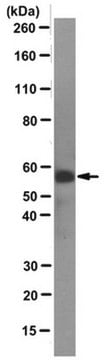
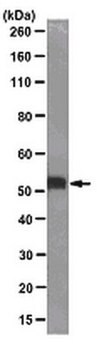
~55 kDa observed. Uniprot describes a molecular weight at ~50 kDa Uniprot states that this protein may be phosphorylated.

Immunogen

Recombinant protein corresponding to human N-Myc.

Application

Immunofluorescence Analysis: A representative lot from an independent laboratory detected N-Myc in IMR5 cells (Ikegaki, N., et al. (1986). 83(16):5929-5933.).

Immunoprecipitation Analysis: A representative lot from an independent laboratory immunoprecipitated N-Myc in IP (Brondyk, W. H., et al. (1991). 6(7):1269-1276.).
Research Category
Epigenetics & Nuclear Function
Research Sub Category
Transcription Factors
Use Anti-N-Myc Antibody, clone NCM II 100 (mouse monoclonal antibody) validated in WB, IP, ICC to detect N-Myc also known as N-myc proto-oncogene protein, Class E basic helix-loop-helix protein 37, bHLHe37.

Physical form

Format: Purified
Protein G Purified
Purified mouse monoclonal IgG1κ in buffer containing 0.1 M Tris-Glycine (pH 7.4), 150 mM NaCl with 0.05% sodium azide.

Preparation Note

Stable for 1 year at 2-8°C from date of receipt.

Analysis Note

Control
IMR-32 cell lysate
Evaluated by Western Blot in IMR-32 cell lysate.

Western Blot Analysis: 0.5 µg/mL of this antibody detected N-Myc in 10 µg of IMR-32 cell lysate.

Other Notes

Concentration: Please refer to the Certificate of Analysis for the lot-specific concentration.

Disclaimer

Unless otherwise stated in our catalog or other company documentation accompanying the product(s), our products are intended for research use only and are not to be used for any other purpose, which includes but is not limited to, unauthorized commercial uses, in vitro diagnostic uses, ex vivo or in vivo therapeutic uses or any type of consumption or application to humans or animals.

類似品目との比較

比較内容をすべて表示

相違点を表示

1 of 1

当該品目
SAB1409334SAB5700642MABE282
biological source

mouse

biological source

mouse

biological source

rabbit

biological source

mouse

species reactivity

human

species reactivity

human

species reactivity

mouse, human, rat

species reactivity

human

Gene Information

human ... MYCN(4613)

Gene Information

human ... MYCN(4613)

Gene Information

human ... MYCN(4613)

Gene Information

human ... MYC(4609)

antibody form

purified immunoglobulin

antibody form

purified immunoglobulin

antibody form

affinity isolated antibody

antibody form

purified immunoglobulin

clone

NCM II 100, monoclonal

clone

polyclonal

clone

polyclonal

clone

9E10, monoclonal

conjugate

unconjugated

conjugate

unconjugated

conjugate

unconjugated

conjugate

-


Still not finding the right product?

製品選択ツール}で選択肢を絞り込んでください。


保管分類

12 - Non Combustible Liquids

wgk

WGK 1

flash_point_f

Not applicable

flash_point_c

Not applicable


適用法令

試験研究用途を考慮した関連法令を主に挙げております。化学物質以外については、一部の情報のみ提供しています。 製品を安全かつ合法的に使用することは、使用者の義務です。最新情報により修正される場合があります。WEBの反映には時間を要することがあるため、適宜SDSをご参照ください。

MABE333:

jan


試験成績書(COA)

製品のロット番号・バッチ番号を入力して、試験成績書(COA) を検索できます。ロット番号・バッチ番号は、製品ラベルに「Lot」または「Batch」に続いて記載されています。

以前この製品を購入いただいたことがある場合

文書ライブラリで、最近購入した製品の文書を検索できます。

文書ライブラリにアクセスする


関連コンテンツ

New Products: Antibodies, Assays, Small Molecules, Inhibitors, and Proteins


Felix Schmitt-Hoffner et al.
Journal of clinical oncology : official journal of the American Society of Clinical Oncology, 39(29), 3217-3228 (2021-06-11)
Clinical outcomes of patients with neuroblastoma range from spontaneous tumor regression to fatality. Hence, understanding the mechanisms that cause tumor progression is crucial for the treatment of patients. In this study, we show that FOXR2 activation identifies a subset of
Annie Beaudry et al.
Scientific reports, 13(1), 16443-16443 (2023-10-01)
Neuroblastoma, the most common type of pediatric extracranial solid tumor, causes 10% of childhood cancer deaths. Despite intensive multimodal treatment, the outcomes of high-risk neuroblastoma remain poor. We urgently need to develop new therapies with safe long-term toxicity profiles for
Patrick Sin-Chan et al.
Cancer cell, 36(1), 51-67 (2019-07-10)
Embryonal tumors with multilayered rosettes (ETMRs) are highly lethal infant brain cancers with characteristic amplification of Chr19q13.41 miRNA cluster (C19MC) and enrichment of pluripotency factor LIN28A. Here we investigated C19MC oncogenic mechanisms and discovered a C19MC-LIN28A-MYCN circuit fueled by multiple


グローバルトレードアイテム番号

カタログ番号GTIN
MABE33304053252691577

質問

レビュー

評価値なし

アクティブなフィルタ