
492002

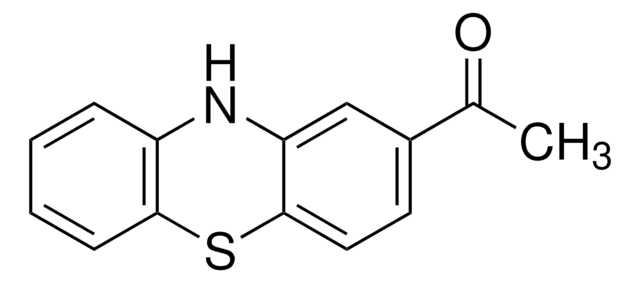
NOX1 Inhibitor, ML171
The NOX1 Inhibitor, ML171, also referenced under CAS 6631-94-3, controls the biological activity of NOX1.
別名:
NOX1 Inhibitor, ML171, NADPH Oxidase-1 Inhibitor, ML171, 2-APT, 2-acetylphenothiazine
サイズを選択してください
| 容量 | カタログ番号 | 在庫状況 | 単価 |
|---|
この商品について
Quality Segment
assay
≥95% (HPLC)
form
powder
manufacturer/tradename
Calbiochem®
storage condition
OK to freeze, protect from light
color
dark yellow-orange
solubility
DMSO: 50 mg/mL
shipped in
ambient
storage temp.
2-8°C
SMILES string
S1c2c(cc(cc2)C(=O)C)Nc3c1cccc3
InChI
1S/C14H11NOS/c1-9(16)10-6-7-14-12(8-10)15-11-4-2-3-5-13(11)17-14/h2-8,15H,1H3
InChI key
JWGBOHJGWOPYCL-UHFFFAOYSA-N
General description
Packaging
Preparation Note
Other Notes
Legal Information
Disclaimer
1 of 1
当該品目 | |||
|---|---|---|---|
| assay ≥95% (HPLC) | assay ≥95% (HPLC) | assay ≥95% (HPLC) | assay ≥97% (HPLC) |
| form powder | form powder | form solid | form solid |
| manufacturer/tradename Calbiochem® | manufacturer/tradename Calbiochem® | manufacturer/tradename Calbiochem® | manufacturer/tradename Calbiochem® |
| Quality Level 100 | Quality Level 100 | Quality Level 100 | Quality Level 100 |
| storage temp. 2-8°C | storage temp. −20°C | storage temp. 2-8°C | storage temp. 2-8°C |
| storage condition OK to freeze, protect from light | storage condition OK to freeze, protect from light | storage condition OK to freeze, desiccated (hygroscopic), protect from light | storage condition OK to freeze, protect from light |


保管分類
11 - Combustible Solids
wgk
WGK 3
適用法令
試験研究用途を考慮した関連法令を主に挙げております。化学物質以外については、一部の情報のみ提供しています。 製品を安全かつ合法的に使用することは、使用者の義務です。最新情報により修正される場合があります。WEBの反映には時間を要することがあるため、適宜SDSをご参照ください。
492002-MG: + 492002-10MG:
jan
試験成績書(COA)
製品のロット番号・バッチ番号を入力して、試験成績書(COA) を検索できます。ロット番号・バッチ番号は、製品ラベルに「Lot」または「Batch」に続いて記載されています。
関連コンテンツ
"Aging: getting older, exhibiting the signs of age, the decline in the physical (and mental) well-being over time, leading to death. Since the beginning of time, man has been obsessed with trying to slow down, stop, or even reverse the signs of aging. Many have gone as far as experimenting with nutritional regimens, eccentric exercises, fantastic rituals, and naturally occurring or synthetic wonder-elements to evade the signs of normal aging. Biologically speaking, what is aging? And what does the latest research tell us about the possibility of discovering the elusive “fountain of youth”? Many advances in our understanding of aging have come from systematic scientific research, and perhaps it holds the key to immortality. Scientifically, aging can be defined as a systems-wide decline in organismal function that occurs over time. This decline occurs as a result of numerous events in the organism, and these events can be classified into nine “hallmarks” of aging, as proposed by López-Otin et al. (2013). Several of the pathologies associated with aging are a direct result of these events going to extremes and may also involve aberrant activation of proliferation signals or hyperactivity. The hallmarks of aging have been defined based on their fulfillment of specific aging related criteria, such as manifestation during normal aging, acceleration of aging if experimentally induced or aggravated, and retardation of aging if prevented or blocked, resulting in increased lifespan. The nine hallmarks of aging are genomic instability, telomere attrition, epigenetic alterations, loss of proteostasis, deregulated nutrient sensing, mitochondrial dysfunction, cellular senescence, stem cell exhaustion, and altered intercellular communication. The biological processes underlying aging are complex. By understanding the hallmarks in greater detail, we can get closer to developing intervention strategies that can make the aging process less of a decline, and more of a recline."
グローバルトレードアイテム番号
| カタログ番号 | GTIN |
|---|---|
| 492002-10MG | 04055977273465 |