
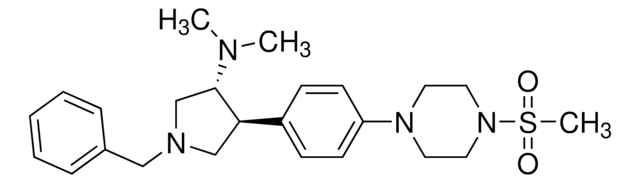
SML1879

A-395N
≥98% (HPLC)
Sinonimo/i:
(3S,4R)-1-Benzyl-N,N-dimethyl-4-(4-(4-(methylsulfonyl)piperazin-1-yl)phenyl)pyrrolidin-3-amine, (3S,4R)-{1-Benzyl-4-[4-(4-methanesulfonyl-piperazin-1-yl)-phenyl]-pyrrolidin-3-yl}-dimethyl-amine
Scegli un formato
| Taglio della confezione | SKU | Disponibilità | Prezzo |
|---|
Informazioni su questo articolo
Quality Level
assay
≥98% (HPLC)
form
powder
optical activity
[α]/D +1.0 to +3.0°, c = 1 in chloroform-d
color
white to beige
solubility
DMSO: 10 mg/mL, clear
storage temp.
2-8°C
Biochem/physiol Actions
A-395, the active enantiomer, is available from Sigma. To learn more about and purchase A-395, click here.
To learn about other SGC chemical probes for epigenetic targets, visit sigma.com/sgc
Features and Benefits
1 of 1
Questo articolo | |||
|---|---|---|---|
| form powder | form powder | form powder | form powder |
| assay ≥98% (HPLC) | assay ≥98% (HPLC) | assay ≥98% (HPLC) | assay ≥98% (HPLC) |
| Quality Level 100 | Quality Level 100 | Quality Level - | Quality Level 100 |
| storage temp. 2-8°C | storage temp. 2-8°C | storage temp. 2-8°C | storage temp. 2-8°C |
| solubility DMSO: 10 mg/mL, clear | solubility H2O: 10 mg/mL, clear | solubility DMSO: 2 mg/mL, clear | solubility DMSO: 10 mg/mL, clear |
| color white to beige | color white to light brown | color white to beige | color white to beige |


signalword
Danger
hcodes
Hazard Classifications
Acute Tox. 3 Oral - Eye Irrit. 2 - Skin Irrit. 2
Classe di stoccaggio
6.1C - Combustible acute toxic Cat.3 / toxic compounds or compounds which causing chronic effects
wgk
WGK 3
flash_point_f
Not applicable
flash_point_c
Not applicable
Scegli una delle versioni più recenti:
Possiedi già questo prodotto?
I documenti relativi ai prodotti acquistati recentemente sono disponibili nell’Archivio dei documenti.
Numero articolo commerciale globale
| SKU | GTIN |
|---|---|
| SML1879-25MG | 04061832639154 |
| SML1879-5MG | 04061832639161 |