Passa al contenuto
Merck

Vai a

C0979

Anti-Catalase antibody ,Mouse monoclonal

clone CAT-505, purified from hybridoma cell culture

Sinonimo/i:

Anti-CAT

Autenticati per visualizzare i prezzi organizzativi e contrattuali.

Scegli un formato

Cambia visualizzazione
Taglio della confezioneSKUDisponibilitàPrezzo
0.2 mL
Per informazioni sulla disponibilità, contatta il Servizio Clienti.
675,00 €
573,75 €

Informazioni su questo articolo

UNSPSC Code:
12352203
NACRES:
NA.41
MDL number:
Conjugate:
unconjugated
Clone:
CAT-505, monoclonal
Application:
ARR, ELISA (i), ICC, IHC, WB
Citations:
83

573,75 €

Prezzo di listino675,00 €Risparmia il 15%
Promozione valida solo online

Per informazioni sulla disponibilità, contatta il Servizio Clienti.
Per il tuo target è disponibile un anticorpo ricombinante privo di conservanti. Prova ZRB1771

Richiedi un ordine in blocco
Servizio Tecnico
Hai bisogno di aiuto? Il nostro team di scienziati qualificati è a tua disposizione.
Permettici di aiutarti


biological source

mouse

Quality Level

conjugate

unconjugated

antibody form

purified from hybridoma cell culture

antibody product type

primary antibodies

clone

CAT-505, monoclonal

form

buffered aqueous solution

mol wt

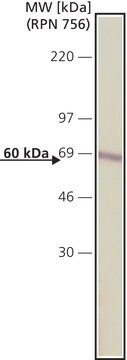
antigen 60 kDa

species reactivity

human, mouse, bovine, rat

concentration

~2 mg/mL

technique(s)

immunocytochemistry: suitable, immunohistochemistry: suitable, indirect ELISA: suitable, microarray: suitable, western blot: 0.5-1 μg/mL using a whole extract of HepG2 cells

isotype

IgG1

UniProt accession no.

shipped in

dry ice

storage temp.

−20°C

target post-translational modification

unmodified

Gene Information

human ... CAT(847)
mouse ... Cat(12359)
rat ... Cat(24248)

General description

Catalase is one of the most efficient and common enzyme found in nearly all living organisms exposed to oxygen. It is a very important enzyme in protecting the cell from oxidative damage by reactive oxygen species (ROS). In most mammalian cell types catalase is localized in peroxisomes which is a tertrameric haemin-enzyme consisting of 4 identical tetrahedrally arranged subunits of 60kDa. It contains four ferriprotoporphyrin groups per molecule having a molecular mass of 240kDa.

Immunogen

human erythrocyte catalase

Application

Applications in which this antibody has been used successfully, and the associated peer-reviewed papers, are given below.
Western Blotting (5 papers)
Monoclonal Anti-Catalase antibody produced in mouse is suitable for the following:
  • Immunocytochemistry
  • Immunohistochemistry
  • Indirect ELISA
  • Microarray
  • Western blotting at a concentration of 0.5-1μg/mL using whole extract of HepG2 cells
  • Immunofluorescence

Biochem/physiol Actions

Catalase reacts with hydrogen peroxide, a reactive oxygen species, activating its decomposition into water and molecular oxygen and it reacts with hydrogen donors. It functions as a natural anti-oxidant, protecting cells against oxidative damage of proteins, lipids and nucleic acids. Catalase also plays a role in gene expression and apoptosis. Antioxidants have been identified in association with a variety of diverse cellular functions including growth control, proliferation, differentiation, immune response, tumor promotion, apoptosis and activation of viruses.

Physical form

Solution in 0.01 M phosphate buffered saline, pH7.4, containing 15 mM sodium azide

Preparation Note

Purified from culture supernatant of hybridoma cells grown in a bioreactor.

Disclaimer

Unless otherwise stated in our catalog or other company documentation accompanying the product(s), our products are intended for research use only and are not to be used for any other purpose, which includes but is not limited to, unauthorized commercial uses, in vitro diagnostic uses, ex vivo or in vivo therapeutic uses or any type of consumption or application to humans or animals.

Confronta articoli simili

Visualizza il confronto per intero

Mostra le differenze

1 of 1

Questo articolo
SAB4200304A8481C7104
biological source

mouse

biological source

mouse

biological source

mouse

biological source

mouse

clone

CAT-505, monoclonal

clone

ATG7-13, monoclonal

clone

2-2.1.14.17, monoclonal

clone

AF3.1, monoclonal

Gene Information

human ... CAT(847)
mouse ... Cat(12359)
rat ... Cat(24248)

Gene Information

human ... ATG7(10533)
mouse ... Atg7(74244)
rat ... Atg7(312647)

Gene Information

bovine ... ACTG1(404122)
chicken ... ACTG1(415296)
human ... ACTG1(71)
mouse ... Actg1(11465)

Gene Information

human ... CDC27(996)
mouse ... Cdc27(217232)
rat ... Cdc27(360643)

antibody form

purified from hybridoma cell culture

antibody form

purified from hybridoma cell culture

antibody form

purified from hybridoma cell culture

antibody form

purified from hybridoma cell culture

species reactivity

human, mouse, bovine, rat

species reactivity

human, mouse, rat

species reactivity

mouse, chicken, canine, bovine, human, hamster

species reactivity

mouse, Xenopus, rat, bovine, canine, human

conjugate

unconjugated

conjugate

unconjugated

conjugate

unconjugated

conjugate

unconjugated


Still not finding the right product?

Provate il nostro Motore di ricerca dei prodotti per restringere le opzioni.


Classe di stoccaggio

12 - Non Combustible Liquids

wgk

nwg

flash_point_f

Not applicable

flash_point_c

Not applicable


Scegli una delle versioni più recenti:

Certificati d'analisi (COA)

Lot/Batch Number

Non trovi la versione di tuo interesse?

Se hai bisogno di una versione specifica, puoi cercare il certificato tramite il numero di lotto.

Possiedi già questo prodotto?

I documenti relativi ai prodotti acquistati recentemente sono disponibili nell’Archivio dei documenti.

Visita l’Archivio dei documenti


J M Matés et al.
Frontiers in bioscience : a journal and virtual library, 4, D339-D345 (1999-03-17)
Aerobic organisms possess antioxidant defense systems that deal with reactive oxygen species (ROS) produced as a consequence of aerobic respiration. Reactive oxygen is related to both, the arrest of growth and the start of cell differentiation. Low concentrations of reactive
E C Kaal et al.
Journal of neuroscience research, 54(6), 778-786 (1998-12-18)
Evidence is growing that reactive oxygen species (ROS), by-products of (normal) cellular aerobic metabolism, are involved in the pathogenesis of neurodegenerative diseases. One of these diseases is amyotrophic lateral sclerosis (ALS), in which motoneurons die, leading to paralysis and death.
S Lapointe et al.
Biology of reproduction, 58(3), 747-753 (1998-03-25)
Hydrogen peroxide (H2O2) is a reactive oxygen species that at low concentration is toxic to sperm. H2O2 inhibits not only sperm viability but also the acrosome reaction, sperm-egg binding, and oocyte penetration. Catalase activates the decomposition of H2O2 into water


Numero articolo commerciale globale

SKUGTIN
C0979-.2ML04061833452820

Domande

Recensioni

Nessuna valutazione

Filtri attivi