Passa al contenuto
Merck

Vai a

07668

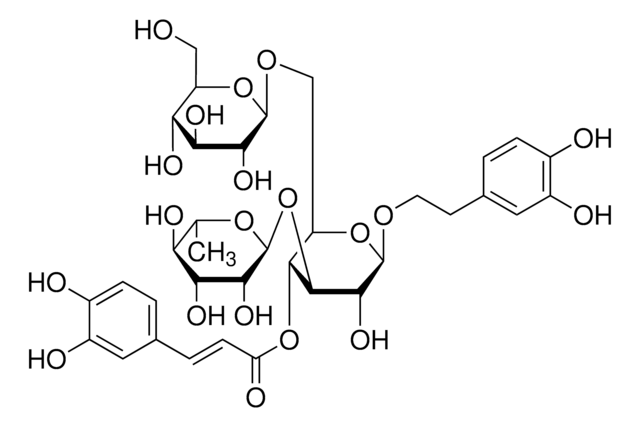
Echinacoside

98% (HPLC)

Autenticati per visualizzare i prezzi organizzativi e contrattuali.

Informazioni su questo articolo

Formula empirica (notazione di Hill):
C35H46O20
Numero CAS:
Peso molecolare:
786.73
NACRES:
NA.32
PubChem Substance ID:
UNSPSC Code:
12352202
MDL number:
Beilstein/REAXYS Number:
4778612


assay

98% (HPLC)

form

powder

application(s)

metabolomics
vitamins, nutraceuticals, and natural products

storage temp.

2-8°C

InChI

1S/C35H46O20/c1-14-24(42)26(44)29(47)35(51-14)55-32-30(48)34(49-9-8-16-3-6-18(38)20(40)11-16)53-22(13-50-33-28(46)27(45)25(43)21(12-36)52-33)31(32)54-23(41)7-4-15-2-5-17(37)19(39)10-15/h2-7,10-11,14,21-22,24-40,42-48H,8-9,12-13H2,1H3/b7-4+/t14-,21+,22+,24-,25+,26+,27-,28+,29+,30+,31+,32+,33+,34+,35-/m0/s1

InChI key

FSBUXLDOLNLABB-ISAKITKMSA-N

General description

Echinacoside (ECH) is a natural secondary metabolite, a phenylethanoid glycoside (PhG) found in the roots and stems of many plants. It is a water-soluble compound. Echinacoside was first isolated from the roots of Echinacea angustifolia (coneflower). It can also be sourced from other medicinal plants such as Echinacea purpurea (purple coneflower) and Cistanche salsa.

Biochem/physiol Actions

Caffeic acid glycoside found in herbal medicine. Potential therapeutic for Parkinson′s disease.
Echinacoside elicits neuroprotective properties against neurological disorders and on tumor necrosis factor-alpha (TNFα)-induced apoptosis in human neuroblastoma (SH-SY5Y) cells. It also displays antioxidant and free radical scavenging properties. ECH exerts hepatoprotective and anti-cancer properties.
Echinacoside is a secondary metabolite found in plants, specifically in the roots of Echinacea angustifolia (cone flower) , E. purpurea (purple coneflower) and Cistanche salsa. It has been shown to possess anti-oxidant and free radical scavenging properties, to have neuroprotective effects and to prevent liver injuries. It has also been found to be antibiotic and anti-inflammatory.[1] Echinacoside was shown to promote proliferation of intestinal epithelial cells by increasing TGF-β1 expression.[2]

Packaging

Bottomless glass bottle. Contents are inside inserted fused cone.

Confronta articoli simili

Visualizza il confronto per intero

Mostra le differenze

1 of 1

Questo articolo
1231750PHL8918807538
Echinacoside 98% (HPLC)

Sigma-Aldrich

07668

Echinacoside

Echinacoside United States Pharmacopeia (USP) Reference Standard

USP

1231750

Echinacoside

Echinacoside phyproof® Reference Substance

PHL89188

Echinacoside

Echinacoside analytical standard

Supelco

07538

Echinacoside

assay

98% (HPLC)

assay

-

assay

≥95.0% (HPLC)

assay

≥98% (HPLC)

form

powder

form

-

form

powder

form

-

application(s)

metabolomics
vitamins, nutraceuticals, and natural products

application(s)

pharmaceutical (small molecule)

application(s)

-

application(s)

food and beverages

storage temp.

2-8°C

storage temp.

2-8°C

storage temp.

-

storage temp.

2-8°C


Still not finding the right product?

Explore all of our products under Echinacoside


Classe di stoccaggio

11 - Combustible Solids

wgk

WGK 3

flash_point_f

Not applicable

flash_point_c

Not applicable


Scegli una delle versioni più recenti:

Certificati d'analisi (COA)

Lot/Batch Number

Non trovi la versione di tuo interesse?

Se hai bisogno di una versione specifica, puoi cercare il certificato tramite il numero di lotto.

Possiedi già questo prodotto?

I documenti relativi ai prodotti acquistati recentemente sono disponibili nell’Archivio dei documenti.

Visita l’Archivio dei documenti


C E Bomberger et al.
Thymus, 19(2), 111-115 (1992-03-01)
Murine bone marrow cells were examined in an in vitro assay to determine whether stress modulates the migration of prethymic stem cells to thymus supernatant. Adult CBA/J mice were either restraint or sound stressed for two hours daily for five
Monika E Czerwińska et al.
Phytochemical analysis : PCA, 26(4), 253-260 (2015-02-20)
The genus Ligustrum (Oleaceae) is distributed in Europe and Asia (south China and Korea), where it is used to prevent hypertension, sore throats, inflammation and diabetes. The main groups of compounds in extracts of Ligustrum vulgare are biologically active secoiridoids
N Shiotani et al.
Veterinary parasitology, 41(1-2), 17-22 (1992-02-01)
The distribution of oocysts, sporocysts and sporozoites of Eimeria tenella and Eimeria maxima in the digestive tract of chicken and in excreta was investigated. At 1 h after the oral inoculation of E. tenella oocysts, the number of sporocysts in


Numero articolo commerciale globale

SKUGTIN
07668-10MG04061832403878
07668-50MG04061832403885

Domande

Recensioni

Nessuna valutazione

Filtri attivi