Passa al contenuto
Merck

Vai a

ABE2860

Anti-KLF4

serum, from rabbit

Sinonimo/i:

Krueppel-like factor 4, Epithelial zinc finger protein EZF, Gut-enriched krueppel-like factor

Autenticati per visualizzare i prezzi organizzativi e contrattuali.

Scegli un formato

Cambia visualizzazione
A voi/SKUDisponibilitàPrezzo
100 μL

Spedizione prevista il05 giugno 2026daMerck S.p.A

432,00 €

Informazioni su questo articolo

UNSPSC Code:
12352203
NACRES:
NA.43
eCl@ss:
32160702
Conjugate:
unconjugated
Clone:
polyclonal
Application:
ChIP, IP, WB
Citations:
-

432,00 €


Spedizione prevista il05 giugno 2026Dettagli


Richiedi un ordine in blocco
Servizio Tecnico
Hai bisogno di aiuto? Il nostro team di scienziati qualificati è a tua disposizione.
Permettici di aiutarti


biological source

rabbit

conjugate

unconjugated

antibody form

serum

antibody product type

primary antibodies

clone

polyclonal

species reactivity

mouse

packaging

antibody small pack of 25 μL

technique(s)

ChIP: suitable (ChIP-seq), immunoprecipitation (IP): suitable, western blot: suitable

isotype

IgG

NCBI accession no.

UniProt accession no.

target post-translational modification

unmodified

Gene Information

mouse ... Klf4(16600)

General description

Krueppel-like factor 4 (UniProt: Q60793; also known as Epithelial zinc finger protein EZF, Gut-enriched krueppel-like factor, KLF4) is encoded by the Klf4 (also known as Ezf, Gklf, Zie) gene (Gene ID: 16600) in murine species. Klf4 is a member of the krueppel C2H2-type zinc-finger protein family that regulates multiple biological processes, including proliferation, differentiation, development, and apoptosis. KLF4 is a developmentally regulated transcription factor that plays an important role in maintaining the pluripotent state in embryonic stem cells (ESCs) and can be used as a marker of the pluripotent state for cells in culture. It can serve both as activator and as repressor depending upon its environment, but its most prominent function is growth suppression. Interestingly, increased expression of Klf4 leads to an increase in expression of P21WAF1/CIP1, which is an important checkpoint protein that inhibits cell cycle progression and is essential in mediating the cell cycle arrest at both the G1/S and G2/M boundaries. Klf4 also mediates the normal functions of the tumor suppressor p53 and contributes to the down-regulation of p53/TP53 transcription. Mutations in Klf4 gene can lead to unchecked growth and tumor formation. KLF4 is shown to be often mutated in many colon cancer cell lines and the lack of Klf4 expression is correlated with colorectal cancer pathogenesis. Elevated expression of Klf4 gene has been linked to gastric cancer, breast cancer, and squamous cell carcinomas. KLF4 is reported to target the primary miR1-2 loop promoter and stimulates miR-1 expression. Loss of KLF4 expression is considered as a mechanistic link between aggressive prostate cancer progression and low canonical AR output through miR-1 inactivation. (Ref.: Jiang, J., et al. (2008). Nat. Cell Biol. 10(3); 353-360; Siu, MK et al. (2016). Oncogenesis 5: e282).
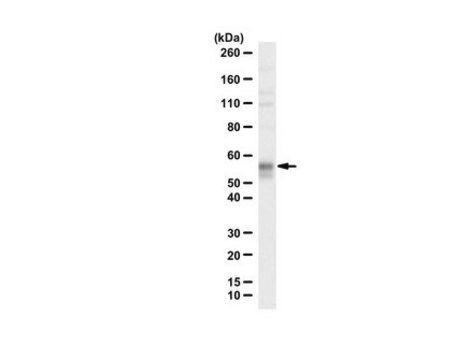
~55 kDa observed; 51.88 kDa calculated. Uncharacterized bands may be observed in some lysate(s).

Immunogen

Epitope: unknown
GST/His-tagged recombinant fragment corresponding to 320 amino acids from the N-terminal and internal region of murine Klf4.

Application

Anti-KLF4, Cat. No. ABE2860, is a highly specific rabbit polyclonal antibody that targets Krueppel-like factor 4 (Klf4) and has been tested for use in ChIP-seq, Chromatin Immunoprecipitation (ChIP), Immunoprecipitation, and Western Blotting.
Immunoprecipitation Analysis: A representative lot immunoprecipitated KLF4 in Immunoprecipitation applications (Jiang, J., et. al. (2008). Nat Cell Biol. 10(3):353-60).

Chromatin Immunoprecipitation Analysis (ChIP): A representative lot detected KLF4 in Chromatin Immunoprecipitation applications (Edupuganti, R.R., et. al. (2017). Stem Cell Reports. 9(4):1291-1303).

Western Blotting Analysis: A representative lot detected KLF4 in Western Blotting applications (Chen, X., et. al. (2008). Cell. 133(6):1106-17).

ChIP-seq Analysis: A representative lot detected KLF4 in ChIP-seq applications (Chen, X., et. al. (2008). Cell. 133(6):1106-17).
Research Category
Epigenetics & Nuclear Function

Biochem/physiol Actions

This rabbit polyclonal antibody detects Klf4 in mouse embryonic stem cells.

Physical form

Rabbit polyclonal antiserum with 0.05% sodium azide.
Unpurified

Preparation Note

Stable for 1 year at -20°C from date of receipt. Handling Recommendations: Upon receipt and prior to removing the cap, centrifuge the vial and gently mix the solution. Aliquot into microcentrifuge tubes and store at -20°C. Avoid repeated freeze/thaw cycles, which may damage IgG and affect product performance.

Analysis Note

Evaluated by Western Blotting in mouse embryonic stem cells.

Western Blotting Analysis: A 1:5,000 dilution of this antibody detected KLF4 in lysate from mouse emmbryonic stem cells.

Other Notes

Concentration: Please refer to lot specific datasheet.

Disclaimer

Unless otherwise stated in our catalog or other company documentation accompanying the product(s), our products are intended for research use only and are not to be used for any other purpose, which includes but is not limited to, unauthorized commercial uses, in vitro diagnostic uses, ex vivo or in vivo therapeutic uses or any type of consumption or application to humans or animals.

Confronta articoli simili

Visualizza il confronto per intero

Mostra le differenze

1 of 1

Questo articolo
MABC631SAB1300678AV32810
Anti-KLF4 serum, from rabbit

Sigma-Aldrich

ABE2860

Anti-KLF4

conjugate

unconjugated

conjugate

unconjugated

conjugate

unconjugated

conjugate

unconjugated

antibody form

serum

antibody form

ascites fluid

antibody form

saturated ammonium sulfate (SAS) precipitated

antibody form

IgG fraction of antiserum

biological source

rabbit

biological source

mouse

biological source

rabbit

biological source

rabbit

clone

polyclonal

clone

1E06, monoclonal

clone

polyclonal

clone

polyclonal

Gene Information

mouse ... Klf4(16600)

Gene Information

human ... KLF4(9314)

Gene Information

human ... KLF4(9314)

Gene Information

human ... KLF1(10661)

technique(s)

ChIP: suitable (ChIP-seq), western blot: suitable, immunoprecipitation (IP): suitable

technique(s)

immunohistochemistry: suitable, western blot: suitable

technique(s)

indirect ELISA: 1:1000, western blot: 1:100-1:500

technique(s)

western blot: suitable


Still not finding the right product?

Provate il nostro Motore di ricerca dei prodotti per restringere le opzioni.


Classe di stoccaggio

12 - Non Combustible Liquids

wgk

WGK 1

flash_point_f

Not applicable

flash_point_c

Not applicable


Certificati d'analisi (COA)

Cerca il Certificati d'analisi (COA) digitando il numero di lotto/batch corrispondente. I numeri di lotto o di batch sono stampati sull'etichetta dei prodotti dopo la parola ‘Lotto’ o ‘Batch’.

Possiedi già questo prodotto?

I documenti relativi ai prodotti acquistati recentemente sono disponibili nell’Archivio dei documenti.

Visita l’Archivio dei documenti


Domande

Recensioni

Nessuna valutazione

Filtri attivi