Passa al contenuto
Merck

Vai a

ABC1691

Anti-PEPCK

from rabbit, purified by affinity chromatography

Sinonimo/i:

Phosphoenolpyruvate carboxykinase, cytosolic, PEPCK-C

Autenticati per visualizzare i prezzi organizzativi e contrattuali.

Scegli un formato

Cambia visualizzazione
A voi/SKUDisponibilitàPrezzo
100 μg

Spedizione prevista il05 giugno 2026daMerck S.p.A

405,00 €

Informazioni su questo articolo

UNSPSC Code:
12352203
NACRES:
NA.41
eCl@ss:
32160702
Conjugate:
unconjugated
Clone:
polyclonal
Application:
IF, IHC, WB
Citations:
1

405,00 €


Spedizione prevista il05 giugno 2026Dettagli


Richiedi un ordine in blocco
Servizio Tecnico
Hai bisogno di aiuto? Il nostro team di scienziati qualificati è a tua disposizione.
Permettici di aiutarti


biological source

rabbit

Quality Segment

conjugate

unconjugated

antibody form

affinity isolated antibody

antibody product type

primary antibodies

clone

polyclonal

purified by

affinity chromatography

species reactivity

human

technique(s)

immunofluorescence: suitable, immunohistochemistry: suitable (paraffin), western blot: suitable

NCBI accession no.

UniProt accession no.

shipped in

ambient

target post-translational modification

unmodified

Gene Information

human ... PCK1(5105)

General description

Phosphoenolpyruvate carboxykinase, cytosolic (UniProt: also known as PEPCK, PEPCK-C) is encoded by the PCK1 (also known as PEPCK1) gene (Gene ID: 5105) in human. PEPCK catalyzes the conversion of oxaloacetate (OAA) to phosphoenolpyruvate (PEP), which is a rate-limiting step in gluconeogenesis. It requires manganese as a cofactor. It is expressed in higher levels in liver of fasting subjects. Kidney and adipocytes exhibit lower expression levels. Two isozymes of PEPCK have been identified, cytosolic and mitochondrial. PEPCK consists of an N-terminal and a catalytic C-terminal domain, with the active site and metal ions located in a cleft between them. Upon binding to substrate, PEPCK undergoes a conformational change that accelerates the catalysis process. Expression of PEPCK can be controlled by cAMP, glucocorticoids, and by insulin. Its expression is induced by glucagon, catecholamines, and glucocorticoids during periods of fasting and in response to stress and is diminished following glucose-induced and by the action of insulin. PEPCK-C is absent in fetal liver but appears at birth, concomitant with the capacity for gluconeogenesis. Deficiency of PEPCK-C is a rare metabolic disorder results in fatty infiltration of liver and kidney, hypoglycemia, hepatomegaly, and failure to thrive.
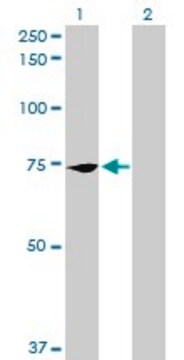
~65 kDa observed; 69.19 kDa calculated. Uncharacterized bands may be observed in some lysate(s).

Immunogen

KLH-conjugated linear peptide corresponding to 15 amino acids from the C-terminal half of human phosphoenolpyyruvate carboxykinase (PEPCK).

Application

Detect Phosphoenolpyruvate carboxykinase, cytosolic [GTP] using this rabbit polyclonal Anti-PEPCK, Cat. No. ABC1691, tested in Immunohistochemistry (Paraffin) and Western Blotting.
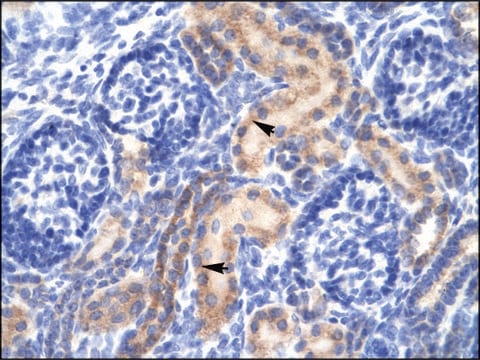
Immunohistochemistry Analysis: A 1:1,000 dilution from a representative lot detected PEPCK in human kidney, human pancreas, human skeletal muscle, and human placental tissue.

Immunofluorescence Analysis: A 1:500 dilution from a representative lot detected PEPCK in human small intestine and differentiated duodenum intestinal organoid tissue sections.

Western Blotting Analysis: 2 µg/mL from a representative lot detected PEPCK in 10 µg of human kidney tissue.
Research Category
Apoptosis & Cancer

Biochem/physiol Actions

This polyclonal antibody detects cytosolic phosphoenolpyruvate carboxykinase in human kidney.

Physical form

Affinity Purified
Purified rabbit polyclonal antibody in buffer containing 0.1 M Tris-Glycine (pH 7.4), 150 mM NaCl with 0.05% sodium azide.

Preparation Note

Stable for 1 year at 2-8°C from date of receipt.

Analysis Note

Evaluated by Immunohistochemistry in human liver tissue

Immunohistochemistry Analysis: A 1:1,000 dilution of this antibody detected PEPCK in human liver tissue.

Other Notes

Concentration: Please refer to lot specific datasheet.

Disclaimer

Unless otherwise stated in our catalog or other company documentation accompanying the product(s), our products are intended for research use only and are not to be used for any other purpose, which includes but is not limited to, unauthorized commercial uses, in vitro diagnostic uses, ex vivo or in vivo therapeutic uses or any type of consumption or application to humans or animals.

Confronta articoli simili

Visualizza il confronto per intero

Mostra le differenze

1 of 1

Questo articolo
SAB1404176AV32801SAB1406227
Anti-PEPCK from rabbit, purified by affinity chromatography

Sigma-Aldrich

ABC1691

Anti-PEPCK

conjugate

unconjugated

conjugate

unconjugated

conjugate

unconjugated

conjugate

unconjugated

biological source

rabbit

biological source

mouse

biological source

rabbit

biological source

mouse

Quality Level

100

Quality Level

-

Quality Level

100

Quality Level

-

antibody form

affinity isolated antibody

antibody form

purified immunoglobulin

antibody form

affinity isolated antibody

antibody form

purified immunoglobulin

technique(s)

immunofluorescence: suitable, western blot: suitable, immunohistochemistry: suitable (paraffin)

technique(s)

capture ELISA: suitable, indirect ELISA: suitable

technique(s)

western blot: suitable

technique(s)

western blot: 1 μg/mL

shipped in

ambient

shipped in

dry ice

shipped in

wet ice

shipped in

dry ice


Still not finding the right product?

Provate il nostro Motore di ricerca dei prodotti per restringere le opzioni.


Classe di stoccaggio

12 - Non Combustible Liquids

wgk

WGK 1

flash_point_f

Not applicable

flash_point_c

Not applicable


Certificati d'analisi (COA)

Cerca il Certificati d'analisi (COA) digitando il numero di lotto/batch corrispondente. I numeri di lotto o di batch sono stampati sull'etichetta dei prodotti dopo la parola ‘Lotto’ o ‘Batch’.

Possiedi già questo prodotto?

I documenti relativi ai prodotti acquistati recentemente sono disponibili nell’Archivio dei documenti.

Visita l’Archivio dei documenti


Domande

Recensioni

Nessuna valutazione

Filtri attivi