Passa al contenuto
Merck

Vai a

S2532

Anti-S100B Antibody

mouse monoclonal, SH-B1

Monoclonal Anti-S-100 (β-Subunit) antibody produced in mouse

Sinonimo/i:

Anti-NEF, Anti-S100, Anti-S100-B, Anti-S100beta

Autenticati per visualizzare i prezzi organizzativi e contrattuali.

Scegli un formato

Cambia visualizzazione
Taglio della confezioneSKUDisponibilitàPrezzo
100 μL
Per conoscere la disponibilità, visualizza il carrello
CHF 473.00
0.2 mL
Per conoscere la disponibilità, visualizza il carrello
CHF 593.00

Informazioni su questo articolo

UNSPSC Code:
12352203
NACRES:
NA.41
MDL number:
Conjugate:
unconjugated
Clone:
SH-B1, monoclonal
Application:
ARR, DB, ELISA (i), IHC (p), RIA
Citations:
324

CHF 473.00


Per conoscere la disponibilità, visualizza il carrello

Richiedi un ordine in blocco
Servizio Tecnico
Hai bisogno di aiuto? Il nostro team di scienziati qualificati è a tua disposizione.
Permettici di aiutarti


Nome del prodotto

Monoclonal Anti-S-100 (β-Subunit) antibody produced in mouse, clone SH-B1, ascites fluid

biological source

mouse

Quality Level

conjugate

unconjugated

antibody form

ascites fluid

antibody product type

primary antibodies

clone

SH-B1, monoclonal

contains

15 mM sodium azide

species reactivity

feline, pig, bovine, sheep, goat, rabbit, canine, human, rat

technique(s)

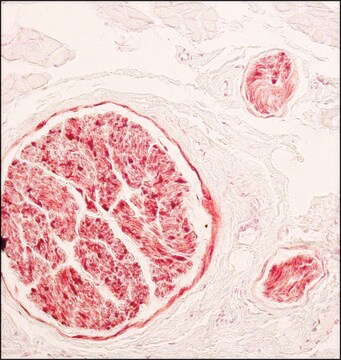
dot blot: suitable using denatured-reduced preparations, immunohistochemistry (formalin-fixed, paraffin-embedded sections): 1:1000 using protease-digested sections of human tongue, indirect ELISA: suitable, microarray: suitable, radioimmunoassay: suitable

isotype

IgG1

UniProt accession no.

shipped in

dry ice

storage temp.

−20°C

target post-translational modification

unmodified

Gene Information

human ... S100B(6285)
rat ... S100b(25742)

General description

S100 gene is mapped on human chromosome 21q22.3 and codes for an acidic calcium binding protein B, which weighs 21 kDa. The gene is predominantly expressed in astrocytes, glial cells, Schwann cells and also found in adipose cells, skin, glioblastoma multiforme and melanoma. The protein is localized in extracellular space and cytoplasm.
S100B (S-100β Subunit) belongs to the S100 family of calcium-binding proteins. It is expressed in melanocytes.
S-100 is a set of small, thermolabile, highly acidic dimer proteins of approximately 20kDa which are widely distributed in different tissues. Dimeric combinations of two chains, the α-chain (93 amino acids,10.4kDa) and the β-chain (91 amino acids, 10.5kDa), form the three known subtypes of S-100: S-100ao (αα), S-100a (αβ) and S-100b (ββ).
Monoclonal Anti-S-100 (β-subunit) (mouse IgG1 isotype) is derived from the SH-B1 hybridoma produced by the fusion of mouse myeloma cells and splenocytes from an immunized mouse.

Immunogen

Bovine brain S-100b

Application

Monoclonal Anti-S-100 (β-Subunit) antibody produced in mouse has been used in the following:
  • ELISA
  • Immunofluorescence
  • Immunohistochemistry
  • Western blotting

Biochem/physiol Actions

Increased expression of S100 is observed in neuronal damage and thus, serves as a biomarker for detecting brain damage and also in several cancers. Also, it is highly permeable through the blood-brain barrier. The gene is known to be associated with cancer progression.
S100β participates in multiple cellular activities including cell growth, cell structure, cell-cell communication, energy metabolism, contraction, and intracellular signal transduction. In utero exposure to cocaine resulting in aberrant S100β levels is linked with neurobehavioral abnormalities and microcephaly. Fetuses with anencephaly show aberrant cell immunoreactivity. Increased levels of this protein are found in plasma of patients with brain damage. S100β is a candidate biochemical marker for spinal cord injury (SCI). Elevated expression of this protein in subpopulations of reactive astrocytes might be linked with hippocampal structural reorganization post-kainic acid (KA)-mediated neurodegeneration.
This antibody recognizes an epitope located on the β chain (i.e. in S-100a and S-100b) but not on the α chain of S-100 (i.e. in S-100a and S-100ao). In ELISA, recognition of S-100 subunit by clone SH-B1 is independent of Ca2+. The product does not react with other members of the EF-hand family such as, calmodulin, parvalbumin, intestinal calcium-binding protein and myosin light chain. In immunohistochemistry, the antibody detects normal and neoplastic S-100 β subunit-containing cells (e.g. Schwann cells, chondrocytes, melanocytes, and melanotic tumors) in protease-digested, formalin-fixed, paraffin-embedded tissues.

Physical form

The product is provided as ascites fluid containing 15 mM sodium azide as a preservative.

Preparation Note

For continuous use, store at 2-8 °C for up to one month. For extended storage, the solution may be frozen in working aliquots. Repeated freezing and thawing is not recommended. Storage in "frost-free" freezers is not recommended. If slight turbidity occurs upon prolonged storage, clarify by centrifugation before use.

Disclaimer

Unless otherwise stated in our catalog or other company documentation accompanying the product(s), our products are intended for research use only and are not to be used for any other purpose, which includes but is not limited to, unauthorized commercial uses, in vitro diagnostic uses, ex vivo or in vivo therapeutic uses or any type of consumption or application to humans or animals.

Confronta articoli simili

Visualizza il confronto per intero

Mostra le differenze

1 of 1

Questo articolo
S2657SAB4200671S2644
biological source

mouse

biological source

mouse

biological source

mouse

biological source

rabbit

conjugate

unconjugated

conjugate

unconjugated

conjugate

-

conjugate

unconjugated

antibody form

ascites fluid

antibody form

(Solution in 0.01M phosphate buffered saline pH 7.4, containing 15mM sodium azide as a preservative)

antibody form

purified from hybridoma cell culture

antibody form

IgG fraction of antiserum

species reactivity

feline, pig, bovine, sheep, goat, rabbit, canine, human, rat

species reactivity

sheep, bovine, goat, pig, feline, rabbit, rat, canine, human

species reactivity

cat, rabbit, porcine, bovine, rat, human

species reactivity

rat, bovine, guinea pig, human

clone

SH-B1, monoclonal

clone

SH-B4, monoclonal

clone

SH-B1, monoclonal

clone

polyclonal

Gene Information

human ... S100B(6285)
rat ... S100b(25742)

Gene Information

human ... S100B(6285)
rat ... S100b(25742)

Gene Information

human ... S100B(6285)

Gene Information

rat ... S100a10(81778)


Still not finding the right product?

Explore all of our products under

o

Provate il nostro Motore di ricerca dei prodotti per restringere le opzioni.


Classe di stoccaggio

10 - Combustible liquids

wgk

WGK 3

flash_point_f

Not applicable

flash_point_c

Not applicable


Scegli una delle versioni più recenti:

Certificati d'analisi (COA)

Lot/Batch Number

Non trovi la versione di tuo interesse?

Se hai bisogno di una versione specifica, puoi cercare il certificato tramite il numero di lotto.

Possiedi già questo prodotto?

I documenti relativi ai prodotti acquistati recentemente sono disponibili nell’Archivio dei documenti.

Visita l’Archivio dei documenti


Contenuto correlato


Effects of sevoflurane and propofol on S100? and neuron?specific enolase protein levels during cardiopulmonary bypass.
Erdem A F, et al.
Nigerian Journal of Clinical Practice, 19(2), 278-283 (2016)
Decreased S100B expression in chronic liver diseases.
Baik SJ, et al.
The Korean Journal of Internal Medicine, 32(2), 269-269 (2017)
Serum levels of S100B protein and neuron-specific enolase are associated with mortality in critically ill patient.
Duda I, et al.
Acta Biochimica Polonica, 64(4) (2017)


Numero articolo commerciale globale

SKUGTIN
S2532-100UL04061837724367
S2532-.2ML04061836919511

Questions

Reviews

Active Filters

  1. 1 Ratings-only review