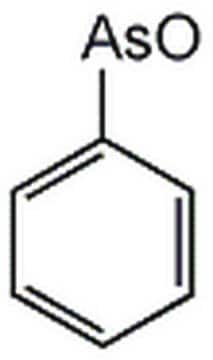
Autenticati per visualizzare i prezzi organizzativi e contrattuali.
Scegli un formato
Cambia visualizzazione
| Taglio della confezione | SKU | Disponibilità | Prezzo |
|---|---|---|---|
| 1 g | Per conoscere la disponibilità, visualizza il carrello | CHF 99.20 | |
| 5 g | Per conoscere la disponibilità, visualizza il carrello | CHF 226.00 |
Informazioni su questo articolo
Formula empirica (notazione di Hill):
C6H5AsO
Numero CAS:
Peso molecolare:
168.02
NACRES:
NA.77
PubChem Substance ID:
UNSPSC Code:
12352119
EC Number:
211-275-3
MDL number:
Beilstein/REAXYS Number:
2935227
Servizio Tecnico
Hai bisogno di aiuto? Il nostro team di scienziati qualificati è a tua disposizione.
Permettici di aiutartiNome del prodotto
Phenylarsine oxide, ≥97%, powder
biological source
synthetic (organic)
Quality Level
assay
≥97%
form
powder
color
white to off-white
mp
145-148 °C
solubility
DMSO: 50 mg/mL
SMILES string
O=[As]c1ccccc1
InChI
1S/C6H5AsO/c8-7-6-4-2-1-3-5-6/h1-5H
InChI key
BQVCCPGCDUSGOE-UHFFFAOYSA-N
General description
Phenylarsine oxide (PhAsO4) is a bifunctional SH group chemical. It is hydrophobic in nature.
Application
Phenylarsine oxide has been used to infuse animals with a nigrostriatal transection, to determine whether peroxovanadium (pVa) would synergize with brain-derived neurotrophic factor (BDNF).
Biochem/physiol Actions
Phenylarsine oxide inhibits internalization of cell surface receptors; inhibits tyrosine phosphatases, with no effect on tyrosine kinase. Metabolic poison.
Phenylarsine oxide (PAO) can reduce the motility and sustainability of Setaria cervi. It has the ability to stimulate cyclosporin A-sensitive transition in the presence of EGTA (ethylene glycol-bis(β-aminoethyl ether)-N,N,N′,N′-tetraacetic acid). It acts as a stimulator of mitochondrial ion fluxes.
Features and Benefits
This compound is featured on the Phosphoprotein Phosphatases (Tyrosine) page of the Handbook of Receptor Classification and Signal Transduction. To browse other handbook pages, click here.
1 of 1
Questo articolo | |||
|---|---|---|---|
| assay ≥97% | assay ≥96% (titration) | assay - | assay ≥99.5% (GC) |
| form powder | form solid | form powder | form liquid |
| Quality Level 100 | Quality Level 100 | Quality Level 100 | Quality Level 200 |
| solubility DMSO: 50 mg/mL | solubility chloroform: 100 mg/mL, DMSO: 50 mg/mL | solubility - | solubility - |
| color white to off-white | color white | color - | color - |
| mp 145-148 °C | mp - | mp - | mp −112 °C (lit.) |
signalword
Danger
hcodes
Hazard Classifications
Acute Tox. 3 Inhalation - Acute Tox. 3 Oral - Aquatic Acute 1 - Aquatic Chronic 1
Classe di stoccaggio
6.1C - Combustible acute toxic Cat.3 / toxic compounds or compounds which causing chronic effects
wgk
WGK 3
flash_point_f
Not applicable
flash_point_c
Not applicable
Scegli una delle versioni più recenti:
Possiedi già questo prodotto?
I documenti relativi ai prodotti acquistati recentemente sono disponibili nell’Archivio dei documenti.
Contenuto correlato
Tyrosine phosphatase inhibition enhances neurotrophin potency and rescues nigrostriatal neurons in adult rats
Lu X, et al.
Experimental neurology, 178(2), 259-267 (2002)
M Wachtel et al.
Journal of cell science, 112 ( Pt 23), 4347-4356 (1999-11-24)
Regulation of epithelial and endothelial permeability is essential for proper function of compartmentalized organisms, and tyrosine phosphorylation plays an important role in this process. We analyzed the impact of protein tyrosine phosphatase (PTP) inhibition on the structure of endothelial junctional
Inhibition of setaria cervi protein tyrosine phosphatases by phenylarsine oxide: A proteomic and biochemical study
Singh N, et al.
Acta Tropica, 159, 20-28 (2016)
Numero articolo commerciale globale
| SKU | GTIN |
|---|---|
| P3075-1G | 04061834367147 |
| P3075-5G | 04061835558285 |