Passa al contenuto
Merck

Vai a

L4669

Anti-Lysyl Oxidase (C-terminal) antibody produced in rabbit

~1 mg/mL, affinity isolated antibody, buffered aqueous solution

Sinonimo/i:

Anti-LOX, Anti-Protein lysine 6-oxidase

Autenticati per visualizzare i prezzi organizzativi e contrattuali.

Informazioni su questo articolo

NACRES:
NA.41
UNSPSC Code:
12352203
Conjugate:
unconjugated
Clone:
polyclonal
Application:
WB
Citations:
14


biological source

rabbit

conjugate

unconjugated

antibody form

affinity isolated antibody

antibody product type

primary antibodies

clone

polyclonal

form

buffered aqueous solution

mol wt

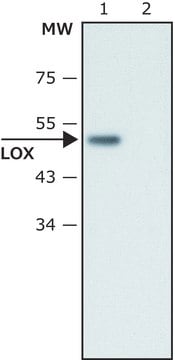
antigen ~50 kDa

species reactivity

human

enhanced validation

recombinant expression
Learn more about Antibody Enhanced Validation

concentration

~1 mg/mL

technique(s)

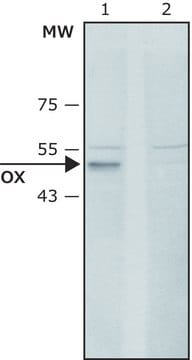
western blot: 1.5-3.0 mg/mL using HEK-293T cellls expressing human LOX

UniProt accession no.

shipped in

dry ice

storage temp.

−20°C

target post-translational modification

unmodified

Gene Information

human ... LOX(4015)
mouse ... Lox(16948)
rat ... Lox(24914)

General description

The LOX gene is located on the human chromosome at 5q23.1.
The gene LOX (lysyl oxidase) encodes a copper-dependent amine oxidase that belongs to LOX family of proteins. These proteins contain highly conserved C- terminal mature catalytic domains that include the copper binding site, the lysyl tyrosyl quinine (LTQ) cofactor residues, and the cytokine receptor like (CRL) domain. It is present in both intercellular and intracellular locations.

Application

Anti-Lysyl Oxidase (C-terminal) antibody produced in rabbit has been used in:
  • western blotting[1]
  • immunofluorescence staining
  • immunohistochemistry

Biochem/physiol Actions

Altered LOX gene expression and activity are linked to skin aging and senescence. Decreased LOX gene expression and activity have been associated with severe connective tissue disorders such as Ehler-Danlos syndrome, cutis laxa, and Menkes′ syndrome. Increased LOX gene expression are associated with the development of fibrotic diseases that involve connective tissue remodeling, such as atherosclerosis, scleroderma and liver cirrhosis. LOX protein also plays an important role in breast cancer metastasis.
Anti-Lysyl Oxidase (C-terminal) specifically recognizes human lysyl oxidase (LOX).
LOX is implicated in various intracellular functions such as the regulation of cellular differentiation, cell migration and gene transcription.
The gene LOX (lysyl oxidase) encodes an extracellular matrix remodeling enzyme that catalyzes the oxidation of primary amino group of peptidyl lysine to reactive peptidyl aldehydes. It is mainly involved in the oxidation of lysine residues in elastin and collagen, resulting in the formation of covalent cross-linkages, which stabilize these fibrous proteins. It also plays a role in several cellular processes such as developmental regulation, tumor suppression, cell motility, and cellular senescence. It is involved in hypoxia-induced metastasis and serves as a therapeutic target for the treatment of metastases.

Physical form

Solution in 0.01 M phos­phate buffered saline, pH 7.4, containing 15 mM sodium azide.

Preparation Note

For continuous use, store at 2–8 °C for up to one month. For extended storage, freeze in working aliquots. Repeated freezing and thawing, or storage in “frost-free” freezers, is not recommended. If slight turbidity occurs upon prolonged storage, clarify the solution by centrifugation before use. Working dilutions should be discarded if not used within 12 hours.

Disclaimer

Unless otherwise stated in our catalog or other company documentation accompanying the product(s), our products are intended for research use only and are not to be used for any other purpose, which includes but is not limited to, unauthorized commercial uses, in vitro diagnostic uses, ex vivo or in vivo therapeutic uses or any type of consumption or application to humans or animals.

Confronta articoli simili

Visualizza il confronto per intero

Mostra le differenze

1 of 1

Questo articolo
L4794ABT112M1946
biological source

rabbit

biological source

rabbit

biological source

rabbit

biological source

rabbit

conjugate

unconjugated

conjugate

unconjugated

conjugate

unconjugated

conjugate

unconjugated

antibody form

affinity isolated antibody

antibody form

affinity isolated antibody

antibody form

affinity isolated antibody

antibody form

affinity isolated antibody

technique(s)

western blot: 1.5-3.0 mg/mL using HEK-293T cellls expressing human LOX

technique(s)

western blot: 1.5-3.0 μg/mL using HEK-293T cells expressing human LOX

technique(s)

immunohistochemistry: suitable (paraffin), western blot: suitable

technique(s)

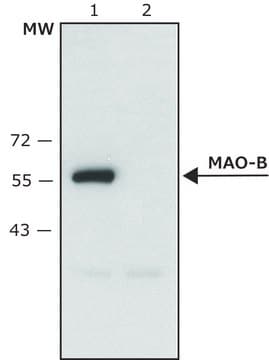
western blot: 0.25-0.5 μg/mL using rat liver mitochondrial fraction and HEK-293T cells expressing human MAO-B

Gene Information

human ... LOX(4015)
mouse ... Lox(16948)
rat ... Lox(24914)

Gene Information

human ... LOX(4015)
mouse ... Lox(16948), Lox(24914)

Gene Information

human ... LOX(4015)

Gene Information

human ... ASCC3(10973), MAOB(4129)
rat ... Maob(25750)

shipped in

dry ice

shipped in

dry ice

shipped in

wet ice

shipped in

dry ice


Still not finding the right product?

Provate il nostro Motore di ricerca dei prodotti per restringere le opzioni.


Classe di stoccaggio

10 - Combustible liquids

flash_point_f

Not applicable

flash_point_c

Not applicable

ppe

Eyeshields, Gloves, multi-purpose combination respirator cartridge (US)


Scegli una delle versioni più recenti:

Certificati d'analisi (COA)

Lot/Batch Number

Non trovi la versione di tuo interesse?

Se hai bisogno di una versione specifica, puoi cercare il certificato tramite il numero di lotto.

Possiedi già questo prodotto?

I documenti relativi ai prodotti acquistati recentemente sono disponibili nell’Archivio dei documenti.

Visita l’Archivio dei documenti


Contenuto correlato

Instructions


Katarzyna A Cieslik et al.
Journal of molecular and cellular cardiology, 63, 26-36 (2013-07-23)
We have demonstrated that scar formation after myocardial infarction (MI) is associated with an endogenous pool of CD44(pos)CD45(neg) multipotential mesenchymal stem cells (MSC). MSC differentiate into fibroblasts secreting collagen that forms a scar and mature into myofibroblasts that express alpha
AICAR-dependent AMPK activation improves scar formation in the aged heart in a murine model of reperfused myocardial infarction
Cieslik K, et al.
Journal of Molecular and Cellular Cardiology, 63(24), 26-36 (2013)
Mari Kielosto et al.
Oncotarget, 9(102), 37733-37752 (2019-02-01)
We have previously shown that proto-oncoprotein c-Jun is activated in ornithine decarboxylase (ODC)- and RAS-transformed mouse fibroblasts, and that the transformed morphology of these cells can be reversed by expressing the transactivation domain deletion mutant of c-Jun (TAM67). Here, we


Numero articolo commerciale globale

SKUGTIN
L4669-200UL04061837883705

Questions

Reviews

No rating value

Active Filters