Passa al contenuto
Merck

Vai a

SCC178

AT-3 Mouse Mammary Carcinoma Cell Line

Mouse

Sinonimo/i:

Ms mammary gland cells

Autenticati per visualizzare i prezzi organizzativi e contrattuali.

Scegli un formato

Cambia visualizzazione
Taglio della confezioneSKUDisponibilitàPrezzo

Informazioni su questo articolo

UNSPSC Code:
41106514
NACRES:
NA.81
eCl@ss:
32011203
Biological source:
mouse
Prezzi e disponibilità al momento non sono disponibili
Servizio Tecnico
Hai bisogno di aiuto? Il nostro team di scienziati qualificati è a tua disposizione.
Permettici di aiutarti


Nome del prodotto

AT-3 Mouse Mammary Carcinoma Cell Line, AT-3 mouse mammary tumor cell line may be used to develop mouse models for mammary cancer studies.

biological source

mouse

technique(s)

cell culture | mammalian: suitable

shipped in

ambient

storage temp.

-140 to -196°C

General description

The AT-3 cell line was isolated from an autologous mammary tumor from cells originating in a transgenic MTAG mouse model [1]. Mammary tumors arising in MTAG mice closely mimic changes observed in human breast carcinomas over the course of disease progression [2]. AT-3 cells are a useful mouse model for studies of tumor physiology that are representative of typical disease states in humans.

Source:
The AT-3 cell line was derived from primary mammary tumor cells of a transgenic MTAG mouse. The MTAG mouse model expresses the polyoma virus middle T antigen under control of the MMTV-LTR promoter [2].

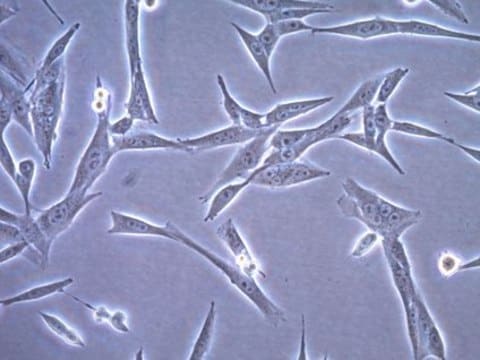
Note: AT-3 cells demonstrate diverse morphologies in culture.
Tumor-induced immunosuppression is a common phenomenon in cancer and an important consideration for cancer immunotherapy. However, most studies on tumor-induced immunosuppression rely on tumor implant models, in which the disease progresses rapidly and usually causes non-physiological host responses that do not recapitulate normal tumor development and progression [3]. Models that generate autochthonous tumors are therefore valuable for providing more physiologically-relevant systems for investigating tumor-host interactions and longer-term immunosuppressive effects.

Application

AT-3 mouse mammary tumor cell line may be used to develop mouse models for mammary cancer studies.
Research Category
Cancer

Oncology
Subject to local law, this product is intended to be sold for internal in vitro research use only subject to terms and conditions found here: www.sigmaaldrich.com/restrictedcelluse. This product may not be: re-engineered or copied; used to make derivatives, modifications or functional equivalents; used to obtain patents or other IP claiming use of the product; used to develop, test, or manufacturer a commercial product; used as a component in a commercial product; resold or licensed; used in any clinical applications or trials; or used in humans. A license or limited commercial use agreement is required for use by any for-profit entity, use in services, and use in sponsored academic research. For information regarding any such use, please contact [email protected].

Biochem/physiol Actions

Cancer Cells

Preparation Note

Store in liquid nitrogen. The cells can be cultured for at least 10 passages after initial thawing without significantly affecting the cell marker expression and functionality.

Analysis Note

• Each vial contains ≥ 1X10⁶ viable cells.
• Cells are tested negative for infectious diseases by a Mouse Essential CLEAR panel by Charles River Animal Diagnostic Services.
• Cells are verified to be of mouse origin and negative for inter-species contamination from rat, chinese hamster, Golden Syrian hamster, human and non-human primate (NHP) as assessed by a Contamination CLEAR panel by Charles River Animal Diagnostic Services.
• Cells are negative for mycoplasma contamination

Disclaimer

This product contains genetically modified organisms (GMO). Within the EU GMOs are regulated by Directives 2001/18/EC and 2009/41/EC of the European Parliament and of the Council and their national implementation in the member States respectively. This legislation obliges {HCompany} to request certain information about you and the establishment where the GMOs are being handled. Click here for Enduser Declaration (EUD) Form.

Unless otherwise stated in our catalog or other company documentation accompanying the product(s), our products are intended for research use only and are not to be used for any other purpose, which includes but is not limited to, unauthorized commercial uses, in vitro diagnostic uses, ex vivo or in vivo therapeutic uses or any type of consumption or application to humans or animals.

Confronta articoli simili

Visualizza il confronto per intero

Mostra le differenze

1 of 1

Questo articolo
SCC177SCC194SCC195
technique(s)

cell culture | mammalian: suitable

technique(s)

cell culture | mammalian: suitable

technique(s)

cell culture | mammalian: suitable

technique(s)

cell culture | mammalian: suitable

biological source

mouse

biological source

mouse

biological source

mouse

biological source

mouse

shipped in

ambient

shipped in

ambient

shipped in

ambient

shipped in

ambient

storage temp.

-140 to -196°C

storage temp.

-140 to -196°C

storage temp.

-140 to -196°C

storage temp.

-140 to -196°C


Classe di stoccaggio

10 - Combustible liquids

wgk

WGK 2


Certificati d'analisi (COA)

Cerca il Certificati d'analisi (COA) digitando il numero di lotto/batch corrispondente. I numeri di lotto o di batch sono stampati sull'etichetta dei prodotti dopo la parola ‘Lotto’ o ‘Batch’.

Possiedi già questo prodotto?

I documenti relativi ai prodotti acquistati recentemente sono disponibili nell’Archivio dei documenti.

Visita l’Archivio dei documenti


C T Guy et al.
Molecular and cellular biology, 12(3), 954-961 (1992-03-01)
The effect of mammary gland-specific expression of the polyomavirus middle T antigen was examined by establishing lines of transgenic mice that carry the middle T oncogene under the transcriptional control of the mouse mammary tumor virus promoter/enhancer. By contrast to
Trina J Stewart et al.
Journal of immunology (Baltimore, Md. : 1950), 179(5), 2851-2859 (2007-08-22)
Ag-specific and generalized forms of immunosuppression have been documented in animal tumor models. However, much of our knowledge on tumor-induced immunosuppression was acquired using tumor implant models, which do not reiterate the protracted nature of host-tumor interactions. Therefore, a transgenic
Weijie Zhang et al.
Cell, 184(9), 2471-2486 (2021-04-21)
Metastasis has been considered as the terminal step of tumor progression. However, recent genomic studies suggest that many metastases are initiated by further spread of other metastases. Nevertheless, the corresponding pre-clinical models are lacking, and underlying mechanisms are elusive. Using


Questions

Reviews

No rating value

Active Filters