Passa al contenuto
Merck

Vai a

T7576

Anti-TGN46

~1 mg/mL, affinity isolated antibody, buffered aqueous solution

Sinonimo/i:

Anti-MGC14722, Anti-TGN38 homolog, Anti-TGN48, Anti-TGN51, Anti-TGOLN2, Anti-TTGN2, Anti-Trans-Golgi network integral membrane protein 2 precursor, Anti-Trans-Golgi network protein TGN51, Anti-Trans-golgi network protein 2

Autenticati per visualizzare i prezzi organizzativi e contrattuali.

Scegli un formato

Cambia visualizzazione
Taglio della confezioneSKUDisponibilitàPrezzo
200 μL
Per conoscere la disponibilità, visualizza il carrello
CHF 541.00

Informazioni su questo articolo

UNSPSC Code:
12352203
NACRES:
NA.41
MDL number:
Conjugate:
unconjugated
Clone:
polyclonal
Application:
IF, IP, WB CL
Citations:
29

CHF 541.00


Per conoscere la disponibilità, visualizza il carrello

Richiedi un ordine in blocco
Servizio Tecnico
Hai bisogno di aiuto? Il nostro team di scienziati qualificati è a tua disposizione.
Permettici di aiutarti


biological source

rabbit

Quality Level

conjugate

unconjugated

antibody form

affinity isolated antibody

antibody product type

primary antibodies

clone

polyclonal

form

buffered aqueous solution

mol wt

antigen 80-100 kDa

species reactivity

human

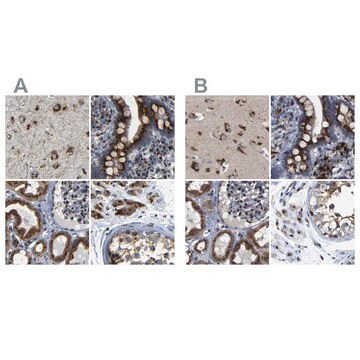
enhanced validation

recombinant expression
Learn more about Antibody Enhanced Validation

concentration

~1 mg/mL

technique(s)

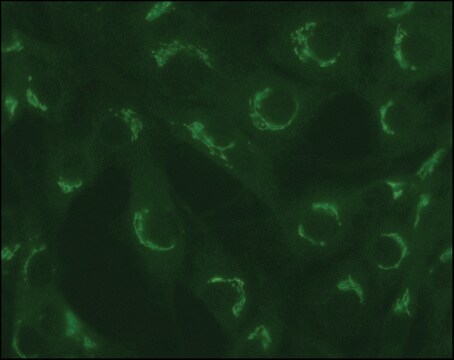
immunoprecipitation (IP): 10-20 μg using TGN46 from human HepG2 cell lysates., indirect immunofluorescence: 5-10 μg/mL using human A549 cells, western blot (chemiluminescent): 0.25-0.5 μg/mL using extracts of human HEK-293T cells expressing recombinant human TGN46

UniProt accession no.

shipped in

dry ice

storage temp.

−20°C

target post-translational modification

unmodified

Gene Information

human ... TGOLN2(10618)

General description

Anti-TGN46 recognizes human trans-golgi network protein 2 (TGN46). Detection of the TGN46 band by immunoblotting is specifically inhibited by the immunizing peptide.
TGN46 (Trans-Golgi network protein, 46 kDa), the human homologue of rat TGN38, is a resident integral membrane protein of the trans-Golgi network (TGN) that cycles constitutively between the TGN and the plasma membrane, returning via endosomes. The TGN is the major sorting compartment of the secretory pathway for proteins, lipids and membrane traffic. TGN46 is a heavily glycosylated protein, probably involved in regulating membrane traffic to and from the TGN. TGN46 contains a signal peptide, lumenal domain, membrane-spanning domain, and cytoplasmic domain. The membrane spanning region and cytoplasmic tail contain the retention and retrieval signals, respectively for localization in the TGN. TGN46 is widely expressed.

Immunogen

synthetic peptide corresponding to amino acid residues 426-437 of human TGN46 with N-terminal added cysteine, conjugated to KLH. The corresponding sequence is identical in monkey and differs by three amino acids in rat and mouse.

Application

Rabbit polyclonal anti-TGN46 antibody is used to tag trans-golgi network protein 2 for detection and quantitation by immunocytochemical and immunohistochemical (IHC) techniques such as immunoblotting, immunoprecipitation, and immunofluorescence. It is used as a probe to determine the presence and roles of trans-golgi network protein 2 as a membrane traffic regulating component of the trans-Golgi network (TGN). Anti-TGN46 may be used as a TGN marker.

Physical form

Solution in 0.01 M phosphate buffered saline, pH 7.4, containing 15 mM sodium azide.

Disclaimer

Unless otherwise stated in our catalog or other company documentation accompanying the product(s), our products are intended for research use only and are not to be used for any other purpose, which includes but is not limited to, unauthorized commercial uses, in vitro diagnostic uses, ex vivo or in vivo therapeutic uses or any type of consumption or application to humans or animals.

Confronta articoli simili

Visualizza il confronto per intero

Mostra le differenze

1 of 1

Questo articolo
SAB4200355T9826HPA012723
antibody form

affinity isolated antibody

antibody form

purified from hybridoma cell culture

antibody form

affinity isolated antibody

antibody form

affinity isolated antibody

biological source

rabbit

biological source

mouse

biological source

rabbit

biological source

rabbit

Quality Level

200

Quality Level

200

Quality Level

200

Quality Level

100

conjugate

unconjugated

conjugate

unconjugated

conjugate

unconjugated

conjugate

unconjugated

species reactivity

human

species reactivity

human

species reactivity

rat

species reactivity

human

form

buffered aqueous solution

form

buffered aqueous solution

form

buffered aqueous solution

form

buffered aqueous glycerol solution


Still not finding the right product?

Provate il nostro Motore di ricerca dei prodotti per restringere le opzioni.


Classe di stoccaggio

10 - Combustible liquids

wgk

WGK 3

flash_point_f

Not applicable

flash_point_c

Not applicable

ppe

Eyeshields, Gloves, multi-purpose combination respirator cartridge (US)


Scegli una delle versioni più recenti:

Certificati d'analisi (COA)

Lot/Batch Number

Non trovi la versione di tuo interesse?

Se hai bisogno di una versione specifica, puoi cercare il certificato tramite il numero di lotto.

Possiedi già questo prodotto?

I documenti relativi ai prodotti acquistati recentemente sono disponibili nell’Archivio dei documenti.

Visita l’Archivio dei documenti


Contenuto correlato

Instructions


Yong Yu et al.
The Biochemical journal, 434(3), 383-390 (2011-01-22)
Peptide hormones and neuropeptides are packaged and stored in a specialized intracellular organelle called the dense core vesicle. It remains elusive how peptide cargoes are correctly sorted. In the present study, we show that a highly conserved Golgi-localized protein named
Jiehua Li et al.
Autophagy, 13(2), 345-358 (2016-11-23)
The membrane source for autophagosome biogenesis is an unsolved mystery in the study of autophagy. ATG16L1 forms a complex with ATG12-ATG5 (the ATG16L1 complex). The ATG16L1 complex is recruited to autophagic membranes to convert MAP1LC3B-I to MAP1LC3B-II. The ATG16L1 complex
Shuaizhi Li et al.
PloS one, 14(11), e0225496-e0225496 (2019-11-20)
Human papillomavirus (HPV) is the most common sexually transmitted pathogen in the United States, causing 99% of cervical cancers and 5% of all human cancers worldwide. HPV infection requires transport of the viral genome (vDNA) into the nucleus of basal


Numero articolo commerciale globale

SKUGTIN
T7576-200UL04061838037992

Questions

Reviews

No rating value

Active Filters